Explore by category
HELOC vs. Reverse mortgage: What’s the right choice for you?

In this article:
- Key differences between a HELOC and a reverse mortgage
- HELOC vs. reverse mortgage: eligibility requirements
- HELOC vs. reverse mortgage: How repayment differs
- HELOC vs. reverse mortgage: costs and fees
- How proceeds are paid out
- Impact on equity and heirs
- Tax considerations
- When a HELOC may be a better option
- When a reverse mortgage may be a better option
- How to choose between a HELOC and a reverse mortgage
- Final thoughts: HELOC vs a reverse mortgage
- HELOC vs reverse mortgage: FAQs
Quick answer: A core difference between a HELOC and a reverse mortgage is how they are repaid: a HELOC requires ongoing payments and allows you to borrow as needed, while a reverse mortgage delays repayment until specific trigger events occur and may offer flexible payout options.
Key Points
HELOCs require ongoing payments that increase after the draw period and rely on credit and income for eligibility.
Reverse mortgages do not require monthly mortgage payments, but do require the borrower to live in and maintain the home and pay taxes, fees, and insurance costs.
Choosing between the two requires considering your financial situation, priorities, ability to make ongoing payments, and how long you plan to stay in the home.
Your home may be one of your largest financial assets, but accessing that equity isn’t always straightforward. Two of the most common options are a home equity line of credit (HELOC) and a reverse mortgage.
However, they operate very differently, especially in terms of repayment, eligibility, and flexibility. Understanding how these options compare may help you decide which approach better fits your financial situation, goals, and plans for the future. Here’s what you need to know to make an informed decision.
Finance of America does not offer HELOCs.
Key differences between a HELOC and a reverse mortgage
HELOCs and reverse mortgages work for different borrowers in different situations. The key distinction is how money is borrowed and repaid.
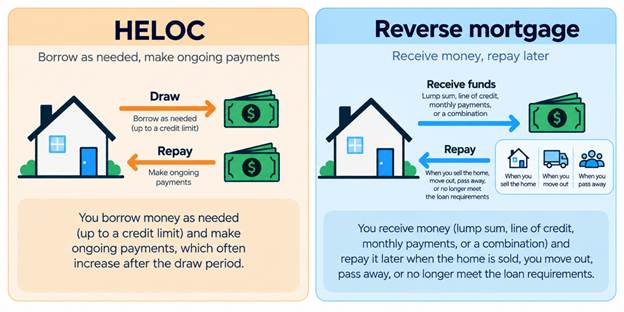
However, there are many other areas where these two home equity borrowing options differ. We’ll dig into the details in further sections, but this is a good starting point.
| Feature | HELOC | Reverse mortgage |
| Age eligibility | 18+ | Typically 62+ for Home Equity Conversion Mortgage (HECMs); some proprietary options may be available to younger borrowers |
| Credit and income requirements | Lenders consider credit score, verifiable income, and DTI ratio | Financial assessment evaluates income, credit, and the ability to meet ongoing obligations |
| Monthly payments | Required; may increase over time | No required monthly mortgage payments as long as you meet the loan terms* |
| Repayment structure | Payments required; often interest-only during the draw period, then principal and interest during the repayment period | Repaid in a lump sum when the home is sold, the borrower moves out, passes away, or no longer meets other loan requirements |
| Interest rate type | Typically variable; some fixed-rate options available | May be fixed or adjustable, depending on the loan structure and payout option |
| Disbursement options | Borrow as needed up to the credit limit during the draw period | Lump sum, line of credit, monthly installments, or combination, depending on loan type |
| Impact on home equity | Equity decreases as you borrow, but may rebuild as you repay | Loan balance grows over time, which may reduce remaining equity |
| Closing costs | May include appraisal, origination, and possible annual/maintenance fees | May include origination fees, title fees, appraisal, and mortgage insurance premiums (HECM) |
| Non-recourse protection1 | The borrower is typically responsible for the full balance | HECMs are non-recourse; borrower or heirs typically do not owe more than the home’s value when it is sold¹ |
| Common use cases | Home improvements, ongoing/flexible expenses, short-term borrowing needs | Flexible; often used for travel, home improvements, managing higher-interest debt, or covering healthcare costs |
*The borrower must meet all loan obligations, including living in the property as the principal residence and paying property charges, including property taxes, fees, and hazard insurance. The borrower must maintain the home. If the homeowner does not meet these loan obligations, then the loan will need to be repaid.
In a nutshell, a HELOC is a flexible, ongoing credit line that lets you borrow money as needed, requires monthly payments, and is based on your creditworthiness. A reverse mortgage lets you borrow money against your home equity, with repayment deferred, and is designed for older homeowners.
→ Learn more: What is a HECM loan, and how does it work?

HELOC vs. reverse mortgage: eligibility requirements
A core difference in eligibility between a HELOC and a reverse mortgage lies in what factors are considered during the qualification process. Since a HELOC requires regular payments, eligibility often considers credit and income, but for a reverse mortgage, age and home equity matter more, though a financial assessment is required.
HELOC eligibility requirements include:
- Credit score
- Verifiable income
- Debt-to-income (DTI) ratio
- Sufficient home equity
To be eligible for a reverse mortgage, you must, at minimum:
- Meet the age requirement (typically 62+ for HECMs; some proprietary options may be available to younger borrowers)
- Have sufficient home equity
- Pass a financial assessment (evaluates income, credit, and ability to meet ongoing obligations)
- Have and maintain primary residence
- Meet with HUD-certified counselor (required for all HECM loans, may be required for proprietary loans as well)
HELOC vs. reverse mortgage: How repayment differs
A HELOC requires monthly interest payments starting immediately or during the draw period. A reverse mortgage requires no monthly payments—interest and fees accrue and are added to the loan balance.
The key distinction is that a HELOC requires budgeting for monthly payments immediately, which can strain a fixed income. A reverse mortgage defers that obligation, letting the loan balance grow. However, both require you to stay current on property taxes, homeowners insurance, and maintenance—failure to do so can trigger repayment.
| Feature | HELOC | Reverse mortgage |
| Monthly payments | Required | No required monthly mortgage payments*, but voluntary payments accepted |
| Payment structure | Payments may increase over time, especially with variable interest rates | No monthly payments; interest and fees are added to the loan balance over time* |
| When repayment occurs | Begins during the draw period and continues through the repayment period | Deferred until home is sold, borrower moves out, or borrower no longer meets loan requirements |
*The borrower must meet all loan obligations, including living in the property as principal residence and paying property charges, including property taxes, fees, and hazard insurance. The borrower must maintain the home. If loan obligations are not met, the loan will need to be repaid.
→ Learn more: How do you repay a reverse mortgage? Understanding your options

HELOC vs. reverse mortgage: costs and fees
Costs and fees vary between HELOCs and reverse mortgages, and they may affect both your upfront expenses and long-term borrowing costs.
HELOCs typically have lower upfront costs but variable interest rates that can increase payments. Reverse mortgages tend to have higher upfront costs, including mortgage insurance, but fixed or adjustable rates, depending on the product.
This chart compares the core differences:
| Feature | HELOC | Reverse mortgage |
| Interest rates | Typically variable; may change over time | May be fixed or adjustable, depending on the loan structure and payout option |
| Upfront costs | May include fees such as appraisal, origination, and possible annual or maintenance fees | May include origination fees, closing costs, and mortgage insurance premiums (for HECMs) |
| Interest accrual | Interest accrues only on the amount borrowed, not the full credit limit | Interest and fees accrue over time, increasing the loan balance |
| Ongoing costs | Continue to pay property taxes, homeowners insurance, and home maintenance costs | Continue to pay property taxes, homeowners insurance, and home maintenance costs |
NOTE: For HELOCs, some lenders may offer rate-lock features that cap your interest rate for a set period. That may be worth considering if you’re looking to reduce payment uncertainty during the repayment phase.
→ Learn more: Reverse mortgage fees: What costs should you expect?
How proceeds are paid out
Another difference to consider when considering a HELOC vs a reverse mortgage is how you can access your funds. In general, a HELOC gives you access to funds as you need them, up to a set limit. A reverse mortgage disburses funds in multiple ways, which can vary by product type and the borrower’s preferences.
| Feature | HELOC | Reverse mortgage |
| Access to funds | Revolving credit line | Structured payouts based on loan terms |
| Disbursement options | Borrow as needed up to the credit limit | Lump sum, line of credit, monthly installments, or combination |
| Flexibility | Ongoing access during the draw period | Payout structure selected upfront, with some flexibility depending on the option chosen |
With a HELOC, you control the timing and amount of draws. With a reverse mortgage, your payout choice (line of credit, lump sum, monthly installments, or combination) is typically locked at closing.
→ Learn more: Understanding your reverse mortgage payout options

Impact on equity and heirs
How each option affects your home equity—and what that means for your heirs—is an important consideration, especially if leaving equity behind is a priority. HELOCs may preserve more equity if you repay the loan aggressively, but non-recourse protection1 doesn’t apply.
Reverse mortgages typically reduce equity more steadily due to accruing interest. However, for HECMs, heirs are protected by non-recourse provisions, which means they won’t owe more than the value of your home.1
The estate impact is worth considering: If a HELOC balance exceeds the home value at your death, your estate must cover the shortfall. With a non-recourse1 reverse mortgage, your heirs’ liability is capped at the home’s value—meaning heirs have no personal liability. However, while HECMs do offer this safeguard, not all reverse mortgages are HECMs, so read your loan terms carefully.
Here’s a closer look at how HELOCs and reverse mortgages may impact your long-term financial situation and that of your heirs.
| Feature | HELOC | Reverse mortgage |
| Impact on equity over time | Equity decreases as you borrow, but may rebuild as you repay | Loan balance grows over time, which may reduce remaining equity |
| Repayment at death or move-out | Loan is repaid from home sale or other funds; remaining equity belongs to you or heirs | The loan becomes due when the borrower sells, moves out, passes away, or no longer meets the loan requirements |
| Options for heirs | Heirs may sell the home or keep it after paying off the remaining balance | Heirs may repay the balance, sell the home, or refinance to keep the property |
| Non-recourse protection1 | Not typically non-recourse; borrower or estate remains responsible for the full balance | HECMs are non-recourse loans; heirs do not owe more than the home’s value when the loan becomes due, and the home is sold¹ |
→ Learn more: Are heirs responsible for reverse mortgage debt?
Tax considerations
There are also differences between how taxes are handled for both a HELOC and a reverse mortgage. In general, you won’t pay income tax on loan proceeds for either because they are a loan, not income. However, there are differences in how taxes are applied to the interest on each loan.
If you use your HELOC funds for home improvements, the interest you pay may be tax-deductible (up to $750,000 in combined home acquisition debt, including your primary mortgage). Keep in mind that HELOC interest deductions only apply if you itemize deductions rather than taking the standard deduction on your tax return. Since many homeowners find the standard deduction is larger, you may not benefit from this deduction even if you are eligible.
Additionally, interest is deductible only if the funds are used for substantial home improvements, such as a roof replacement or a kitchen remodel, not for routine maintenance or minor repairs.
Reverse mortgage interest is typically not tax-deductible until the loan is partially or fully paid off, which usually happens when you sell your home. Tax rules can be complicated and can vary based on your situation.
| Tax treatment | HELOC | Reverse mortgage |
| Loan proceeds taxable? | Not typically | Not typically |
| Interest deductible? | Yes, if used for eligible home improvements | No, until the loan is paid off |
| Deduction limit | Up to $750,000 combined mortgage debt | Deductible only upon repayment |
| Other requirements | Must itemize deductions; funds must be for substantial improvements | Limits still apply at repayment |
Generally, reverse mortgage proceeds, like other loan advances, are not income and therefore are not taxable. Not tax advice. Consult a tax professional.
When a HELOC may be a better option
A HELOC may make more sense if you’re comfortable taking on a monthly payment and want the flexibility to borrow only what you need, when you need it. That could be especially useful if you have a steady income and expect your expenses to come up gradually rather than all at once.
For example, maybe you have several home projects planned over the next few years, but you don’t know exactly when you’ll tackle them or how much each will cost. Here’s what that could look like.
HELOC scenario: Carol’s home improvement plan
Carol is 58, a project manager with a full-time job and a steady income, and has built substantial equity in her home. She’s planning home improvement projects over the next few years, including a kitchen update and a new roof, but the timing and costs aren’t set in stone. She wants to avoid borrowing a large lump sum upfront.
With strong credit and verifiable income, Carol qualifies for a HELOC. She can draw funds as each project begins, pay only interest on what she borrows, and manage the variable-rate risk given her financial stability. After reviewing her options, Carol chooses a HELOC for its flexibility and ability to preserve equity if she repays aggressively.
When a reverse mortgage may be a better option
A reverse mortgage may make more sense if you’re looking for a way to access your home equity without adding a required monthly mortgage payment. For homeowners who plan to stay in their homes long-term, this could provide more flexibility in their monthly budgets.
You might consider a reverse mortgage if you:
- Have a fixed or limited income, and reducing monthly obligations is a priority
- Want to reduce or eliminate required monthly mortgage payments
- Plan to remain in your home long term
- Want flexible ways to access your home equity
The borrower must meet all loan obligations, including living in the property as a principal residence and paying property charges, including property taxes, fees, and hazard insurance. The borrower must maintain the home. If loan obligations are not met, the loan will need to be repaid.
Here’s how that might look for a homeowner whose priorities are different from Carol’s.
Reverse mortgage scenario: Sue’s retirement plan
Sue is 72, retired on a fixed income from Social Security and a pension from her time as a postal carrier. Her monthly budget has tightened due to rising healthcare and living costs, and she wants to supplement retirement funds without adding new monthly payments. She has substantial home equity.
A reverse mortgage appeals to her because it offers flexible payouts—she could take a line of credit for unexpected costs or monthly installments for steady income—without required monthly mortgage payments. Non-recourse protection1 also gives her some peace of mind: she won’t owe more than her home’s value. Sue chooses a reverse mortgage to ease her financial situation while staying in the home she loves.
→ Meet Craig, a real-life Finance of America borrower.
The borrower must meet all loan obligations, including living in the property as the principal residence and paying property charges, including property taxes, fees, and hazard insurance. The borrower must maintain the home. If the homeowner does not meet these loan obligations, then the loan will need to be repaid.
How to choose between a HELOC and a reverse mortgage
When comparing a HELOC and a reverse mortgage, think about how each option fits your age, income, timeline, and financial priorities. These five questions may help you narrow it down.
1. How old are you?
- 62 or older: You may have access to both HELOCs and HECMs, depending on eligibility.
- Under 62: A HELOC may be an option. Some proprietary reverse mortgages are also available to younger borrowers in certain states.
2. Are you comfortable taking on a monthly loan payment?
- Yes: A HELOC may be worth considering, particularly if you have a reliable income to manage the payments.
- No: A reverse mortgage may be worth considering because it does not require monthly mortgage payments, provided you continue to meet the loan obligations.
3. How long do you plan to stay in your home?
- Long term: Either option could make sense, depending on your other priorities.
- Short term or uncertain: A HELOC may make more sense because reverse mortgages generally have higher upfront costs.
4. How do you want to access the money?
- Borrow as needed: A HELOC provides a revolving line of credit. A HECM line of credit may also provide flexible access to available funds.
- Lump-sum or structured payouts: A reverse mortgage may offer more payout options, depending on the loan type.
5. How important is preserving home equity?
- It’s a high priority: A HELOC may allow you to preserve more equity if you borrow selectively and repay the balance.
- I’m more focused on financial flexibility: A reverse mortgage may be worth considering if accessing your equity without a required monthly mortgage payment is a higher priority.
What do your answers suggest?
Not all of your answers may point to the same answer. To decide which is a better fit, consider which priorities matter the most to you.
- A HELOC may be a good fit if you are still working, are comfortable with monthly payments, want to borrow as needed, and want to repay what you borrow over time.
- A reverse mortgage may be a good fit if you’re an eligible older homeowner, plan to stay in your home, and prioritize accessing equity without adding a required monthly mortgage payment.
- Still somewhere in the middle? Other home equity options, including a reverse second mortgage, may be worth exploring.
The borrower must meet all loan obligations, including living in the property as principal residence and paying property charges, including property taxes, fees, and hazard insurance. The borrower must maintain the home. If loan obligations are not met, the loan will need to be repaid.
Final thoughts: HELOC vs a reverse mortgage
There’s no one-size-fits-all answer when choosing between a HELOC and a reverse mortgage. The right option depends on your financial situation, including your income, comfort with monthly payments, how long you plan to stay in your home, and your goals for the funds.
While both options allow you to access home equity, they differ in how funds are received, how repayment works, and how they may affect your long-term financial plans. Understanding these differences may help you make a more informed decision.
If you’re exploring your options, Finance of America can help you evaluate how a reverse mortgage might fit your goals. Use our reverse mortgage calculator to estimate how much you may be able to access with a reverse mortgage.
Finance of America does not offer HELOCs.
1Non-recourse means that you, or your estate, can’t owe more than the value of your home when the loan becomes due and the home is sold. Non-recourse means that if you default on the loan, or if the loan cannot otherwise be repaid, the lender cannot look to your other assets (or your estate’s assets) to meet the outstanding balance on your loan.
HELOC vs reverse mortgage: FAQs
Can you have both a HELOC and a reverse mortgage?
In most cases, a reverse mortgage must be the primary loan on the home. If you currently have a HELOC, it would typically need to be paid off before or at closing. After obtaining a reverse mortgage, taking out a new HELOC is generally not allowed. However, some second-lien reverse mortgages may allow you to maintain your traditional mortgage or HELOC as a first lien.
Is a reverse mortgage better than a HELOC for retirees?
There’s no single better option—it depends on your circumstances. A reverse mortgage is often better if you’re 62+, have limited income, and want to eliminate monthly loan payments. A HELOC may work better if you have a steady income, prefer flexible access to funds, and can manage variable payments.
→ Learn more: Is a reverse mortgage a good idea?
The borrower must meet all loan obligations, including living in the property as principal residence and paying property charges, including property taxes, fees, and hazard insurance. The borrower must maintain the home. If loan obligations are not met, the loan will need to be repaid.
What happens if you move after taking out a HELOC or reverse mortgage?
If you move, both types of loans generally need to be repaid. With a HELOC, the remaining balance on your line of credit is due. With a reverse mortgage, moving out for more than 6 months or more than 12 months for medical care triggers repayment.
→ Learn more: How do you repay a reverse mortgage?
Can you pay off a reverse mortgage early?
Yes. Reverse mortgages can typically be repaid at any time without prepayment penalties. Borrowers or their heirs may choose to pay off the loan balance early, for example, if they decide to sell the home or refinance the loan.
Can I get a reverse mortgage if I’m under 62?
Most reverse mortgages, including HECMs, are available to borrowers age 62 and older. Some proprietary reverse mortgages may be available to younger borrowers, depending on the product and state.
→ Learn more: What is HomeSafe Second?
How much equity do you need for a HELOC or reverse mortgage?
Both options require sufficient home equity, but the exact amount varies. HELOCs are typically based on combined loan-to-value (CLTV) limits, often allowing borrowing up to 80%-85% of the home’s value. Reverse mortgages also require significant equity, with the amount you could access depending on factors such as age, home value, and interest rates.
→ Learn more: How much equity is needed for a reverse mortgage?
Can I get a HELOC if I already have a reverse mortgage?
In most cases, no. A reverse mortgage typically holds a primary lien on the home, and lenders are reluctant to subordinate it to a new HELOC. You may have other options, such as a cash-out refinance or a proprietary second-lien product, but discuss this with a lender.
About the author

is the Web Content Manager at Finance of America and a journalist with more than 10 years of experience whose work has appeared in MoneyWise, MSN, Yahoo! Finance, and The Motley Fool. She specializes in making complex financial topics accessible and is passionate about advancing financial literacy.
Disclaimer
This article is intended for general informational and educational purposes only and should not be construed as financial or tax advice. For tax advice, please consult a tax professional. For more information about whether a reverse mortgage fits into your retirement strategy, you should consult your financial advisor.