Explore by category
What is HECM for purchase?

Key points
A HECM for purchase (H4P) may allow homeowners 62+ to buy a new principal residence using a reverse mortgage loan, which requires no monthly mortgage payments.
Borrowers must meet the loan requirements, including living in the home, paying property taxes, insurance, and covering home maintenance. Failing to meet the terms of the loan will trigger the loan to be repaid.
HECM for purchase loans are insured by the Federal Housing Administration (FHA) and come with eligibility, counseling, and occupancy requirements.
More older adults are buying homes than ever. In fact, according to the National Association of Realtors (NAR), adults age 62 and older made up 46% of recent homebuyers—far outpacing Gen X (25%) and Millennials (26%). Whether you’re downsizing, moving closer to family, or upgrading to a home that better fits your lifestyle, buying later in life often means balancing that purchase with your long-term retirement goals.
A Home Equity Conversion Mortgage (HECM) for purchase is a unique way for older homebuyers to purchase a new primary residence without required monthly mortgage payments. Instead, you sell your current home, use part of the proceeds as a down payment, and pair it with a HECM reverse mortgage to fund the remainder of the home’s purchase price.
As long as you continue to live in the home as your primary residence, maintain the property, and stay current on property taxes, homeowners insurance, and any required HOA fees, no monthly mortgage payments are required.
Does it sound too good to be true? HECM for purchase isn’t a new concept. The program has been available since 2009, when the U.S. Department of Housing and Urban Development established guidelines allowing eligible older homeowners to use a HECM to purchase a new primary residence. This guide will walk you through how it works, who may be eligible, and what to consider before deciding if it’s right for you.
What is a HECM for purchase?
A Home Equity Conversion Mortgage (HECM) for purchase, sometimes referred to informally as a purchase reverse mortgage or H4P loan, is a specialized reverse mortgage loan that allows eligible borrowers to buy a new principal home using the combination of a down payment and a HECM loan.
Unlike a traditional mortgage, it does not require monthly mortgage payments as long as you continue to meet the loan obligations, including living in the home as a primary residence, maintaining the property, and paying property taxes, homeowners insurance, and any applicable HOA fees. The property also needs to meet Federal Housing Administration (FHA) guidelines.
A HECM for purchase may be an appealing solution for those who want to downsize, move closer to family, or buy a home better suited to aging in place without sacrificing financial stability or flexibility.
–> Learn more: What is a reverse mortgage and how does it work?
The right to remain in the home is contingent on paying property taxes and homeowner’s insurance, maintaining the home, and complying with the loan terms.

How does HECM for purchase work?
A HECM for purchase works much like a standard HECM loan, with one important difference: instead of pulling home equity from your current property, you’re using the reverse mortgage to help finance the purchase price of a new principal residence. You bring a substantial down payment, and the reverse mortgage finances the remaining portion of the purchase price.
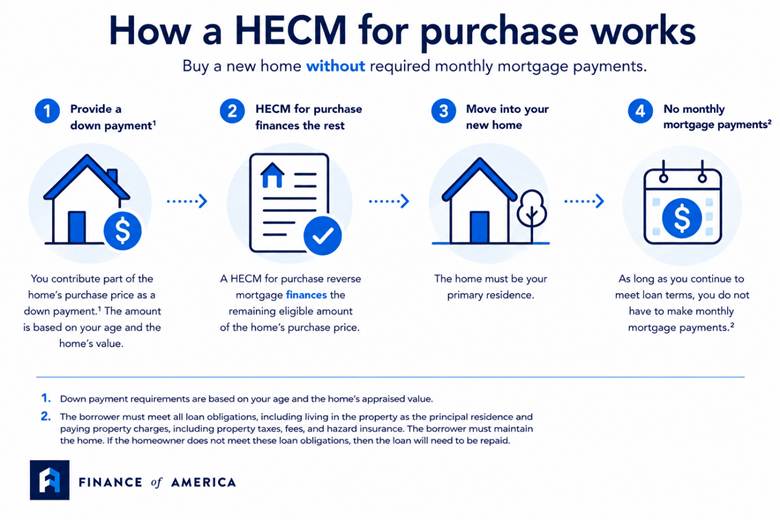
Here is the general process:
- Connect with a reverse mortgage for purchase lender or find a home you are interested in purchasing.
- Sell your current home or use other eligible assets to fund the required down payment.
- Apply for a HECM for purchase through a lender approved by the Federal Housing Administration (FHA).
- Upon approval, you’ll be told how much of a down payment is required, and the HECM finances the remaining balance of the home’s purchase price.
- You move into your new home and, as long as you meet the ongoing loan obligations, you can remain there without required monthly mortgage payments. Those include living in the home as a primary residence, paying property taxes, homeowners insurance, HOA fees, and general home maintenance. Failing to meet these obligations could cause the loan to become due.
Here’s an example of how the process might work:
Imagine Sarah, age 72, wants to buy a $400,000 condo closer to her daughter. She sells her previous home and uses $200,000 from the proceeds as a down payment on a new home. She completes the required HUD-certified counseling session, applies for a HECM for purchase loan, and is approved by a lender.
Her HECM for purchase loan covers the remaining $200,000 purchase price of the new home. Because the loan doesn’t require monthly mortgage payments as long as she meets the loan requirements, Sarah can move into her new home with no ongoing principal or interest payments and keep the remaining cash from her previous home’s sale available for future needs.
To retain homeownership and avoid default, Sarah must comply with the loan terms, including living in the home as her primary residence, continuing to pay property taxes, HOA dues, homeowners insurance, and maintaining the home.
Over time, the loan balance grows as interest and fees are added, but repayment isn’t required until Sarah moves, sells the home, passes away, or fails to comply with the loan terms. At that point, the sale of the property is used to pay off the loan balance, and any remaining equity belongs to Sarah or her heirs.
Who is potentially eligible for HECM for purchase?
Eligibility for a Home Equity Conversion Mortgage (HECM) for purchase is similar to a standard HECM reverse mortgage loan, with a few additional requirements tied to the home purchase itself. To be eligible for a HECM for purchase, borrowers must, at minimum, meet the following key criteria:
- Age requirement: At least one borrower must be 62 or older.
- Property type: The new home must meet FHA property standards and be used as your principal residence. Eligible properties typically include single-family homes, FHA-approved condominiums, and certain manufactured homes.
- Down payment: Borrowers must contribute a down payment, usually between 45% and 65% of the home’s purchase price, depending on age, current interest rates, and the appraised value of the property. The older the borrower, the lower the required down payment percentage.
- Counseling requirement: Before applying, you must complete a session with a HUD-certified reverse mortgage counselor. This ensures you understand the costs, responsibilities, and long-term implications of the loan.
- Financial assessment: Lenders will review your credit history and verify that you can continue to pay property taxes, homeowners insurance, and ongoing maintenance expenses.
- Occupancy requirement: You must live in the property as your principal residence within 60 days of closing and continue to occupy it as long as the loan is active.
Borrowers can be first-time homebuyers, but funds for the down payment must come from acceptable sources—such as the sale of a previous home, personal savings, or a financial gift from a family member—and not from borrowed funds or other loans.
–> Learn more about reverse mortgage eligibility requirements.

HECM vs traditional mortgage
While a HECM for purchase and a traditional mortgage are both types of home financing, their structure, repayment terms, and long-term impact are very different.
A HECM for purchase loan is designed for individuals 62 or older who want to buy a new principal residence without taking on new monthly mortgage payments. The loan has specific terms the borrower must follow, including maintaining primary residency, keeping the home in good repair, and paying property taxes, HOA fees, and homeowners insurance.
A traditional mortgage, by contrast, requires regular monthly payments toward principal and interest until the loan is paid off.
This table breaks down the main differences between the two types of loans:
| Feature | HECM for purchase | Traditional mortgage |
| Monthly mortgage payments | No required monthly mortgage payments; borrower must live in the home as a principal residence, pay property taxes, insurance, and maintenance | Requires monthly payments toward principal and interest |
| Down payment | Typically 45%–65% of the purchase price, based on age, interest rate, and home value | Usually 5%–20% of the purchase price, depending on credit and loan type |
| Loan balance | Increases over time as interest and fees are added to the principal balance | Decreases over time as payments are made |
| Age requirement | Borrower must be 62 or older | Legal age of majority in your state |
| Repayment timing | Due when borrower moves, sells, passes away, or fails to comply with loan terms | Repaid gradually through regular payments |
| FHA involvement | Insured by the Federal Housing Administration (FHA) | May or may not be FHA-insured |
While a traditional mortgage may suit younger borrowers or those with steady income, a HECM for purchase offers an alternative for homeowners 62 and older who want to buy a home that better fits their needs—without taking on required monthly mortgage payments.
The reverse mortgage borrower must meet all loan obligations, including living in the property as the principal residence and paying property charges, including property taxes, fees, hazard insurance. The borrower must maintain the home. If the borrower does not meet these loan obligations, then the loan will need to be repaid.
→ Learn more: Traditional vs. reverse mortgage: What’s the difference?
How to determine if HECM for purchase is right for you
A HECM for purchase can be a flexible, practical way to buy a new home later in life, but it’s not right for every situation. Before deciding, it is important to consider whether this type of reverse mortgage loan aligns with your financial goals, lifestyle, and long-term plans. Here are a few questions to ask yourself:
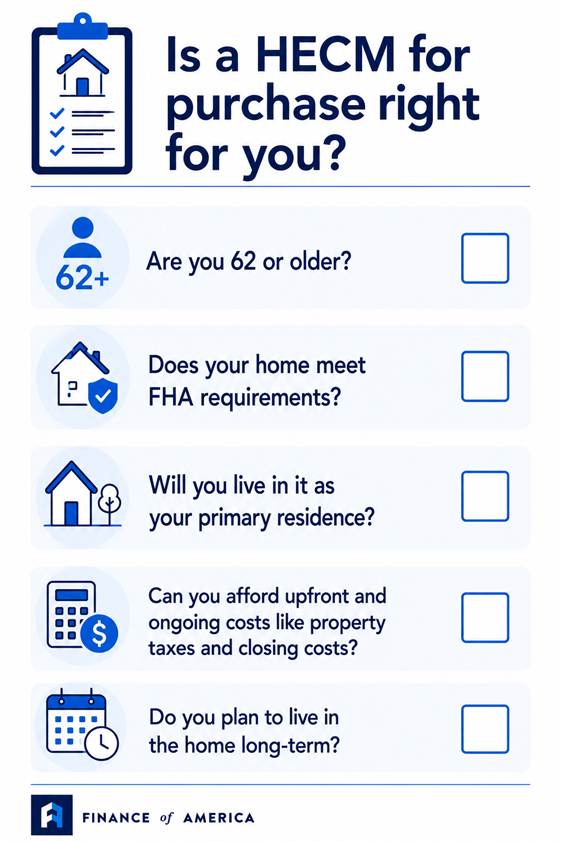
Do you meet eligibility requirements?
You must be 62 or older, live in the property as your principal residence, and meet the Federal Housing Administration (FHA) guidelines for property type and condition. The home must be move-in ready at the time of purchase, and you’ll need to complete a session with a HUD-certified counselor to confirm your understanding of the loan’s structure and obligations.
Can you afford upfront and ongoing costs?
A HECM for purchase still comes with closing costs, accruing interest, and ongoing financial responsibilities. These include property taxes, homeowners insurance, and general maintenance, which are required to keep the loan in good standing.
Typical costs may include:
- Origination fee: Usually 2% of the first $200,000 of the home’s value, plus 1% of any amount above that (capped at $6,000 by HUD rules).
- Mortgage insurance premium: Generally, the lesser of 2% of the home’s purchase price upfront, appraised value, or FHA limit, plus an annual 0.5% on the remaining loan balance.
- Counseling: You’ll need to pay for a session with a HUD-certified counselor to discuss eligibility, financial implications, alternatives, and what makes the loan due and payable.
- Third-party closing costs: Appraisal, title, and recording fees must be paid out of pocket and generally total $2,000–$4,000, depending on location.
While some reverse mortgage costs and fees can be financed into the loan, they do increase the initial loan balance. Financing closing costs reduces the amount of proceeds available to you and increases the loan balance, which grows over time with interest.
How long do you plan to stay in the home?
A HECM for purchase is generally best for homeowners planning to stay in their new home long-term. Because of the upfront costs and structure of the loan, staying in the home longer helps spread the fee over a longer time period.
If you expect to move again within a few years, the cost of closing and setting up the loan may outweigh the advantages. But if you plan to age in place, live closer to family, or settle into a more comfortable or accessible home, a purchase reverse mortgage can provide lasting flexibility and stability.
The right to remain in the home is contingent on paying property taxes and homeowner’s insurance, maintaining the home, and complying with the loan terms.
Although no monthly mortgage payments are required, to retain ownership and avoid defaulting on the loan, you still need to pay your property taxes, insurance, and home maintenance and comply with loan terms for as long as you own your home.

Step-by-step application process for HECM for purchase
Applying for a HECM for purchase has additional steps to ensure borrowers fully understand their responsibilities and eligibility. The process typically takes 30 to 60 days.
Here’s how the process works:
1. Meet with a reverse mortgage specialist
Your first step is to connect with a lender or loan officer experienced in reverse mortgage transactions. They’ll review your financial goals, see if you meet the basic Federal Housing Administration (FHA) requirements, and help you understand how a HECM for purchase could fit your plans.
2. Complete HUD-approved counseling
Before applying, you must attend a session with a HUD-certified reverse mortgage counselor. This independent counseling ensures you understand how the loan works, including your responsibilities for property taxes, insurance, and home maintenance—as well as the impact on your loan balance and estate.
3. Select your new home and make an offer
Once counseling is complete, you can begin the home search. The property must be move-in ready and meet all FHA property standards. Newly built homes are eligible, but construction must be fully complete, with a certificate of occupancy in place before loan closing.
4. Submit your application
After your offer is accepted, your lender will begin the official application process. You’ll provide documentation verifying your down payment source (for example, proceeds from your previous home sale or savings), as well as information about your new property.
5. Home appraisal and underwriting
An FHA-approved appraiser evaluates the home to confirm it meets lending standards and accurately reflects the purchase price. The lender’s underwriting team then reviews your financial profile to ensure you can meet ongoing obligations—including living in the home as a primary residence, and paying property taxes, homeowners insurance, and HOA dues.
6. Loan approval and closing
If your loan is approved, you’ll review and sign the final loan documents. You’ll pay a single set of closing costs, which covers both the purchase and the reverse mortgage transaction. Once complete, you can move into your new home.
7. After closing
After you move in, you’ll maintain your home, keep up with property taxes, and stay current on insurance and maintenance. You can live in your home for as long as you wish, as long as you meet the loan terms. The loan balance will be repaid later—typically when you move, sell, or pass away—and any remaining equity belongs to you or your heirs.
To learn more, please visit the CFPB’s “Reverse Mortgage: A Discussion Guide”
Getting started with a HECM purchase
A HECM for purchase could help you buy a new home that better fits your needs and lifestyle. By combining your home purchase and reverse mortgage loan into a single transaction rather than two separate transactions, you can simplify the process and keep more cash on hand for the future.
If you’re considering a Home Equity Conversion Mortgage for purchase, start by exploring what’s possible. Use our reverse mortgage calculator to see how much home equity you could access and whether this type of loan might fit your financial goals.
Frequently asked questions about HECM for purchase
What’s the difference between a HECM for purchase and a standard reverse mortgage?
A HECM for purchase and a standard HECM reverse mortgage follow the same FHA rules and borrower requirements. The main difference is how the loan is used. A HECM allows you to access equity from a home you already own. A HECM for purchase uses a reverse mortgage to help finance the purchase of a new primary residence, combined with a required down payment. Note that not all reverse mortgages are HECM loans.
Can you use a HECM for purchase to upsize to a more expensive home?
Yes. A HECM for purchase is not limited to downsizing. Some borrowers use it to purchase a larger or more expensive home. The reverse mortgage finances a portion of the purchase price, and you provide the required down payment. The amount you need to bring to closing depends on factors such as your age, current interest rates, and the home’s purchase price.
Can a non-borrowing spouse remain in the home?
Potentially. If one spouse is under age 62, they generally cannot be a borrower on a HECM. However, HUD’s eligible non-borrowing spouse protections may allow them to remain in the home after the borrowing spouse passes away, as long as they meet the program’s requirements and continue to satisfy the loan’s ongoing obligations.
Can the seller or builder help pay your HECM for purchase closing costs?
Yes, according to HUD. Sellers, builders, developers, and real estate agents may contribute up to 6% of the home’s sales price toward eligible borrower closing costs. These contributions cannot be used for your required down payment, and lenders and third-party loan originators are not permitted to provide these credits.
Read more: HUD Mortgagee Letter on Interested Party Contributions
What if the home you want to buy costs more than the HECM loan limit?
You may still be able to purchase the home, but you’ll typically need to provide a larger down payment to cover the difference between the home’s price and the maximum HECM loan amount. If you’re purchasing a higher-value home, a proprietary (jumbo) reverse mortgage may also be an option, depending on your eligibility and the lender’s requirements.
Read more: What is a jumbo reverse mortgage and who are they for?
Do you have to pay mortgage insurance premiums with a HECM for purchase?
Yes. Because a HECM for purchase is an FHA-insured reverse mortgage, it requires mortgage insurance premiums (MIP). These premiums help fund the FHA insurance program and provide important borrower protections, including the loan’s non-recourse feature, which protects you from owing more than the home is worth.1
Read more: Reverse mortgage fees and costs explained
1Non-recourse means that you, or your estate, can’t owe more than the value of your home when the loan becomes due and the home is sold. Non-recourse means that if you default on the loan, or if the loan cannot otherwise be repaid, the lender cannot look to your other assets (or your estate’s assets) to meet the outstanding balance on your loan.
About the author

is the Web Content Manager at Finance of America and a journalist with more than 10 years of experience whose work has appeared in MoneyWise, MSN, Yahoo! Finance, and The Motley Fool. She specializes in making complex financial topics accessible and is passionate about advancing financial literacy.
Disclaimer
This article is intended for general informational and educational purposes only and should not be construed as financial or tax advice. For tax advice, please consult a tax professional. For more information about whether a reverse mortgage fits into your retirement strategy, you should consult your financial advisor.