Explore by category
Second mortgage: How it works and an option for eligible homeowners 55+

In this article:
- What is a second mortgage?
- Who is eligible for a second mortgage?
- What are second mortgages usually used for?
- What are the benefits of a second mortgage?
- What are the cons of a second mortgage?
- What are the different types of second mortgages?
- Reverse second mortgages: Access equity without monthly mortgage payments
- HomeSafe Second: A reverse second mortgage for homeowners 55+1
- Frequently asked questions
If you’re looking for ways to access your home equity, you may have heard about second mortgages. However, you might not be as familiar with them as you are with the traditional mortgage you likely used to buy your home.
And, if you’re an older homeowner, taking on a second mortgage payment before or in retirement might not make the most sense.
In this guide, we’ll cover what a second mortgage is, discuss how these loans work, and explore an alternative to second mortgages that may allow you to borrow from your home equity without making an additional monthly mortgage payment—or refinancing your current primary mortgage.
The borrower must meet all loan obligations, including meeting all loan obligations under the first lien mortgage, living in the property as the principal residence, and paying property charges, including property taxes, fees, and hazard insurance. The borrower must maintain the home. If the homeowner does not meet these loan obligations, then the loan will need to be repaid.
What is a second mortgage?
A second-lien mortgage loan may allow homeowners to borrow from their home equity while keeping a first, traditional mortgage in place. The term “second” doesn’t refer to timing; rather, it refers to the lien’s position: your first, traditional mortgage holds the first lien, and your second mortgage’s lien comes in after.
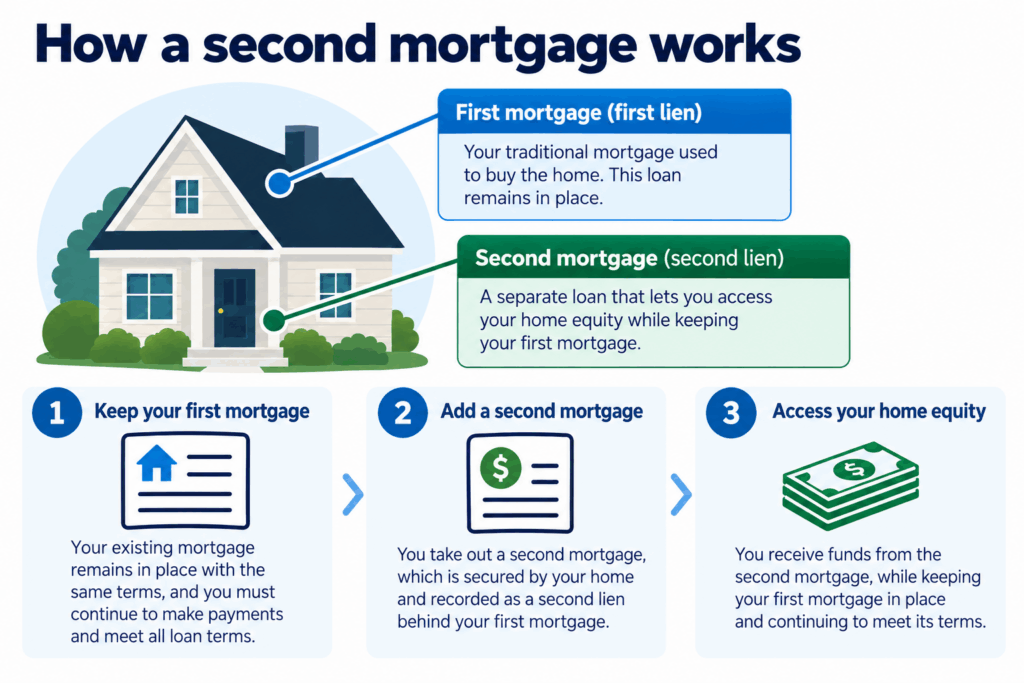
Imagine the first and second liens like people waiting in line to buy tickets to a popular band. The first person (a traditional mortgage) buys their ticket first, and the second person (a second mortgage) only gets a ticket if the box office doesn’t run out (i.e., if the house goes into foreclosure and is sold, but the sale price only covers the first lien).
There are a few important factors to keep in mind. First, a second mortgage does not generally pay off your first mortgage. It is a second loan with its own terms, which also means you’ll have two payments to make.
Second mortgages also carry a higher risk for lenders. If the house goes into foreclosure and is sold, the first lien is repaid first. The second lien is repaid only if the sale price covers the first lien with enough left over to repay the second lien. Due to the higher lending risk, second mortgages often carry higher interest rates than primary mortgages.

Who is eligible for a second mortgage?
Eligibility requirements for a second mortgage will vary depending on the lender and type of loan. However, most lenders consider these factors:
- Credit score: A higher credit score may improve your chances of approval and help you secure a lower interest rate.
- Debt-to-income (DTI) ratio: Lenders typically compare your monthly debt payments to your gross monthly income to determine whether you can afford another loan payment.
- Available home equity: You’ll also need sufficient equity in your home to be eligible. The amount you may be able to borrow depends partly on your home’s value and how much you still owe on your first mortgage.
- Income and employment: Lenders may review your income, employment history, and other financial resources to assess your ability to repay the loan.
What are second mortgages usually used for?
Second mortgage proceeds can generally be used for a wide range of purposes, though some loans may have terms and restrictions.
Common uses for a second mortgage include:
- Funding home improvements or repairs: Renovate a kitchen, replace a roof, make age-in-place updates, or tackle other home projects.
- Managing higher-interest debt: Use home equity to get a handle on higher-interest debt, like credit cards. Keep in mind that this replaces unsecured obligations with a loan secured by your home.
- Covering major expenses: Pay for high or unexpected costs, such as medical bills or a major purchase.
- Financing education costs: Help pay for a child’s or grandchild’s college tuition or other education costs.
- Helping family: Provide financial support to children or other family members, such as helping with a down payment on a home.
How you use the funds is ultimately up to you. However, because your home secures a second mortgage, it’s worth weighing the cost of borrowing against what you plan to use the money for.

What are the benefits of a second mortgage?
One of the biggest advantages of a second mortgage is that it lets you access home equity without refinancing your existing mortgage. That may be especially appealing if your current mortgage has a lower interest rate than you could get by refinancing today.
Potential advantages include:
- Keeping your first mortgage in place: Your existing mortgage, including its interest rate and repayment schedule, typically stays intact. Note that there may be eligibility requirements set by the second-mortgage lender.
- Accessing a portion of your home equity: Depending on your equity, credit, income, and other requirements, you may be able to borrow enough to cover large expenses without selling your home.
- Potentially lower rates than unsecured borrowing: Because your home secures a second mortgage, interest rates may be lower than those available with some credit cards or personal loans.
- Flexible use of funds: Second mortgage proceeds can generally be used for a wide range of expenses.
- Different loan structures to choose from: Depending on the product, you may be able to choose between a lump-sum home equity loan, a revolving HELOC, or other second-mortgage options.
What are the cons of a second mortgage?
While a second mortgage may help you access your home equity without refinancing your existing home loan, there are some potential disadvantages to consider.
Some of the biggest drawbacks include:
- Additional monthly payments: Most traditional second mortgages require monthly principal and interest payments on top of your existing mortgage payment. This could strain your budget, especially if you’re retired or have a limited monthly income.
- Risk of foreclosure: Because a second mortgage is secured by your home, failing to meet your loan obligations could put your home at risk of foreclosure.
- Higher interest rates: Second mortgages often have higher interest rates than first mortgages because the second lender assumes more risk. However, rates may still be lower than those on some unsecured loans.
- Closing costs and fees: Depending on the loan, you may have to pay appraisal and title search fees, as well as other closing costs. Some HELOCs also charge yearly maintenance fees, inactivity fees, or other account-related expenses.
- Reduced home equity: Borrowing against your home reduces the equity you have available. This could leave you with less money when you sell your home or limit your ability to borrow against it in the future.
- Changing payment requirements: Some second mortgages, like HELOCs, allow interest-only payments during the draw period. Once the repayment period begins, you’ll generally need to pay both principal and interest, which could significantly increase your monthly payment.
Keep in mind, not all second mortgages work the same way. The disadvantages may vary based on the type of loan, the lender, and the loan terms of your specific home loan.

What are the different types of second mortgages?
Two of the most common types of second mortgages are home equity loans and home equity lines of credit (HELOC). Both let you borrow against your home equity while keeping your first mortgage in place. However, they work a bit differently.
Home equity loan
A home equity loan provides a lump sum of money that you repay over a set period, typically with a fixed interest rate and fixed monthly payments. Because you receive the money all at once, a home equity loan may make sense for a large, one-time expense, such as a home renovation or major repair.
They also offer predictable payments and typically fixed interest rates, which can be helpful for long-term budgeting.
Home equity line of credit (HELOC)
A HELOC is a revolving line of credit that lets you borrow from your home equity as needed, up to an approved limit. You can also repay and re-borrow during the draw period. HELOCs generally have variable interest rates. Depending on the loan terms, borrowers may make interest-only payments during the draw period, followed by principal and interest payments during the repayment period.
They may be useful when you expect expenses to occur over time rather than all at once. However, the payment increase between the draw and repayment period can catch some borrowers off guard.
This quick comparison table outlines the key differences between a HELOC and a home equity loan.
| Home equity loan | HELOC | |
| Disbursement | Lump sum | Draw as needed during the draw period |
| Rate | Fixed | Generally variable, but some fixed-rate options are available |
| Payment | Fixed monthly | Typically, interest only during the draw period; interest and principal during the repayment period |
| May make sense for | One-time needs | Ongoing or phased expenses |
| Eligibility requirements | Lenders typically consider income, credit, existing obligations, and home equity | Lenders typically consider income, credit, existing obligations, and home equity |
Traditional second mortgages tend to work well for borrowers with a steady income who plan to continue working for several years. But for older borrowers who are retired or nearing retirement, there may not be room in the budget for additional monthly payments.
That’s where reverse second mortgages come in. While less well-known, they offer a different way to access your home’s equity without adding a required monthly principal and interest payment on the second mortgage.
Reverse second mortgages: Access equity without monthly mortgage payments
The borrower must meet all loan obligations, including meeting all loan obligations under the first lien mortgage, living in the property as the principal residence and paying property charges, including property taxes, fees, and hazard insurance. The borrower must maintain the home. If the homeowner does not meet these loan obligations, then the loan will need to be repaid.
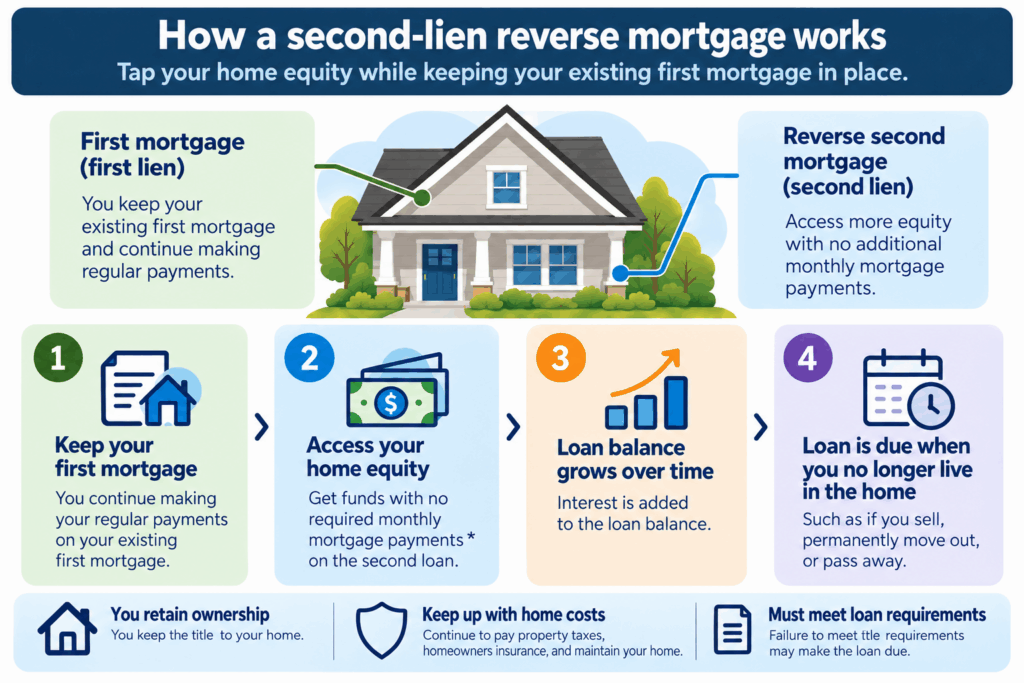
A reverse second mortgage (or second-lien reverse mortgage) may allow eligible older homeowners to access their home equity while keeping their existing first mortgage. Unlike a traditional second mortgage, there are no required monthly mortgage payments on the reverse second mortgage itself as long as you live in the home as a primary residence, pay property taxes and insurance, maintain the home, and continue making payments on the first lien and meet the terms of the second mortgage.
Like all second mortgages, a reverse second mortgage is in second position—meaning the first mortgage gets paid first in a foreclosure. The difference between a second mortgage and a reverse second mortgage is that, instead of paying down the loan monthly, interest accrues and is added to what you owe. The loan typically becomes due when you sell, permanently move, die, or fail to meet loan terms.
You still own your home and can stay in it as long as you meet the loan requirements: living there as your primary residence, paying property taxes and insurance, and maintaining the property. If you don’t meet these obligations, the loan must be repaid.
Second-lien reverse mortgages may be a good fit for older borrowers who want to improve their financial flexibility without taking on an additional monthly mortgage payment.
*The borrower must meet all loan obligations, including meeting all loan obligations under the first lien mortgage, living in the property as the principal residence and paying property charges, including property taxes, fees, and hazard insurance. The borrower must maintain the home. If the homeowner does not meet these loan obligations, then the loan will need to be repaid.
Here’s how the second mortgage options we discussed above compare with a reverse second mortgage:
| Home equity loan | HELOC | Reverse second mortgage | |
| Existing mortgage | Stays in place; monthly mortgage payments must continue | Stays in place; monthly mortgage payments must continue | First mortgage stays in place; monthly mortgage payments must continue |
| Disbursement | Lump sum | Draw as needed during the draw period | Typically lump sum |
| Rate | Fixed | Generally variable, but some fixed-rate options are available | Typically fixed |
| Payment | Fixed monthly | Typically, interest only during the draw period; principal and interest during repayment | No required monthly mortgage payments on the second mortgage* |
| May make sense for | One-time needs | Ongoing or phased expenses | Older homeowners who want to access equity while keeping their first mortgage |
| Eligibility requirements | Lenders typically consider income, credit, existing obligations, and home equity | Lenders typically consider income, credit, existing obligations, and home equity | Lenders typically consider age, home equity, property value, and the ability to meet ongoing loan obligations |
| Loan balance | Generally decreases with scheduled payments | Depends on borrowing and repayment activity; generally decreases as payments are made | Generally increases as interest accrues unless voluntary payments are made |
*The borrower must meet all loan obligations, including meeting all loan obligations under the first lien mortgage, living in the property as the principal residence and paying property charges, including property taxes, fees, and hazard insurance. The borrower must maintain the home. If the homeowner does not meet these loan obligations, then the loan will need to be repaid.

HomeSafe Second: A reverse second mortgage for homeowners 55+1
HomeSafe Second is a proprietary second-lien reverse mortgage from Finance of America that may allow homeowners age 55+1 to access a portion of their home equity while keeping an eligible first mortgage in place. Minimum age requirements and product availability vary by state.
HomeSafe Second eligibility depends on factors including age, home equity, property value, credit and financial assessment, the type and terms of the existing first mortgage, and the borrower’s ability to meet ongoing loan obligations. Additional property, counseling, and state-specific requirements apply.
There are no required monthly mortgage payments on HomeSafe Second, so you may be able to access equity without refinancing your existing first mortgage or adding another required monthly mortgage payment. However, you must continue making payments on your first mortgage and meet all loan obligations. Please note that availability and age requirements may vary by state.
→ Learn more: What is HomeSafe Second?
The borrower must meet all loan obligations, including living in the property as the principal residence and paying property charges, including property taxes, fees and hazard insurance. The borrower must maintain the home. If the homeowner does not meet these loan obligations, then the loan will need to be repaid. Borrowers must also continue making required payments and complying with the terms and conditions of the existing first mortgage.
1 Excluding Massachusetts, New York, and Washington, where the minimum age is 60, and Texas, where the minimum age is 62.
HomeSafe Second is a proprietary reverse mortgage product and is not related to the Home Equity Conversion Mortgage (HECM) program.
Frequently asked questions
Can I get a second mortgage if I’m retired?
Typically, yes. Being retired does not automatically prevent you from getting a second mortgage. Lenders usually consider factors such as your income, credit history, existing debts, home value, and available equity. Retirement income, including Social Security, pensions, and eligible retirement-account income, may also be considered during the eligibility process.
What happens to my Social Security or Medicare if I take out a second mortgage?
Taking out a second mortgage typically does not affect Social Security retirement benefits or Medicare eligibility because these programs are not based on your assets. However, loan proceeds could potentially affect needs-based programs such as Medicaid or Supplemental Security Income (SSI), depending on how the funds are used. Consider speaking with a qualified financial or benefits professional about your specific situation.
What’s the difference between a second mortgage and refinancing my primary mortgage?
A second mortgage lets you borrow against your home equity while keeping your existing first mortgage in place. Refinancing replaces your current mortgage with a new loan, typically with a new interest rate, loan term, and monthly payment. A second mortgage may be worth considering if you want to access equity without giving up the terms of your current mortgage.
Can I pay off a second mortgage early without a penalty?
Often, yes, but it depends on the loan terms. Some second mortgages may charge an early-closure or prepayment fee if you pay off or close the account within a certain period. Review your loan agreement or ask the lender about any prepayment or early-termination fees before borrowing.
What if I can’t make payments on a second mortgage?
If you stop making required payments on a traditional second mortgage, the lender may charge late fees, report missed payments to credit bureaus, and eventually begin foreclosure proceedings. Because your home secures your second mortgage, falling behind could put your home at risk. Contact your lender as soon as possible if you think you may have trouble making payments.
How much money can I borrow with a second mortgage?
The amount you may borrow depends on the type of second mortgage and factors such as your home value, available equity, existing mortgage balance, credit profile, and lender requirements. Age may also affect how much you may borrow with a reverse second mortgage.
How long does it take to get a second mortgage?
A second mortgage may take anywhere from a few weeks to more than a month to close, depending on the lender, loan type, appraisal or valuation requirements, underwriting, and how quickly you provide documentation.
Should I get a home equity loan or HELOC?
There is no one answer for everyone. A home equity loan may be a better fit if you need a lump sum and prefer predictable payments, while a HELOC may make more sense if you want to borrow money as needed over time. Compare how much you need, how you plan to use the funds, and whether you are comfortable with changing payments before deciding.
→ Learn more: Reverse mortgage vs HELOC vs home equity loan.
About the author

is the Web Content Manager at Finance of America and a journalist with more than 10 years of experience whose work has appeared in MoneyWise, MSN, Yahoo! Finance, and The Motley Fool. She specializes in making complex financial topics accessible and is passionate about advancing financial literacy.
Disclaimer
This article is intended for general informational and educational purposes only and should not be construed as financial or tax advice. For tax advice, please consult a tax professional. For more information about whether a reverse mortgage fits into your retirement strategy, you should consult your financial advisor.