Explore by category
Home modifications for aging in place safely
In this article:
- Why home modifications matter for aging in place
- How to assess your home for aging in place
- The most important home modifications for aging in place
- Aging-in-place house plans: Universal design for new construction and major renovations
- Remodeling vs. moving: When to consider other housing options
- How much do aging-in-place home modifications cost?
- Ways to pay for aging-in-place home modifications
- When to prioritize home modifications
- Funding your aging-in-place plan
- FAQs
Quick Answer: Home modifications for aging in place may help older adults safely remain in their homes for longer. Updates range from simple improvements, such as grab bars and better lighting, to larger renovations, such as walk-in showers, ramps, and stair lifts.
Key Points
Planning ahead for aging in place may help reduce safety risks and prevent accessibility challenges from becoming urgent.
Aging-in-place plans often focus on fall prevention, accessibility, and making everyday activities easier and safer.
Homeowners may have several options for funding aging-in-place improvements, including savings, grants, and home equity.
Whether you’re thinking about your own long-term needs or helping a loved one remain safely at home, planning should start long before age-related challenges arise.
Fortunately, many aging-in-place improvements are simpler than you might expect and may be completed with minimal effort and expense. Updates like grab bars, better lighting, and the removal of tripping hazards may be relatively inexpensive. Others, like walk-in showers, ramps, wider doorways, or stair lifts, may require more planning and investment.
Taking a proactive approach is becoming a priority for many older adults. According to AARP’s 2024 Home and Community Preferences Survey, 43% of adults aged 50 and older plan to make home modifications to accommodate their future needs better.
Occupational therapist Matt Haase told the New York Times that homeowners who want to age in place should start making home adaptations gradually once they are in what they consider their forever home. That’s because if you try to do everything at once, it’s “like drinking out of a fire hydrant,” he said.
This guide explains how to assess your home for future needs, identify the most important home modifications for aging in place, review typical costs, and look into potential funding options.
Why home modifications matter for aging in place
Most homes were not designed with aging in mind. Everyday tasks like climbing stairs, reaching high shelves, or navigating narrow spaces can become more difficult and less safe as we age. Research shows that falls within the home are a major health concern, and environmental factors are often a contributing cause.
By addressing potential hazards before they become problems, home modifications could help older adults maintain their independence, remain in familiar surroundings, and continue living at home with greater confidence. Whether it’s installing grab bars, improving lighting, or making more extensive accessibility upgrades, these changes support both safety and quality of life while allowing many people to age in place for longer.
These updates may also benefit other household members. According to AARP’s HomeFit Guide, 20% of American households include three or more generations, meaning multiple people could benefit.
→Learn more: How to age in place: A planning guide for homeowners
The right to remain in the home is contingent on paying property taxes and homeowner’s insurance, maintaining the home, and complying with the loan terms.

How to assess your home for aging in place
Before you start making home modifications, take a step back and evaluate how well your home supports your current needs—and how those needs might change over time. An aging-in-place assessment may help identify potential safety concerns, accessibility barriers, and opportunities to improve comfort and independence.
The graphic below highlights how many older adults already have key accessibility features in their homes.
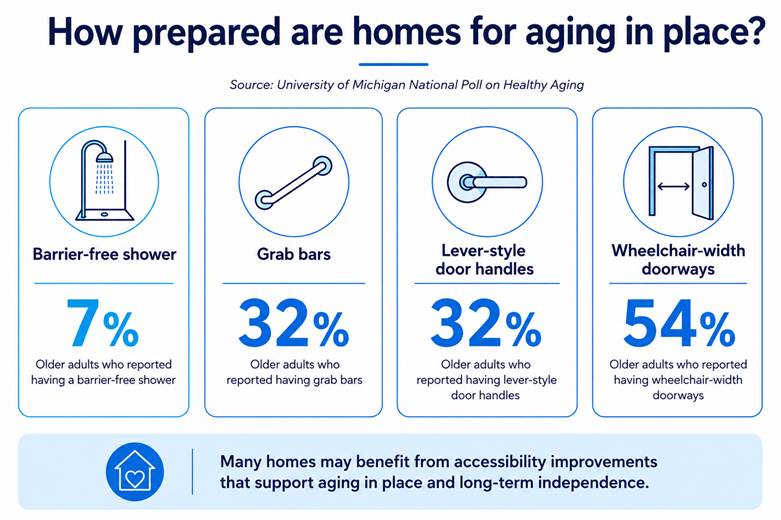
When evaluating your own home, consider the following:
1. Start with yourself: Think about how easily you move throughout your home and whether mobility challenges could develop in the future.
2. Review daily routines: Consider whether common tasks require excessive reaching, bending, climbing, or carrying heavy items.
3. Examine the overall layout: Review hallway widths, doorway clearances, and room layouts to determine whether the home would remain accessible if mobility needs change.
4. Assess single-floor living: Determine whether essential living spaces—including a bedroom, bathroom, kitchen, and laundry area—are accessible on one level of the home.
5. Focus on high-risk areas: Bathrooms, stairs, and entryways often require special attention because they involve transitions, uneven surfaces, steps, or frequent movement throughout the day.
6. Identify potential hazards: Check for dimly lit spaces, uneven flooring, throw rugs, cluttered walkways, and other conditions that could increase fall risk.
7. Think ahead: Aging-in-place planning is often most effective when it accounts for potential future challenges rather than only current limitations.
8. Prioritize improvements: Focus first on modifications that provide the greatest safety advantages, support daily routines, and fit within your budget.
Homeowners who want additional guidance may benefit from working with a Certified Aging-in-Place Specialist (CAPS) or an occupational therapist, both of whom can help assess the home’s accessibility needs and identify potential improvements.
The most important home modifications for aging in place
The right home modifications depend on your individual needs and circumstances. However, certain updates are commonly recommended because they may improve safety, accessibility, and long-term independence. The following sections take a closer look at several of these modifications.
Fall prevention and mobility updates
Falls are the leading cause of injury among adults age 65 and older, making fall prevention a major focus of many aging-in-place plans. According to the Centers for Disease Control and Prevention (CDC), more than 25% of older adults fall each year.
“A dark hallway can lead to unwelcome bumps in the night, the result of banging into furniture or tripping over random items left on the floor,” the AARP guide notes. “Proper lighting, handrails and an absence of clutter can make halls, staircases and other passageways safe for all residents.”
Common fall prevention and mobility updates include:
- Installing grab bars in bathrooms and other areas where extra support may be helpful.
- Adding sturdy handrails to all stairways and steps, including at the entrance of the home.
- Replacing slippery surfaces with slip-resistant flooring materials.
- Improving overall lighting throughout the home, particularly in hallways, stairwells, and other frequently used areas.
- Adding motion-activated night lights in hallways, bedrooms, and bathrooms to make late-night navigation safer.
- Incorporating high-contrast colors on stairs, transitions, doorways, or other key areas to improve visibility and depth perception
- Keeping walkways clear by decluttering, securing loose cords, and removing other tripping hazards
“As they get older, people have more stuff, and the more stuff you have, the more you are at risk for a fall,” aging-in-place specialist Kate Stephan told the New York Times.
Bathroom accessibility updates
Bathrooms are often among the most important areas to address when creating an age-in-place house plan. They are also among the most commonly modified areas of the home. Research shows that among older adults planning home modifications, 72% expect to upgrade bathrooms with features such as grab bars or non-slip flooring.
“Sometimes, more attention is paid to how a bathroom is decorated than to the safety of the space,” the AARP guide says. “Water on a bathroom floor is a slipping hazard, and often an invisible one. Falling in a bathroom is painful and potentially life-threatening because of the many hard surfaces—the floor, toilet, countertop, tub.”
Common modifications here include updates to the shower, sink, and toilet areas:
- Replacing traditional tubs with walk-in showers.
- Adding built-in or portable shower seating.
- Installing comfort-height toilets or toilet seat risers to reduce the effort required to sit and stand.
- Installing lever-style or touchless faucets that are easier to operate for individuals with limited hand strength or dexterity.
- Adding anti-scald or temperature-limiting faucets to help reduce the risk of burns.
- Applying non-slip decals or other slip-resistant surfaces in tubs and shower areas to improve traction on wet floors.
Entryway and stair modifications
Steps leading into the home may create barriers for people who use wheelchairs, rely on crutches, or have limited mobility. That is perhaps why 71% of older adults planning home modifications told AARP they intend to make updates such as ramps or stair lifts to improve accessibility.
“The ideal is for all homes to have at least one zero-step exterior doorway,” AARP recommends. “If step-free access isn’t possible for the front of the home, a side door, back door or door located inside the garage may be a suitable substitute.”
In addition to these updates, common entryway and stair modifications include:
- Adding sturdy railings along exterior walkways, steps, and staircases
- Replacing high thresholds with low- or no-step entryways
- Widening doorways to accommodate walkers, wheelchairs, or other mobility aids
- Creating wider hallways and clear pathways throughout the home to improve maneuverability
While Americans with Disabilities Act (ADA) standards do not apply to most private homes, they are often used as a benchmark. Under ADA standards, doorways generally require 32 inches of clearance, although some devices do require more space. Accessibility specialists also recommend minimizing raised thresholds and creating smoother transitions between rooms when possible. Together, these modifications can make it easier to move safely throughout the home as mobility needs change over time.
Kitchen and daily living improvements
The kitchen is one of the most frequently used spaces in the home, making accessibility and convenience especially important for aging in place. Many aging-in-place modifications are designed to make cooking, cleaning, and other daily tasks easier and safer.
Common kitchen and daily living improvements include:
- Positioning frequently used items like appliances at accessible heights to reduce unnecessary reaching and bending.
- Installing pull-out shelves, pull-down cabinet systems, and other storage solutions that make frequently used items easier to access.
- Using lazy Susan corner storage systems to easily access deep corner cabinets without excessive reaching or twisting motion.
- Consider induction cooktops, which may reduce burn risks because the cooking surface does not remain as hot as traditional electric burners.
- Adding lowered work surfaces or seated food-preparation areas.
- Replacing round doorknobs with lever-style door and cabinet handles that are easier to grip and operate.
Laundry may also become more physically demanding over time.
“Investing in a laundry basket with wheels or using a foldable shopping cart is a better and safer option than hoisting heavy bags or baskets and carrying them to and fro,” the AARP guide says. “Using a laundry service that offers pickup and delivery can be a helpful solution when doing laundry becomes too difficult or time-consuming (or both).”
Smart home and safety technology
Many smart home features are designed to improve convenience, support everyday living, and provide greater peace of mind for both older adults and the family members who support them.
Examples of smart home and safety technology commonly incorporated into aging-in-place plans include:
- Medical alert systems, which may help users quickly call for assistance during an emergency.
- Motion-activated lighting, which may improve visibility and may reduce fall risks, particularly at night.
- Smart thermostats, which allow homeowners to adjust temperatures more easily and maintain a comfortable living environment.
- Voice-activated assistants, which may help with communication, reminders, and everyday tasks.
- Video doorbells, which help homeowners identify visitors without opening the door.
- Smart door locks, which may be operated remotely and may make it easier for homeowners and caregivers to manage access.
- Water-leak sensors, which may help detect plumbing leaks before they cause more extensive damage.
While technology is not a substitute for physical home modifications, these tools may complement other aging-in-place improvements and support long-term safety and independence.

Aging-in-place house plans: Universal design for new construction and major renovations
While many home modifications may be added to an existing home, some homeowners may be building a new home or planning a major renovation. In these situations, incorporating universal design principles may help create a home that remains functional and accessible over time.
Universal design is an approach to home design that aims to make spaces safer, more accessible, and easier to use for people of all ages and abilities. While it is not specific to aging in place, many aging-in-place house plans incorporate universal design principles to help homeowners remain comfortable and independent as their needs change over time.
Common features include single-level living, wider hallways and doorways, open floor plans, step-free entryways, and accessible bathrooms. These design choices may make it easier to navigate the home as mobility needs change over time.
Remodeling vs. moving: When to consider other housing options
While many homes may be modified to support aging in place, some properties may be difficult or expensive to adapt for long-term accessibility. Older homes, multi-story layouts, steep lots, and structural limitations may require significant changes, such as relocating bedrooms, bathrooms, or laundry rooms to the main floor, building an addition, or undertaking a major renovation.
For some households, moving may ultimately be the more practical solution. According to the University of Michigan National Poll on Healthy Aging, about one in five older adults (21%) had moved within the previous five years. Among those who moved, 52% chose a home that was easier to navigate.
Depending on your home’s condition, layout, renovation costs, and long-term goals, relocating to a more accessible property may better align with your needs and budget.

How much do aging-in-place home modifications cost?
Because aging-in-place projects vary in scope, it may be helpful to think of them in three broad categories: low-cost safety updates, moderate accessibility improvements, and major renovations. The examples below are intended to provide general cost ranges. Actual costs vary based on factors like location, materials, contractor rates, and project requirements.
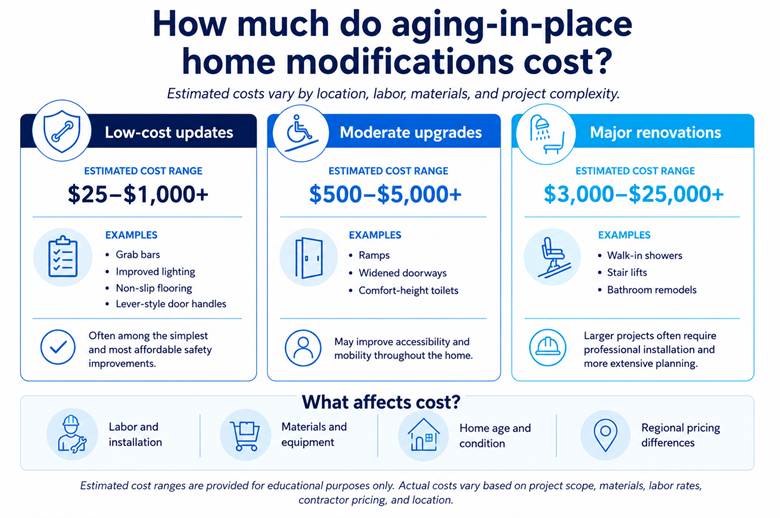
Costs may also vary considerably based on location, contractor rates, and the age and condition of the home. Because budgets are often limited, you may need to prioritize modifications based on safety, accessibility, and day-to-day impact. Addressing the most important needs first may help spread costs over time while supporting long-term independence and quality of life at home.
Ways to pay for aging-in-place home modifications
Because aging-in-place improvements range from simple safety updates to major renovations, many homeowners explore multiple ways to pay for these projects. Fortunately, multiple funding options may be available depending on your needs, available resources, and long-term financial goals.
The right funding strategy depends on the size of your project, how quickly modifications are needed, your available financial resources, and your broader retirement planning goals. Carefully comparing options may help you identify an approach that aligns with both your accessibility needs and long-term financial goals.
Reverse mortgages and aging in place
For some homeowners, savings or assistance programs may not fully cover the cost of larger accessibility renovations. In these situations, home equity could be a source of funds for aging-in-place improvements. Eligible homeowners may use reverse mortgage proceeds to help pay for accessibility and safety updates such as bathroom remodels, ramps, stair lifts, widened doorways, or other home modifications.
One advantage of a reverse mortgage is that eligible borrowers are generally not required to make monthly mortgage payments on the loan balance, provided they continue to meet the loan’s requirements. However, borrowers remain responsible for paying property taxes, maintaining homeowners insurance, keeping the home in good condition, and occupying the property as their principal residence.
A Home Equity Conversion Mortgage (HECM), which is insured by the Federal Housing Administration (FHA), is the most common type of reverse mortgage. Proprietary reverse mortgage options may also be available for some homeowners age 55 and older, depending on the product and state. Homeowners considering a reverse mortgage may also wish to review the Consumer Financial Protection Bureau’s “Reverse Mortgage: A Discussion Guide.”
→Read more: What is a reverse mortgage and how does it work?
The borrower must meet all loan obligations, including living in the property as the principal residence and paying property charges, including property taxes, fees, and hazard insurance. The borrower must maintain the home. If the homeowner does not meet these loan obligations, then the loan will need to be repaid.
The right to remain in the home is contingent on paying property taxes and homeowner’s insurance, maintaining the home, and complying with the loan terms.
When to prioritize home modifications
Many homeowners do not begin planning for accessibility needs until after a fall, injury, or noticeable change in mobility. However, making modifications before they become urgent may provide more time to evaluate options, prioritize projects, and spread costs over time.
The graphic below highlights some of the most common situations that may prompt homeowners and families to consider aging-in-place modifications.
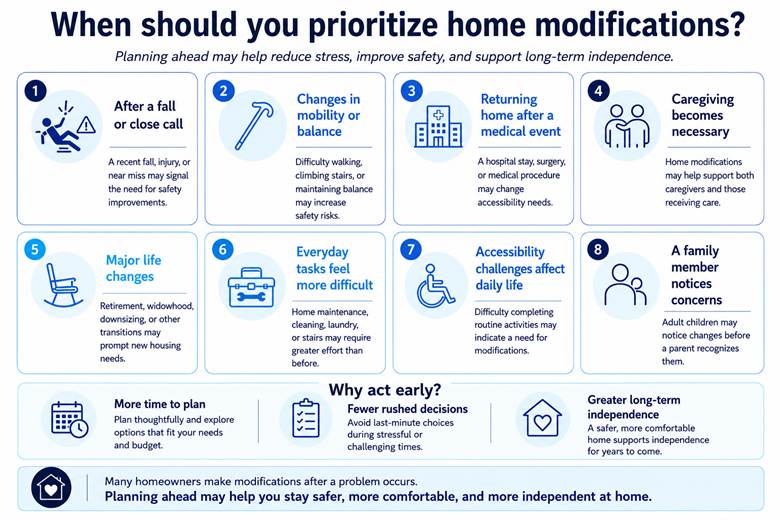
Planning ahead may help you and your family make thoughtful decisions and avoid rushed modifications during a health crisis or emergency. In many cases, small changes made early may help support independence and safety for years to come.
Funding your aging-in-place plan
Planning for aging in place often includes thinking not only about the modifications you may need, but also how you’ll pay for them.
If you’re considering using home equity to help fund aging-in-place improvements, Finance of America’s reverse mortgage calculator can serve as a helpful starting point for estimating how much home equity could be available.
→ Try Finance of America’s reverse mortgage calculator
The right to remain in the home is contingent on paying property taxes and homeowner’s insurance, maintaining the home, and complying with the loan terms.
FAQs
Which home modifications should older adults prioritize first?
The best home modifications depend on your needs, mobility, and living situation. However, many homeowners start with safety-focused updates such as grab bars, improved lighting, handrails, non-slip flooring, and clutter-free walkways because these improvements may help reduce fall risks and support everyday mobility.
What home modifications may help reduce fall risk?
Common fall-prevention modifications include grab bars, handrails, non-slip flooring, improved lighting, nighttime pathway lighting, high-contrast stair markings, and clear walkways free of tripping hazards. Bathrooms, stairs, and entryways are often among the first areas homeowners address.
Are there grants or programs that help pay for aging-in-place home modifications?
Possibly. Depending on where you live and your circumstances, local governments, nonprofit organizations, veteran assistance programs, or other community resources may offer grants, low-interest loans, or financial assistance for accessibility improvements.
Can a reverse mortgage be used to pay for home modifications?
For eligible homeowners, reverse mortgage proceeds may be used for a variety of purposes, including accessibility and safety improvements. Some homeowners use reverse mortgage funds to help pay for projects such as bathroom remodels, ramps, stair lifts, or other aging-in-place modifications.
The right to remain in the home is contingent on paying property taxes and homeowner’s insurance, maintaining the home, and complying with the loan terms.
How can I help my parents make their home safer?
Start by observing everyday challenges and identifying potential safety concerns. Pay particular attention to stairs, bathrooms, lighting, walkways, and tasks that require excessive reaching, bending, or climbing. Having open conversations about future needs and planning improvements before a health event occurs may help reduce stress and support long-term independence.
This article is part of our ongoing series on aging in place. If you’re just getting started, check out our other published articles below:
- How to age in place – a planning guide for homeowners
- Aging-in-place checklist – preparing for independent living
- Solo aging: How to play for care, costs, and your future – for those without nearby support
- What is Age Tech? – learn how tech can support your aging-in-place plans
- Fall prevention: A guide for homeowners – tips on how to prevent one of the most common injuries for aging adults
- How to care for aging parents – an adult child’s guide
About the author

is a Senior Web Content Writer at Finance of America and a journalist with more than 20 years of experience specializing in business, and technology. Her work has been published in The Wall Street Journal, The Financial Times, and numerous other leading outlets.
Disclaimer
This article is intended for general informational and educational purposes only and should not be construed as financial or tax advice. For tax advice, please consult a tax professional. For more information about whether a reverse mortgage fits into your retirement strategy, you should consult your financial advisor.