Explore by category
Can you refinance a reverse mortgage?

In this article:
- What is reverse mortgage refinancing?
- Why would you refinance a reverse mortgage?
- What are your options when refinancing a reverse mortgage?
- How to refinance a reverse mortgage
- Considerations before refinancing your reverse mortgage
- Pros and cons of refinancing a reverse mortgage
- Find out how much you may be eligible to borrow
- Frequently asked questions about reverse mortgage refinancing
Quick Answer: Yes, you may be able to refinance a reverse mortgage. Whether refinancing makes sense depends on your current home value, remaining equity, interest rates, age, existing loan terms, financial goals, and long-term housing plans.
Key Points
Reverse mortgage refinancing is possible, but eligibility requirements and available options vary by loan type.
Refinancing may help eligible homeowners borrow more against their homes, adjust loan terms, add eligible spouses as co-borrowers, or choose a loan that better fits their monthly budgets.
Before refinancing, carefully evaluate the upfront costs, current interest rates, the potential impact on your remaining home equity, and your long-term housing plans.
After getting a reverse mortgage, your financial situation or long-term plans may change. Maybe your home value has increased, interest rates have gone down, or your retirement goals have shifted. When that happens, it’s natural to wonder whether refinancing your reverse mortgage is an option.
This guide explains why homeowners may choose to refinance a reverse mortgage, the options available, how the process works, and the factors to consider before making a decision.
What is reverse mortgage refinancing?
Reverse mortgage refinancing replaces an existing reverse mortgage with a new loan that pays off the outstanding balance and sets updated terms, interest rates, and disbursement options. Depending on your financial goals and eligibility, the new loan may be another reverse mortgage or, in some cases, a traditional (forward) mortgage.
Important: Refinancing doesn’t change the ongoing requirements of a reverse mortgage. To remain eligible, you must continue to live in the home as your primary residence, meet applicable age requirements, and have sufficient equity. Lenders also review whether property taxes, homeowners insurance, and ongoing home maintenance obligations are being met.
→ Take a closer look: What is a reverse mortgage and how does it work?

Why would you refinance a reverse mortgage?
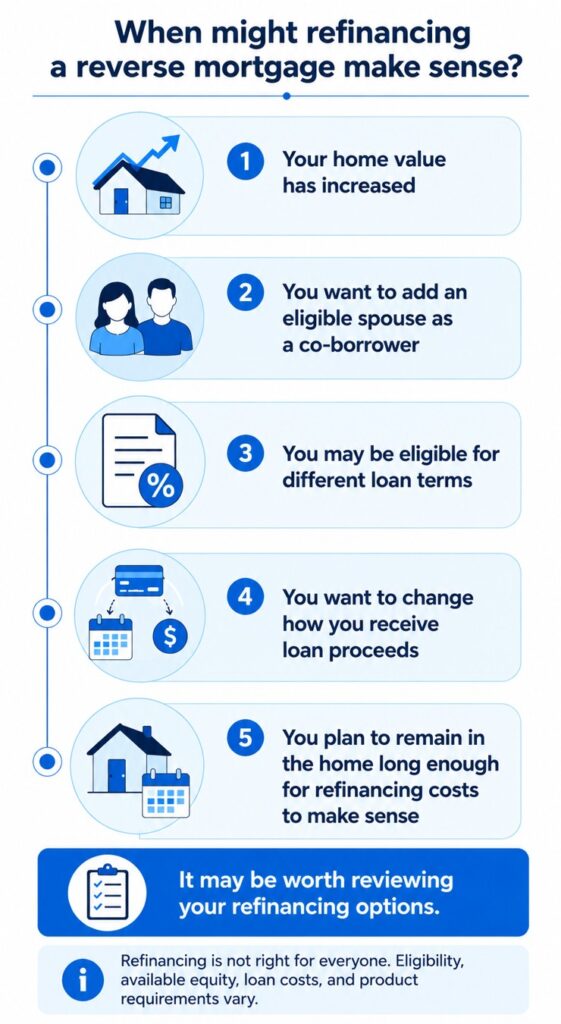
Most borrowers refinance a reverse mortgage for the same reason they refinance any loan: their circumstances change. Refinancing may allow you to access additional home equity, switch loan types, secure a lower interest rate, or better align the loan with your current financial goals. Here are some of the most common reasons homeowners choose to refinance:
To access more home equity
If your home has increased in value since you first took out your reverse mortgage, the additional equity may allow you to borrow more than when you first got the loan. Appreciation in home value or higher Federal Housing Administration (FHA) lending limits may increase the amount available through a new reverse mortgage, even after paying off your existing loan balance.
For borrowers with a Home Equity Conversion Mortgage (HECM), an FHA-insured reverse mortgage, the maximum claim amount is $1,249,125 for 2026. If your home’s value previously exceeded the HECM lending limit, the 2026 increase may raise the amount available through a new HECM. How much you may be able to borrow still depends on factors such as your age, interest rates, home value, and existing loan balance.
To secure a lower interest rate or better loan terms
Interest rates play an important role in how quickly a reverse mortgage loan balance grows over time. Refinancing into a loan with a lower interest rate or improved terms may slow balance growth, which could help preserve more home equity in the long run.
To switch loan types
Refinancing may allow homeowners to switch to a different type of reverse mortgage, such as moving from an FHA-insured HECM to a proprietary reverse mortgage or from an adjustable-rate HECM to a fixed-rate option. Depending on the loan you choose, you may have access to different borrowing limits, loan features, or payout options that better fit your current financial needs.
To reduce certain loan costs
Depending on the loan product, refinancing may reduce certain reverse mortgage costs. For example, proprietary reverse mortgages do not require FHA mortgage insurance and may have different fee or servicing structures than FHA-insured HECMs.
To adjust your payout options
Depending on the product, refinancing may allow homeowners to change how they receive loan proceeds, such as establishing or expanding a line of credit, adjusting monthly payments, or choosing a different payout option. These changes may help the loan better support your current financial needs and long-term plans.
To add a spouse to the loan
Some homeowners refinance to add a spouse who was not originally listed as a borrower on the reverse mortgage. This may occur after getting married or when a spouse who previously did not meet the applicable age requirements later becomes eligible. Refinancing may allow both spouses to be listed as borrowers, which may affect the spouse’s rights and obligations under the new loan. Eligibility, safeguards, and requirements vary by product.
→ Read more about non-borrowing spouses and reverse mortgages.
What are your options when refinancing a reverse mortgage?
Generally, when refinancing a reverse mortgage, you have three options: another HECM, a proprietary reverse mortgage, or a conventional (forward) mortgage. Each approach serves different financial goals and has different eligibility requirements.
This table breaks down the core differences:
| Refinance option | Basic requirements | Best for | Key pros | Key cons |
| HECM-to-HECM refinance | Age 62+; primary residence; sufficient equity; HUD counseling; must provide a net tangible benefit | Borrowers who want FHA safeguards and improved terms | FHA-insured; no monthly mortgage payments required; flexible payout options* | Mortgage insurance premiums; loan limits apply |
| Proprietary reverse mortgage refinance | Age varies by product and state; higher home value; lender-specific guidelines | Homeowners with higher-value homes seeking to borrow more | May offer higher maximum loan amounts for eligible borrowers; no mortgage insurance premium | Lender-specific requirements; safeguards and features vary by product and applicable state law |
| Refinance into a conventional mortgage | Eligibility is based on income, credit, and debt-to-income ratios | Borrowers planning to sell, move, or preserve equity | Removes the reverse mortgage; may leave more equity for heirs | Monthly payments required; credit and income underwriting |
*The borrower must meet all loan obligations, including living in the property as the principal residence and paying property charges, including property taxes, fees, and hazard insurance. The borrower must maintain the home. If the homeowner does not meet these loan obligations, then the loan will need to be repaid.
Here’s a closer look at how each refinance option works.
HECM-to-HECM refinance
A HECM-to-HECM refinance replaces an existing FHA-insured HECM with a new one. HUD requires these refinances to provide a net tangible benefit, which means the new loan must leave you in a clearly better financial position. That improvement may include more available funds, a lower interest rate, or loan features—such as different payout options or higher lending limits—that better fit your current needs.
These refinances generally cannot be completed until at least 18 months after the original loan closed. Your lender must also provide a HECM Anti-Churning Disclosure, which compares the refinancing costs with the new loan amount and the funds expected to remain after the existing loan and refinancing costs are paid.
Like all HECMs, these refinances must also meet FHA requirements for age, equity, and counseling.
Proprietary reverse mortgage refinance
Some borrowers refinance into a proprietary reverse mortgage offered by a private lender, such as a jumbo reverse mortgage loan. These loans are not insured by the FHA and may appeal to homeowners with higher-value homes who want to borrow more without FHA mortgage insurance premiums.
Proprietary reverse mortgages have product- and state-specific age requirements and may follow different underwriting standards than HECMs.
→ Learn more about HomeSafe, a proprietary reverse mortgage from Finance of America.
Refinance into a conventional mortgage
Unlike a reverse mortgage, a conventional mortgage requires monthly principal and interest payments. It may make sense for borrowers who want to replace their reverse mortgage with a traditional loan to preserve more home equity or, in some situations, for heirs who want to keep the home after the reverse mortgage becomes due.

How to refinance a reverse mortgage
Refinancing a reverse mortgage follows a similar process to getting your original loan, with a few additional considerations. The exact steps vary depending on the type of loan you’re refinancing into, but here’s what you can generally expect:
Step 1: Review your current reverse mortgage
Start by reviewing your reverse mortgage statement, including your loan balance, interest rate, any remaining line of credit or payment plan, and available home equity. Having your original loan documents available may also help you compare your current loan with the proposed refinance.
Step 2: Confirm eligibility for refinancing
To refinance, you must continue to live in the home as your principal residence and stay current on property taxes, homeowners insurance, and required home maintenance. Sufficient equity is also required, and age rules apply—borrowers must be at least 62 for an FHA-insured HECM, while certain proprietary reverse mortgages, such as Finance of America’s HomeSafe, have a minimum age of 55 in most states; 60 in Massachusetts, New York, and Washington; and 62 in North Carolina and Texas. Additional eligibility criteria may vary by loan product and lender.
Step 3: Attend HUD-approved counseling
Counseling is generally required for a HECM refinance. Many proprietary reverse mortgage refinances also require it, depending on the lender and loan product. During the session, a HUD-certified counselor reviews the proposed loan terms, costs, ongoing responsibilities, and possible alternatives to help you make an informed decision.
→ Read more: Reverse mortgage counseling: What to expect and why it’s required
Step 4: Apply with a lender
At this stage, you’ll provide documents such as proof of income, bank statements, identification, and information related to property taxes and homeowners insurance. Your lender will complete a financial assessment to evaluate your ability to continue paying property taxes, homeowners insurance, and other ongoing obligations. You’ll also discuss how you’d like to receive your loan proceeds, such as a lump sum, monthly payments, a line of credit, or a combination of those options.
Step 5: Appraisal and underwriting
An appraisal determines the current value of your home, which helps determine how much you may be able to borrow through the new loan. The lender also completes underwriting to confirm that the property meets FHA or lender-specific requirements and that you meet all applicable eligibility criteria.
Step 6: Finalize the loan
Before closing, you’ll receive information about the costs associated with refinancing, including the appraisal, origination fee, standard closing costs, and mortgage insurance premiums for HECM loans. Your lender will also provide a Total Annual Loan Cost (TALC) disclosure to help you understand the long-term cost of the loan.
After closing, you’ll generally have three business days to cancel the refinance under the right of rescission before the new loan is funded.
Step 7: Receive loan proceeds or updated payment plan
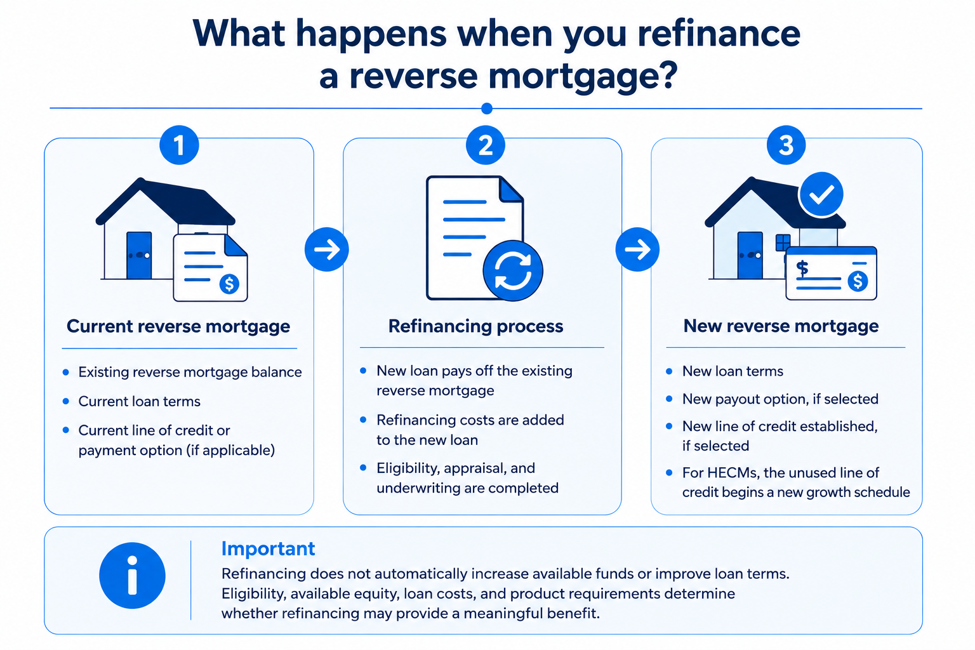
After funding, the proceeds are first used to pay off your existing reverse mortgage. Any remaining funds are then disbursed according to the payout option you selected.
If your original reverse mortgage included a line of credit, it will be closed. If your refinanced loan also includes a line of credit, a new one will be established under the new loan’s terms.
To learn more, please visit the CFPB’s “Reverse Mortgages: A Discussion Guide.”
Considerations before refinancing your reverse mortgage
It’s important to consider both the potential advantages and the tradeoffs before refinancing. Here’s what to keep in mind:
Upfront costs
A reverse mortgage refinance involves additional expenses that are typically added to the new loan balance. These may include appraisal fees, origination charges, counseling fees, closing costs, and, for HECM-to-HECM refinances, mortgage insurance premiums (MIPs). If you’re refinancing one HECM into another, FHA credits a portion of the initial mortgage insurance premium paid on the original HECM toward the new loan.
Impact on remaining home equity
A reverse mortgage refinance pays off your existing reverse mortgage with a new loan. If the costs of the new loan are added to the balance, you’ll owe more than you did before the refinance. While you may receive additional funds in the short term, the higher loan balance may reduce the amount of home equity that remains over time. That’s an important consideration if you’re thinking about future needs or what you’d like to leave behind for heirs.
Interest rate considerations
Interest rates influence how quickly a loan balance grows over time. Lower rates may slow balance growth, which could help preserve more home equity. Higher rates may have the opposite effect. Comparing your current rate with the proposed rate is one factor in deciding whether refinancing is right for you.
Eligibility for needs-based programs
Additional loan proceeds or changes to your payout option may affect eligibility for needs-based programs such as Medicaid or Supplemental Security Income (SSI). If you participate in one of these programs, consider speaking with a financial advisor or benefits specialist before refinancing.
Long-term housing plans
Refinancing comes with additional expenses that are typically added to the new loan balance. The longer you expect to remain in your home, the more time you have to offset those costs. If you plan to move or sell in the near future, refinancing may not provide enough long-term value to justify the added expense.

Pros and cons of refinancing a reverse mortgage
Refinancing a reverse mortgage offers potential advantages and tradeoffs. Weighing both can help you decide whether refinancing makes sense for you.
Potential pros to consider:
- Access to additional home equity: If your home value has increased or lending limits are higher than when you first borrowed, you may be able to borrow more than you could when you first got the loan.
- Lower interest rate or improved loan terms: A lower interest rate may slow balance growth, while different loan features may better support your financial needs.
- Opportunity to add a spouse to the loan: Both spouses may be listed as borrowers, offering added security and long-term planning flexibility.
- Ability to switch loan types: Switching from an adjustable-rate loan to a fixed-rate option or to a proprietary reverse mortgage may better fit your current financial goals.
- Flexible payout options: A new loan may allow you to reset or expand a line of credit, adjust monthly payments, or choose a different payout option.
Potential cons include:
- Upfront costs: Refinancing may include appraisal, origination, counseling, and closing costs, along with mortgage insurance premiums for HECM loans. Because these expenses are typically added to the new loan balance, they increase the amount you owe.
- Reduced remaining home equity: New loan costs and a higher loan balance may reduce the amount of home equity that remains over time, which may affect your future financial flexibility or the amount of home equity available to your heirs.
- Interest rate risk: If interest rates are higher than when you first got your reverse mortgage, refinancing may cause the loan balance to grow faster over time.
- Eligibility for needs-based programs: Receiving additional loan proceeds or changing your payout option may affect eligibility for needs-based programs such as Medicaid or SSI.
- Limited value for short-term homeowners: If you expect to move or sell your home in the near future, refinancing may not provide enough long-term value to outweigh the added costs.
Find out how much you may be eligible to borrow
If you’re considering refinancing, the next step is understanding how much you may be eligible to borrow. Use our reverse mortgage calculator to estimate your borrowing capacity and explore your refinancing options.
Frequently asked questions about reverse mortgage refinancing
How many times can you refinance a reverse mortgage?
There is no formal limit on how many times you may refinance a reverse mortgage. However, each refinance must meet the new loan’s eligibility requirements. A HECM-to-HECM refinance must also satisfy HUD requirements, including providing a net tangible benefit.
What is the 2% rule for refinancing?
The 2% rule is a traditional mortgage rule of thumb suggesting that refinancing may be worth considering when the new interest rate is about two percentage points lower than the current rate. It is not a HUD requirement and is not specific to reverse mortgages. When evaluating a reverse mortgage refinance, consider the interest rate along with the refinancing costs, proceeds, remaining home equity, loan features, and your long-term housing plans.
How long do you have to wait before you can refinance a HECM?
HUD imposes what is known as a seasoning requirement for HECM-to-HECM refinances. That means a new HECM generally cannot close until at least 18 months after you took out your original HECM. Proprietary reverse mortgages follow lender-specific waiting periods, which may vary by product.
Do you have to pay the mortgage insurance premium all over again when you refinance a HECM?
No. When one HECM is refinanced into another, FHA credits a portion of the initial mortgage insurance premium (MIP) paid on the original loan toward the new HECM’s initial MIP.
Can you refinance a proprietary reverse mortgage into a HECM?
Yes, if the borrower and property meet HECM requirements. The borrower must be at least 62 years old to be eligible for a HECM, even if they were eligible for the proprietary reverse mortgage at a younger age. Other HECM eligibility and counseling requirements also apply.
If I refinance to add my spouse to the loan, does my spouse have to meet the age requirement?
Yes. To be added as a co-borrower, your spouse must independently meet the minimum age requirement for the reverse mortgage product you’re considering. For HECMs, the minimum age is 62. For HomeSafe, the minimum age is 55 in most states; 60 in Massachusetts, New York, and Washington; and 62 in North Carolina and Texas. If your spouse does not meet the applicable age requirement, they may instead be eligible as a non-borrowing spouse, depending on the loan and your circumstances.
→ Read more: A non-borrowing spouse guide to reverse mortgage
What happens to my existing line of credit if I refinance?
Your existing line of credit does not transfer to the new loan. It is closed when your original reverse mortgage is paid off. If your new reverse mortgage includes a line of credit, a new one is established under the new loan’s terms. For a HECM, the unused line of credit growth feature restarts rather than carrying over from the original loan.
Can I refinance my reverse mortgage if my home has lost value?
Generally, no. Refinancing depends on the amount of equity available in your home, and a lower appraised value combined with your existing loan balance may leave insufficient equity for a refinance that provides a net tangible benefit. Before ordering an appraisal, review your current loan balance and estimated home value with your lender to determine whether refinancing is likely to provide a meaningful advantage.
Can an heir refinance a reverse mortgage?
Yes. When a borrower passes away, the reverse mortgage becomes due. An heir who wants to keep the home may be able to refinance the balance into a loan in their own name if they meet the new loan’s requirements. Heirs often use a traditional (forward) mortgage rather than a reverse mortgage.
About the author

is a Senior Web Content Writer at Finance of America and a journalist with more than 20 years of experience specializing in business, and technology. Her work has been published in The Wall Street Journal, The Financial Times, and numerous other leading outlets.
Disclaimer
This article is intended for general informational and educational purposes only and should not be construed as financial or tax advice. For tax advice, please consult a tax professional. For more information about whether a reverse mortgage fits into your retirement strategy, you should consult your financial advisor.