Explore by category
Reverse mortgage fees: What costs should you expect?

In this article:
- What fees come with a reverse mortgage?
- What are the upfront costs of a reverse mortgage?
- What ongoing costs are added to a reverse mortgage?
- What other costs should you plan for?
- Can reverse mortgage fees be rolled into the loan?
- How do HECM and proprietary reverse mortgage fees differ?
- Why can reverse mortgage fees seem high?
- What affects the total cost of a reverse mortgage?
- How can you compare reverse mortgage offers?
- How can you reduce or manage reverse mortgage costs?
- Take the next step
- FAQs
Quick answer: A reverse mortgage loan includes upfront fees, ongoing borrowing costs, and regular homeownership expenses. Some costs are paid before or at closing, while others may be added to the loan balance over time, reducing the remaining home equity.
Many eligible closing costs may be financed, which may reduce the cash needed at closing but also reduce the funds available to you.
- Costs for a Home Equity Conversion Mortgage (HECM) may include an initial mortgage insurance premium, annual mortgage insurance, interest, and certain lender or third-party charges.
Total borrowing costs depend on factors such as how much you borrow, when you access funds, the interest rate, and how long the loan remains open.
Understanding how much a reverse mortgage may cost can be challenging when you’re trying to decide whether it fits your financial needs. Expenses vary by loan type and may include upfront fees, ongoing borrowing costs, and charges that depend on your individual loan and property. Upfront fees can total thousands of dollars, while interest and other charges may add to the cost over time, so the total amount you pay may vary widely.
For a Home Equity Conversion Mortgage (HECM), costs may include a loan origination fee, third-party closing costs, interest, and mortgage insurance. Proprietary reverse mortgages often have their own fee structures, so what you pay may differ by lender and product.
To help you understand what you may actually pay and when, this guide breaks down the most common reverse mortgage fees, when they’re charged, which costs may be financed, and how they may affect your loan balance and remaining home equity over time.
What fees come with a reverse mortgage?
There are two main types of reverse mortgages: HECM reverse mortgages, which are insured by the Federal Housing Administration (FHA), and proprietary reverse mortgages offered by private lenders. The costs associated with each type are different.
Regardless of which reverse mortgage you choose, costs may come from several sources and arise at different points in the loan process. These may include lender fees, HECM-specific charges, and third-party expenses for services such as appraisals, title work, and settlement.
Finance of America confirmed with the U.S. Department of Housing and Urban Development (HUD), which administers the HECM program through the FHA, that the cost ranges below are reasonable estimates of what borrowers may encounter as of August 2026:
| When | Common costs and typical amounts |
| Before closing | Counseling: $125–$250 Appraisal: $300–$900 |
| At closing | Origination fee: Up to $6,000 for a HECM Initial HECM mortgage insurance premium: 2% of maximum claim amount (generally the home’s appraised value, up to the FHA HECM limit) Title insurance: 0.1%–1.0% of the property’s value Other closing costs: $1,500–$4,000 |
| After closing | Interest: Varies Annual HECM mortgage insurance premium: 0.5% of outstanding loan balance Servicing fee, if applicable: Up to $30 or $35 per month, depending on the rate adjustment schedule |
Note: Actual fees may vary by provider, property, location, and individual transaction.
Have questions about what these costs could look like for you? Your loan officer can explain which fees may apply, which costs may be financed, and how they could affect the amount you owe over time. Current customers can speak with their loan officer or contact Finance of America directly for more information.

What are the upfront costs of a reverse mortgage?
Some upfront reverse mortgage costs are charged by the lender, while others cover third-party services. For HECMs, federal requirements set or limit certain costs, while others vary by provider and location. Some eligible costs may be paid with other funds or financed into the loan. Let’s take a closer look at these costs.
Reverse mortgage counseling
If you’re applying for a HECM, you must first complete counseling through an independent HUD-certified counseling agency. The session helps you understand how reverse mortgages work, including their costs, your ongoing responsibilities, repayment triggers, and possible alternatives.
The counseling agency determines its own fee, which typically ranges from $125 to $250 but may vary by agency and location. Some agencies may reduce or waive the fee based on their policies or available funding. Counseling fees are generally handled separately rather than financed as part of the loan.
→ Learn more: Reverse mortgage counseling: What to expect and why it’s required
Appraisal and property-related charges
An appraisal is typically needed to establish your home’s market value and assess whether the property meets FHA requirements for condition and eligibility for a HECM. Appraisal fees commonly range from $300 to $900, although actual costs may be higher depending on factors such as the property’s size, location, type, complexity, and local market conditions.
In some cases, a second appraisal, inspection, or repair-related evaluation may be required.
Important: In some cases, borrowers may be responsible for appraisal costs even if the reverse mortgage does not ultimately close.
Loan origination fee
The origination fee covers the lender’s costs for processing and originating the reverse mortgage. For HECMs, the FHA limits the amount a lender may charge. The maximum origination fee is the greater of:
- $2,500, or
- 2% of the first $200,000 of the maximum claim amount, plus 1% of any amount above $200,000
The total origination fee may not exceed $6,000. This is a maximum, so lenders may charge less or offer a credit. Proprietary reverse mortgage lenders establish their own origination fee structures.
Initial HECM mortgage insurance premium
HECM borrowers pay an initial mortgage insurance premium equal to 2% of the maximum claim amount, which is generally based on the home’s appraised value and capped at the FHA’s HECM lending limit. For 2026, the HECM maximum claim amount is $1,249,125. Here’s what upfront costs could look like for an $800,000 home:
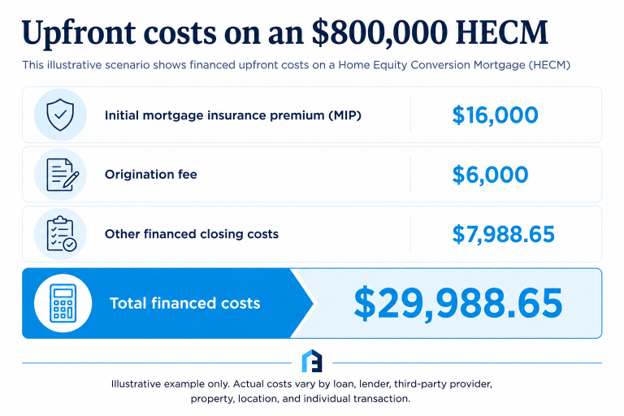
Note: This example assumes an $800,000 maximum claim amount.
You may pay the initial premium with other funds at closing or finance it as part of the loan. If financed, it becomes part of the loan balance, reducing available proceeds and accruing interest over time.
HECM mortgage insurance also supports important borrower safeguards, including the loan’s non-recourse feature.1 This means you or your heirs won’t owe more than the home’s value if the loan balance exceeds that amount when the loan becomes due and payable, as long as the loan obligations have been met. FHA insurance covers the difference.
Proprietary reverse mortgages do not have FHA mortgage insurance, but may be non-recourse loans in some cases.
Other reverse mortgage closing costs
Reverse mortgages also include third-party closing costs similar to those associated with traditional mortgages. They may include:
- Title search and lender’s title insurance
- Settlement or closing services
- Recording fees
- Credit report fees
- Flood determination or certification
- Document preparation fees
- Attorney fees
Lender’s title insurance helps verify ownership of the property and covers certain title-related issues that could affect the lender’s interest in the home. It may range from 0.1% to 1.0% of the property’s value. Other third-party closing costs may total $1,500 to $4,000, although actual costs vary based on the factors listed above.
State and local fees
Depending on where you live, you may also pay state or local fees at closing. These may range from $500 to more than $3,000, although actual costs vary significantly by location and transaction. They may include recording fees, mortgage taxes, transfer taxes, or other legal or title-related charges.
Examples include:
Because these charges vary, your lender should provide an itemized estimate of the costs for your loan.
What ongoing costs are added to a reverse mortgage?
Some reverse mortgage costs continue after closing and are added to the outstanding loan balance over time. Because reverse mortgages generally do not require monthly mortgage payments as long as borrowers meet their loan obligations, including living in the home as their principal residence, paying required property charges, and maintaining the home, these costs may accumulate and increase the total amount owed.
The best way to keep your ongoing costs low is to borrow only as much money as you need.
— Consumer Financial Protection Bureau (CFPB)
To read more, please visit the CFPB’s Reverse Mortgages: A Discussion Guide.
Here’s a closer look at how ongoing costs may affect what you owe over time:
Interest rates
The interest rate on a reverse mortgage affects how quickly interest accrues and the loan balance grows. A higher rate generally means more interest will be added to the balance, all else being equal. Because rates and other loan terms may vary by lender, comparing offers from multiple lenders can help you understand the potential costs of your options.
Rather than being paid through required monthly mortgage payments, accrued interest is generally added to the amount you owe. As the loan balance increases, interest also accrues on previously added interest. You may make voluntary payments at any time to reduce the amount you owe, which may also reduce the interest that accrues over time.
The borrower must meet all loan obligations, including living in the property as the principal residence and paying property charges, including property taxes, fees, and hazard insurance. The borrower must maintain the home. If the homeowner does not meet these loan obligations, then the loan will need to be repaid.
Fixed vs. adjustable interest rates
Both HECMs and proprietary reverse mortgages may offer fixed or adjustable interest rates, depending on the loan and lender. A fixed rate remains the same for the life of the loan, which may make balance growth more predictable but means your rate will not decrease if market rates fall. An adjustable rate can change over time based on the terms of the loan, so the rate at which interest accrues may increase or decrease.
For HECMs, fixed rates are generally associated with a lump-sum payment, while payment options such as a line of credit or monthly advances use an adjustable rate. HECM lines of credit are available only with an adjustable interest rate.
Annual HECM mortgage insurance premium
HECM borrowers also pay an annual mortgage insurance premium equal to 0.5% of the outstanding loan balance. This charge is added to the amount owed over time rather than paid as a separate annual bill.
FHA mortgage insurance premiums help provide non-recourse protection for HECMs, meaning borrowers or their heirs generally won’t owe more than the home is worth when the loan is repaid through the sale of the home. Proprietary reverse mortgages do not include FHA mortgage insurance premiums, but some may also be non-recourse and may have their own costs.1
Servicing fees
Some reverse mortgages may charge a separate monthly servicing fee to cover activities such as providing account statements, distributing loan proceeds, and monitoring loan requirements. If charged, the fee will be included in your loan disclosures and may be added to the loan balance over time.
Not all reverse mortgages charge a separate servicing fee. For HECMs that do, the FHA limits the monthly fee to $30 for fixed-rate loans or loans that adjust annually, and $35 for loans that adjust monthly, although lenders may charge less.

What other costs should you plan for?
A reverse mortgage doesn’t replace the regular costs of owning a home, and some of those expenses also factor into the HECM loan process.
Property taxes, insurance, and maintenance
Property taxes, homeowners insurance, HOA dues, and home maintenance aren’t reverse mortgage fees, but you’re still responsible for them as part of the loan. You must pay applicable property charges, maintain the home in good condition, and use it as your primary residence. Failure to meet these loan obligations may cause the reverse mortgage to become due and payable and could ultimately result in foreclosure.
For maintenance and repairs, a common guideline is to set aside 1% to 3% of your home’s value each year, although actual costs vary based on the home’s age, condition, and location.
Financial assessment and LESA
As part of the HECM application process, the lender considers your ability to continue paying required property charges, such as taxes and homeowners insurance. In some cases, a Life Expectancy Set-Aside (LESA) may be required. A LESA reserves a portion of your available HECM proceeds to help pay certain future property charges.
Property tax assistance
If you’re concerned about keeping up with property taxes, you may be eligible for assistance programs that help reduce them. Depending on where you live, these may include homestead exemptions, age-based property tax relief, or other state and local programs. AARP’s Property Tax-Aide may also help you find property tax relief programs available in your area.
Can reverse mortgage fees be rolled into the loan?
Many reverse mortgage closing costs may be financed instead of paid out of pocket. These may include the origination fee, initial mortgage insurance premium for HECMs, and costs for services such as title work, recording, and settlement. Other expenses may need to be paid separately, including counseling fees and certain appraisal-related charges.
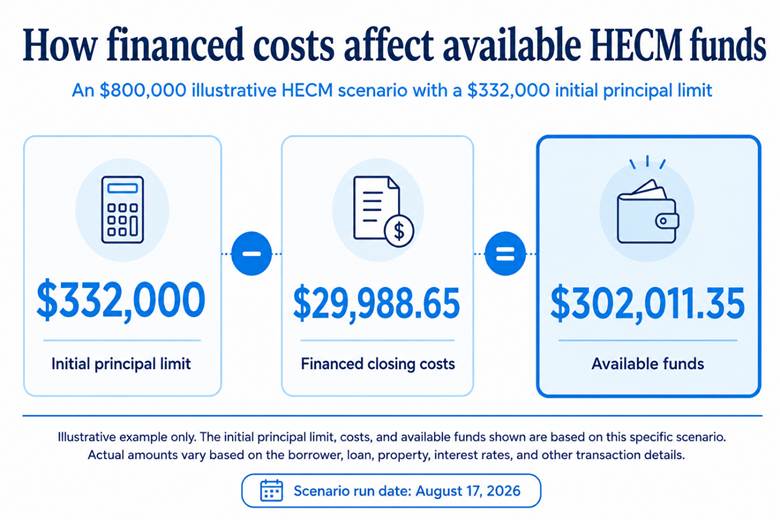
For costs that can be financed, you may have the option to pay them with other funds instead. Paying them separately leaves more of your reverse mortgage proceeds or line of credit available to you. Financing them reduces what you need to pay at closing, but those costs become part of your loan balance and accrue interest over time. For HECMs, they also increase the balance used to calculate the annual mortgage insurance premium.
Example: A HECM’s initial principal limit is the amount available to borrow before closing costs are deducted. It’s based on factors including your age, interest rate, and home value. Here’s how those costs affect the funds available in our $800,000 example:
→ Learn more: How much can I get from a reverse mortgage?

How do HECM and proprietary reverse mortgage fees differ?
HECMs and proprietary reverse mortgages both have upfront and ongoing costs, but their fee structures differ. The biggest distinction is that HECMs are insured by the FHA and include mortgage insurance premiums, while proprietary reverse mortgages are offered by private lenders and use their own fee and pricing structures.
| Cost | HECM | Proprietary reverse mortgage |
| Origination fee | FHA formula applies, with a maximum of $6,000 | Varies by product and lender |
| Initial mortgage insurance premium | 2% of the maximum claim amount | No FHA mortgage insurance premium |
| Annual mortgage insurance premium | 0.5% of the outstanding loan balance | No FHA mortgage insurance premium; additional costs for non-recourse protection may apply1 |
| Counseling | Required for HECMs, typically $125–$250 | Requirements and costs vary; typically similar to HECM counseling |
| Third-party closing costs | Appraisal: $300–$900 Title insurance: 0.1%–1.0% of the property’s value Other closing costs: $1,500–$4,000 | Similar third-party costs may apply and vary by property, location, provider, and transaction |
| Interest | Accrues on the outstanding loan balance | Accrues on the outstanding loan balance according to the loan’s terms and pricing |
Traditional mortgages and home equity borrowing options may include some of the same upfront expenses as reverse mortgages, such as appraisal, title, origination, and other closing costs. However, their ongoing cost structures differ. Home equity loans and HELOCs generally require monthly payments, while reverse mortgage interest typically accrues to the outstanding loan balance.2
→ Read more: Reverse mortgage vs HELOC vs home equity loan
Why can reverse mortgage fees seem high?
The cost of a reverse mortgage isn’t driven by any single fee. Several expenses may come into play, and how they’re handled can affect both what you pay upfront and what you owe over time. Some of the biggest reasons the associated fees may seem high include:
- HECMs have additional insurance costs: HECMs include FHA mortgage insurance in addition to many of the closing costs associated with traditional mortgages. The initial premium alone is 2% of the maximum claim amount, which is generally the home’s appraised value up to the FHA’s HECM lending limit.
- Financing costs can increase what you owe: Financing eligible closing costs reduces what you pay upfront but adds those expenses to the loan balance, where they can accrue interest.
- Costs can accumulate for years: Interest is added to the loan over time, and for HECMs, the annual mortgage insurance premium increases the balance as well. As the amount owed grows, future interest is calculated on a larger total. The longer the loan remains open, the more time these costs have to accumulate, which may also reduce the home equity that remains.
- Fixed costs can have a bigger impact on smaller loans: Some reverse mortgage costs are fixed transaction expenses, so they may represent a larger share of the amount borrowed on a smaller loan.
The borrower must meet all loan obligations, including living in the property as the principal residence and paying property charges, including property taxes, fees, and hazard insurance. The borrower must maintain the home. If the homeowner does not meet these loan obligations, then the loan will need to be repaid.
What affects the total cost of a reverse mortgage?
Several factors may affect the total cost of a reverse mortgage over time, including:
- Loan type: HECMs and proprietary reverse mortgages have different fees, insurance requirements, and other costs.
- Interest rate and lender margin: Higher interest rates generally cause the loan balance to grow more quickly. For adjustable-rate HECMs, the lender margin also helps determine the interest rate.
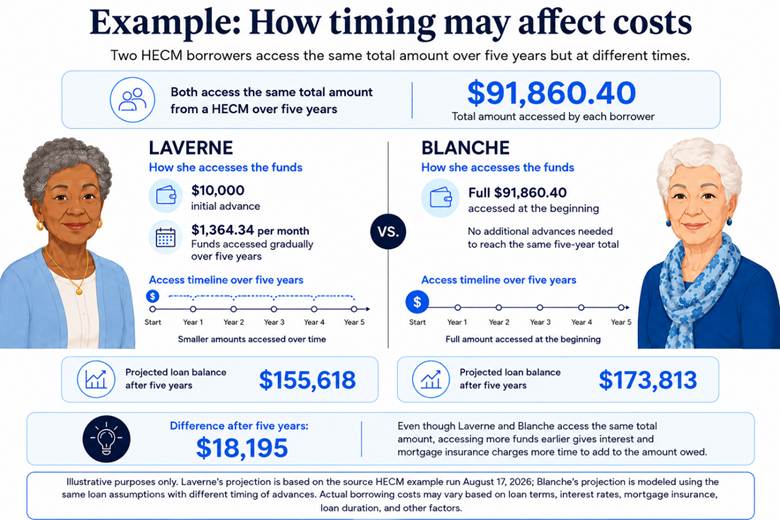
- Amount and timing of advances: The more you borrow—and the earlier you access those funds—the longer interest and applicable charges may accrue.
- Loan duration: Interest and applicable charges may continue to accrue as long as a balance remains outstanding.
- Home value and age: Both factors may affect how much you can borrow, while home value may also affect certain costs, including the initial HECM mortgage insurance premium.
- Property and location: Appraisal, title, recording, attorney, and other costs may vary based on the property and where you live.
- Financial assessment and LESA: A required LESA reserves a portion of available HECM funds for certain future property charges, reducing the amount available for other uses.
- Lender pricing and credits: Interest rates, origination charges, and lender credits may vary, so a lower upfront charge does not necessarily mean a lower overall cost.
How can you compare reverse mortgage offers?
Lenders may differ in their upfront charges, interest rates, lender margins, and lender credits. To make a meaningful comparison, look at the total projected cost of each loan, not just individual fees.
The following steps may help you compare your options:
Check itemized disclosures
Review each lender’s disclosures to understand which costs are paid before closing, which may be financed, and which charges come from the lender or third-party providers. Also, compare the interest rate, lender margin, and any lender credits.
Use consistent loan scenarios
When comparing offers, use the same assumptions for each one, including:
- Loan type
- Home value
- Existing mortgage balance
- Advance amount or payment plan
- Estimated loan duration
Using the same assumptions may give you a clearer picture of how the projected costs differ between offers.
Look beyond the origination fee
A lower origination fee doesn’t necessarily mean a lower-cost loan. For example, a lender may offer a lower upfront charge or lender credit alongside a higher interest rate. Looking at the full offer may help you understand the trade-off between upfront and long-term costs.
Review the TALC disclosure
For a HECM, the total annual loan cost (TALC) disclosure shows projected loan costs based on different assumptions about how long you keep the loan and how the home’s value may change over time. Reviewing the TALC disclosure may help you compare the projected cost of different reverse mortgage offers.
→ Learn more: What is the TALC for reverse mortgages?
How can you reduce or manage reverse mortgage costs?
While you may not have control over every reverse mortgage cost, there are ways to manage what you pay upfront and how costs build over time. Here are a few strategies to consider:
Ask about origination charges and lender credits
For HECMs, the FHA sets a maximum origination fee, but lenders may charge less or provide a credit toward closing costs. Ask whether reducing your upfront costs would affect the interest rate or other loan terms.
Pay eligible closing costs from other funds
You may choose to pay eligible closing costs with other funds instead of financing them. This keeps those costs from being added to the loan balance and accruing interest over time.
Draw from a HECM line of credit as needed
If you choose a HECM line of credit, consider drawing funds as you need them rather than taking them before they’re necessary. Because interest and the annual HECM mortgage insurance premium are based on the outstanding balance, the timing of your advances may affect long-term costs.
Make voluntary payments
Reverse mortgages generally do not require monthly mortgage payments as long as you meet the loan obligations, but you may make voluntary payments. Reducing the outstanding balance may also reduce future interest charges and help preserve more home equity.
The borrower must meet all loan obligations, including living in the property as the principal residence and paying property charges, including property taxes, fees, and hazard insurance. The borrower must maintain the home. If the homeowner does not meet these loan obligations, then the loan will need to be repaid.
Take the next step
Understanding the costs is an important part of evaluating how a reverse mortgage may align with your financial needs and goals. Consider both what you may pay upfront and how costs could affect the amount you owe and your home equity over time.
If you have questions about reverse mortgage costs or how they may apply to your situation, contact Finance of America at 800-841-5166 to speak with a loan officer. You can also use our Reverse Mortgage Calculator to estimate how much you may be eligible to borrow.
FAQs
Do reverse mortgage fees reduce how much money I can get?
Yes. Financing eligible closing costs reduces the funds available to you because those costs become part of the initial loan balance. Paying eligible costs out of pocket may leave more of your reverse mortgage funds available to you.
Are there monthly fees with a reverse mortgage?
Reverse mortgages generally do not require monthly mortgage payments. However, interest and, for FHA-insured HECMs, annual mortgage insurance premiums accrue over time, and some loans may also include a monthly servicing fee.
The borrower must meet all loan obligations, including living in the property as the principal residence and paying property charges, including property taxes, fees, and hazard insurance. The borrower must maintain the home. If the homeowner does not meet these loan obligations, then the loan will need to be repaid.
Are there reverse mortgages with no closing costs?
A reverse mortgage may be offered with little or no out-of-pocket closing costs, but that doesn’t necessarily mean there are no closing costs. A lender may provide credits that cover some eligible charges, which may be offset by a higher interest rate or other differences in loan pricing. Review the loan disclosures to understand which costs apply and how they’re being paid.
Do I pay interest on money I haven’t drawn from my line of credit?
No. With a HECM line of credit, interest is charged, and the annual mortgage insurance premium is calculated only on the outstanding loan balance—not on the unused portion of your available line of credit. That’s one reason a line of credit may cost less over time than taking a lump sum.
→ Read more: How much can I get from a reverse mortgage?
How do reverse mortgage costs compare with regular mortgages?
Reverse mortgages and traditional mortgages may include similar closing costs, such as appraisal, title, and origination fees. However, HECMs also include mortgage insurance premiums, and interest typically accrues over time instead of being paid through required monthly mortgage payments.
Are reverse mortgage costs tax-deductible?
Some reverse mortgage costs may be tax-deductible, depending on the expense and your individual tax situation. In general, reverse mortgage interest is not deductible until it is actually paid. For more information about the tax treatment of reverse mortgage interest, consult a qualified tax professional or review Internal Revenue Service (IRS) guidance.
Is there a penalty if I pay off a reverse mortgage early?
No. FHA-insured HECMs do not have a prepayment penalty, so you may make voluntary payments or repay the loan at any time to reduce the outstanding balance. Proprietary reverse mortgage terms are determined by the lender, so review your loan documents for details.
If you’re considering replacing your current reverse mortgage with a new loan, that’s different from simply paying it off early.
→ Take a closer look: Can you refinance a reverse mortgage?
Can I cancel a reverse mortgage after closing?
Most HECMs include a three-business-day right of rescission that allows you to cancel the loan after closing. If you exercise this right within that period, you generally will not owe loan-related fees. However, third-party services already completed, such as counseling or the appraisal, are generally not refundable.
Do the fees work the same way if I use a reverse mortgage to buy a home instead of refinancing?
Many of the same fees apply to a HECM for Purchase, including origination fees, mortgage insurance premiums, and third-party closing costs. However, with a HECM for Purchase, these costs are handled as part of the home purchase transaction, along with the required down payment and other applicable closing costs.
1 Non-recourse means that you, or your estate, can’t owe more than the value of your home when the loan becomes due and the home is sold. Non-recourse means that if you default on the loan, or if the loan cannot otherwise be repaid, the lender cannot look to your other assets (or your estate’s assets) to meet the outstanding balance on your loan.
2Finance of America does not currently offer home equity loans.
About the author

is a Senior Web Content Writer at Finance of America and a journalist with more than 20 years of experience specializing in business, and technology. Her work has been published in The Wall Street Journal, The Financial Times, and numerous other leading outlets.
Disclaimer
This article is intended for general informational and educational purposes only and should not be construed as financial or tax advice. For tax advice, please consult a tax professional. For more information about whether a reverse mortgage fits into your retirement strategy, you should consult your financial advisor.