Explore by category
Reverse mortgage counseling: What to expect and why it’s required

In this article:
- What is reverse mortgage counseling?
- How to find a HUD-certified reverse mortgage counselor
- Who needs to complete reverse mortgage counseling?
- What happens during a reverse mortgage counseling session?
- How to prepare for reverse mortgage counseling
- Do reverse mortgage counseling rules vary by state?
- How long does reverse mortgage counseling take?
- How much does reverse mortgage counseling cost?
- Common misconceptions about reverse mortgage counseling
- Next steps
- FAQs
Key Points
Homeowners seeking an FHA-insured Home Equity Conversion Mortgage (HECM) must complete reverse mortgage counseling before the application can move forward.
Reverse mortgage counseling is provided through an independent, HUD-certified agency to help you understand how the loan works, your responsibilities as a borrower, and the alternatives available before making a decision.
After completing the session, you’ll receive a reverse mortgage counseling certificate that’s generally valid for 180 days. You’ll provide it to your lender if you decide to move forward with the application.
Throughout life, certain milestones begin with an educational step. Young drivers complete driver education before earning a license, many couples choose premarital counseling before walking down the aisle, and some homebuyer assistance programs require applicants to complete a financial education course before purchasing a home. The reverse mortgage application process works similarly.
Before borrowers can move forward with a Home Equity Conversion Mortgage (HECM), they must complete an independent counseling session. HECMs are insured by the Federal Housing Administration (FHA). Many proprietary reverse mortgage lenders also require counseling, although requirements vary by lender.
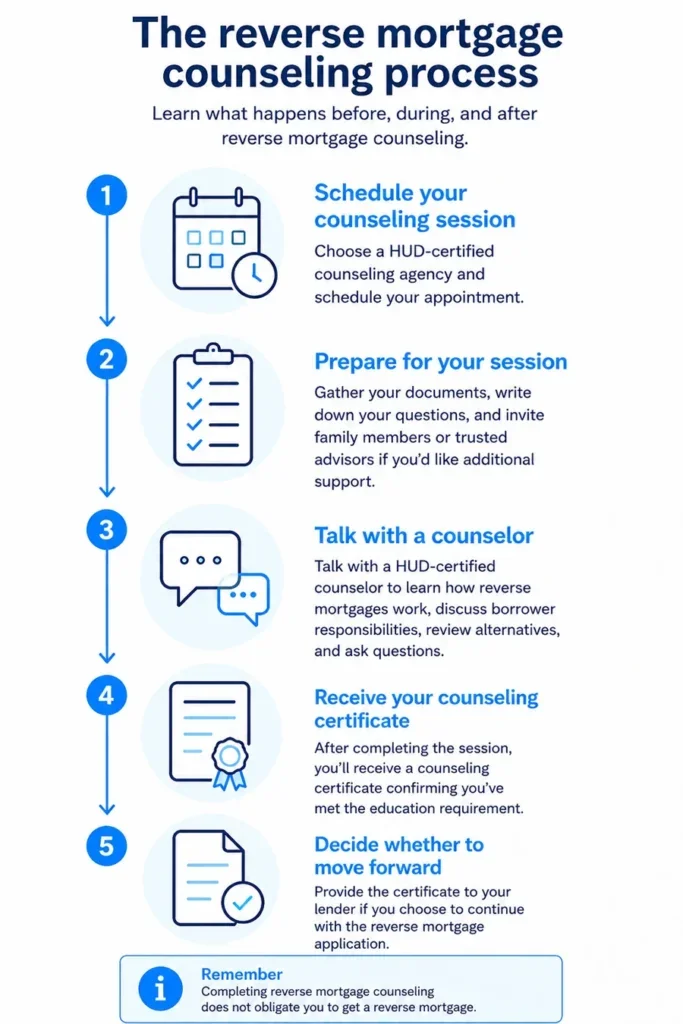
During the session, a counselor certified by the U.S. Department of Housing and Urban Development (HUD) explains how reverse mortgages work, reviews your responsibilities as a borrower, discusses alternatives, and answers your questions. This guide explains what to expect during reverse mortgage counseling, who must complete it, how to prepare, and what happens afterward.
What is reverse mortgage counseling?
Reverse mortgage counseling is designed to help you make an informed decision about whether a reverse mortgage is right for you. The counselor does not represent your lender or recommend a specific reverse mortgage product. Instead, they provide independent education about your responsibilities as a borrower, available options, costs, and other important considerations before you decide whether to move forward.
After completing counseling, you’ll receive a certificate that’s generally valid for 180 days. If you decide to continue with the application, you’ll provide the signed certificate to your lender. Completing counseling does not obligate you to move forward with a reverse mortgage.
→ Learn more: How to apply for a reverse mortgage in 5 steps
Why is reverse mortgage counseling required?
Reverse mortgage counseling helps protect homeowners before they make an important financial decision. Rather than determining whether you’re eligible for a reverse mortgage, the session explains how a reverse mortgage works, answers your questions, and walks you through the advantages, costs, responsibilities, and other important considerations so you have the information you need to make an informed decision.
Counselors also discuss common reverse mortgage scams, high-pressure sales tactics, and fraud schemes that target older homeowners, helping you recognize potential warning signs before making a decision.
You’ll have the opportunity to ask questions about your individual circumstances, discuss how a reverse mortgage could affect your retirement plans, and better understand what it could mean for your spouse, heirs, or other family members.
To learn more, please visit the CFPB’s “Reverse Mortgage: A Discussion Guide.”

How to find a HUD-certified reverse mortgage counselor
There are several ways to find a HUD-certified reverse mortgage counselor.
You can use HUD’s online housing counselor directory to locate HUD-certified agencies nationwide.
You can also call HUD’s toll-free Housing Counseling Hotline at 800-569-4287.
Your lender may also provide a list of HUD-certified agencies, but the choice is ultimately yours. You may select any HUD-certified counseling agency, regardless of where you live, and your counseling certificate is generally not tied to a specific lender. As long as your counseling certificate remains valid, you generally won’t need to repeat counseling if you change lenders.
Who needs to complete reverse mortgage counseling?
Depending on who owns the property and who is involved in the transaction, more than one person may need to complete reverse mortgage counseling before the loan process can continue.
Depending on the loan type and ownership structure, the following individuals may need to receive counseling:
- All borrowers and co-borrowers applying for the reverse mortgage.
- Eligible non-borrowing spouses, when required under the loan product or lender guidelines.
- Non-borrowing owners who will come off the title at closing.
- Anyone acting under a valid power of attorney, guardianship, or conservatorship, when permitted by the lender and applicable law.
- Individuals with certain future ownership interests in the property (such as remaindermen in a life estate arrangement) or other individuals with an ownership interest in the property.
Because ownership situations can vary, your lender and HUD-certified counseling agency can explain who must participate based on your circumstances and the type of reverse mortgage you’re considering.

What happens during a reverse mortgage counseling session?
A reverse mortgage counseling session is designed to help you understand how the loan works. Although the discussion is tailored to your financial situation and the type of reverse mortgage you’re considering, most sessions cover topics such as:
- How reverse mortgages work
- Borrower responsibilities, including paying property taxes, maintaining homeowners insurance, and keeping the home in good condition
- The financial assessment process, including the Financial Interview Tool (FIT), which counselors may use to better understand your situation
- Repayment requirements, how interest and fees accumulate, how the loan balance grows over time, and when the loan becomes due and payable
- Available payout options, such as a lump sum, monthly payments, or a line of credit, depending on the loan
- Reverse mortgage costs and fees
- Alternatives that may better meet your financial goals
- How a reverse mortgage may affect non-borrowing spouses and heirs
- Questions about your individual circumstances
How to prepare for reverse mortgage counseling
Preparing for your counseling session may help you ask better questions and make the most of your time with the counselor. Before your appointment, it’s helpful to gather or review documents such as:
- The reverse mortgage loan comparison printout provided by your lender
- The total annual loan cost (TALC) disclosure
- Your mortgage amortization schedule, if applicable
- The National Council on Aging’s “Use Your Home to Stay at Home” booklet
- Basic information about your income, monthly expenses, assets, and debts
It’s also a good idea to write down any questions you’d like to discuss during the session. For example, you may want to ask:
- How could a reverse mortgage affect my retirement income and long-term financial plans?
- Could a reverse mortgage help cover living expenses or medical costs if I’m living on a fixed income?
- Which payment option may best fit my financial goals?
- What responsibilities will I have as a borrower?
- How and when does the loan become due and payable?
- How could a reverse mortgage affect my spouse, heirs, or estate?
- Are there any tax implications?
- What alternatives should I consider before deciding on a reverse mortgage?
To help you get the most from your counseling session:
- Be honest about your questions and concerns.
- Invite a family member or financial advisor if you’d like another perspective.
- Take notes so you can review the information afterward.
- Don’t feel pressured to make a decision immediately. Counseling is intended to help you understand your options before deciding whether to move forward.
What happens after counseling?
After completing the session, you’ll receive a reverse mortgage counseling certificate confirming you’ve met the education requirement. The certificate is generally valid for 180 days and, if you decide to proceed, you’ll provide it to your lender as part of the loan application process.
Receiving a counseling certificate doesn’t mean you have to move forward with a reverse mortgage, and it doesn’t guarantee loan approval. If your certificate expires before your loan closes, you may need to complete another counseling session and obtain a new certificate.
Can I fail reverse mortgage counseling?
Reverse mortgage counseling includes a knowledge assessment to help confirm you understand how the loan works and your responsibilities as a borrower. During the session, the counselor will ask questions about topics like how reverse mortgages work, repayment requirements, borrower obligations, and how the loan could affect your financial situation.
To receive a counseling certificate, you must correctly answer at least five of the ten questions. If you don’t, the counselor won’t issue the certificate at that time. Instead, they may schedule another session, encourage you to include a trusted family member or advisor, or refer you to another HUD-certified counselor. The certificate is issued once you demonstrate an adequate understanding of the required topics.

Do reverse mortgage counseling rules vary by state?
Yes. Although HUD requires counseling for FHA-insured HECMs, some states have additional consumer safeguards that lenders must follow.
For example:
| State | Additional counseling requirement |
| California | Lenders generally may not order an appraisal, begin title work, or charge fees until at least seven days after counseling is completed. |
| Texas | Counseling generally must be completed at least five days before closing, and the counseling certificate must remain valid through closing. |
| Arizona | Counseling generally must be completed before submitting a reverse mortgage application. |
Because state requirements change over time, ask your lender or HUD-certified counseling agency whether additional requirements apply where you live.
How long does reverse mortgage counseling take?
Most reverse mortgage counseling sessions take about 60 to 90 minutes, although the exact length depends on your financial situation and the questions you ask.
You can complete counseling:
- By telephone
- By video conference
- In person
Telephone is the most common way to complete reverse mortgage counseling. In-person counseling may also be available for borrowers who prefer a face-to-face meeting or may benefit from additional assistance during the counseling process.
How much does reverse mortgage counseling cost?
Reverse mortgage counseling typically costs between $125 and $200, although fees may vary depending on the counseling agency and location.
Some HUD-certified counseling agencies offer reduced fees, fee waivers, or other assistance for borrowers who meet financial hardship criteria. If cost is a concern, ask the counseling agency about assistance when scheduling your appointment.
To preserve the independence of the counseling process, lenders generally cannot pay the counseling fee on your behalf.
Before your appointment, ask the counseling agency about:
- The cost of the session
- When payment is due and which payment methods are accepted
- Whether you may be eligible for a hardship fee waiver or reduced fee
Common misconceptions about reverse mortgage counseling
Although reverse mortgage counseling is designed to educate borrowers, misconceptions about the process are still common. For example:
- It’s a sales presentation from your lender: It isn’t. Reverse mortgage counseling is an independent educational session conducted by a HUD-certified counselor who does not represent your lender or recommend specific loan products.
- Completing counseling means you must get a reverse mortgage: It doesn’t. Counseling satisfies the education requirement, but you’re free to move forward, explore other options, or decide a reverse mortgage isn’t right for you.
- It’s a credit check or loan approval: It isn’t. Counseling doesn’t affect your credit score, guarantee loan approval, or determine whether you meet your lender’s eligibility requirements.
Next steps
Reverse mortgage counseling is an important step in understanding how the loan works and whether it’s the right fit for your financial goals. If you’re considering a reverse mortgage, Finance of America’s reverse mortgage calculator may help you estimate how much home equity could be available before speaking with a loan officer.
FAQs
Is counseling required for a HomeSafe or proprietary reverse mortgage?
Often, yes. Many proprietary reverse mortgages, including Finance of America’s HomeSafe products, require independent counseling before the loan process can continue. Counseling requirements and fees vary depending on the lender and loan product.
Does my spouse need counseling if they’re not on the loan?
Possibly. Whether a non-borrowing spouse must complete counseling depends on the loan product, lender requirements, and your individual circumstances. Your lender and HUD-certified housing counselor can explain who must participate based on your situation.
Can I choose my own counselor, or does the lender pick one?
Yes. You may choose your own HUD-certified counseling agency. Although your lender may provide a list of approved agencies, you’re not required to use one from that list.
Can family members attend the counseling session?
Yes. Many borrowers choose to invite family members, caregivers, or advisors to participate in the session. Check with your HUD-certified counseling agency when scheduling your appointment to confirm its participation policies.
Can the lender pay for my reverse mortgage counseling?
No. To preserve the independence of the counseling process, lenders generally cannot pay the counseling fee on your behalf.
What happens if my counseling certificate expires?
If your certificate expires before your lender completes the loan process, you may need to complete counseling again and receive a new certificate before continuing the process.
Does completing counseling mean I’ll be approved for a reverse mortgage?
No. Completing counseling satisfies the education requirement but does not guarantee loan approval. Your lender will still review factors such as your eligibility, property, and financial assessment before making a lending decision.
→ Read more: What are reverse mortgage eligibility requirements?
About the author

is a Senior Web Content Writer at Finance of America and a journalist with more than 20 years of experience specializing in business, and technology. Her work has been published in The Wall Street Journal, The Financial Times, and numerous other leading outlets.
Disclaimer
This article is intended for general informational and educational purposes only and should not be construed as financial or tax advice. For tax advice, please consult a tax professional. For more information about whether a reverse mortgage fits into your retirement strategy, you should consult your financial advisor.