Explore by category
What is a LESA? Reverse mortgage set-asides explained

In this article:
- What is a LESA in a reverse mortgage?
- Why would a HECM borrower need a LESA?
- How is the LESA calculated?
- Fully funded vs. partially funded LESAs
- How does a LESA affect your reverse mortgage proceeds?
- What if a LESA leaves you with little or no money to access?
- What happens if a LESA runs low or has money remaining?
- What should you ask if your lender says you need a LESA?
- FAQs
Quick answer: A life expectancy set-aside (LESA) reserves some of the money available from a reverse mortgage to help pay future property taxes and homeowners insurance. It may be required based on a financial assessment.
Key points
LESAs are used with HECMs insured by the Federal Housing Administration (FHA) to help manage certain ongoing homeownership expenses and reduce the risk of default.
Whether a LESA is required—and what type—depends on the lender’s review of your finances.
Fully and partially funded LESAs differ in how much money is reserved and whether the loan servicer or the borrower pays the covered expenses.
LESA funds are added to the loan balance only as they’re used.
The longer you own a home, the more you understand: There’s always something to pay for, fix, or maintain. Utilities, routine upkeep, unexpected repairs, property taxes, and homeowners insurance can add up—and may become harder to manage as you get older.
These financial pressures are one reason older homeowners may consider a reverse mortgage, which provides access to funds without requiring monthly principal and interest payments. But borrowers still have ongoing responsibilities.
In the past, unpaid property taxes and insurance in particular contributed to defaults among some borrowers. That led to important changes in 2015, including financial assessments for Home Equity Conversion Mortgage (HECM) applicants and life expectancy set-asides, or LESAs, for some borrowers.
A LESA reserves part of the available proceeds to help pay certain future expenses and help keep the loan in good standing.
This guide takes a closer look at when a LESA may be required, how the set-aside works, and what it means for the money available from your HECM.
The borrower must meet all loan obligations, including living in the property as the principal residence and paying property charges, including property taxes, fees, and hazard insurance. The borrower must maintain the home. If the homeowner does not meet these loan obligations, then the loan will need to be repaid.
What is a LESA in a reverse mortgage?
A life expectancy set-aside (LESA) is part of the U.S. Department of Housing and Urban Development’s (HUD) HECM financial assessment requirements. It reserves part of the borrowing capacity available through a HECM for future property taxes and insurance. This may include homeowners or hazard insurance and, when applicable, flood, wind, fire, or hurricane coverage. Other expenses, such as condominium or homeowners association fees and ground rents, remain the borrower’s responsibility.
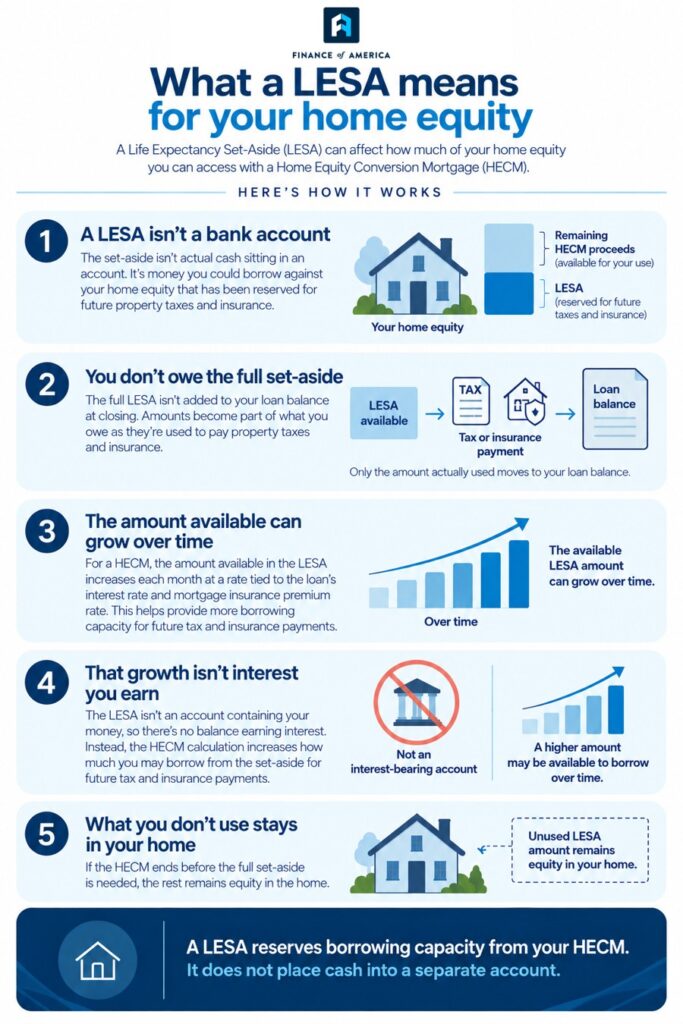
Despite the name, a LESA isn’t a separate account holding money you’ve already borrowed. Instead, it sets aside part of your HECM borrowing capacity, which is based on the equity in your home, for future tax and insurance payments.
Good to know: The borrowing capacity within the LESA increases each month based on a rate tied to the HECM’s interest rate and mortgage insurance premium rate.
Is a LESA the same as an escrow account?
A LESA may seem similar to a traditional mortgage escrow account because both help manage property taxes and insurance. But unlike an escrow account funded through monthly mortgage payments, a LESA sets aside part of the borrowing capacity available through the HECM.
Important: A LESA is not an additional fee, and the amount set aside is not considered borrowed until it is disbursed. Interest accrues only on the amount actually used.
To learn more, please visit the CFPB’s “Reverse Mortgages: A Discussion Guide.”

Why would a HECM borrower need a LESA?
During the application process, the financial assessment looks at both the borrower’s history of meeting financial obligations and whether they have enough income left after regular expenses. Those findings help determine which type of LESA the borrower may need, if any:
- A fully funded LESA may be required if the borrower has had difficulty paying bills like property taxes and insurance, unless documented extenuating circumstances contributed to the missed payments.
- A partially funded LESA may be required if the borrower doesn’t have enough income remaining after regular monthly expenses. HUD sets guidelines for how much income borrowers should have left after monthly expenses, based on household size and location.
Needing a LESA doesn’t automatically mean you’re not eligible for a HECM. But the size of the set-aside may make a big difference in how much money the HECM makes available to you.
→ Learn more: Reverse mortgage eligibility requirements
How is the LESA calculated?
There is no standard amount or percentage that goes into a LESA. The amount can vary significantly from borrower to borrower.
For a fully funded LESA, HUD considers factors such as:
- The life expectancy of the youngest borrower
- Projected property taxes and insurance costs
- Expected increases in those costs over time
- Estimated interest and mortgage insurance costs over time
A partially funded LESA is calculated differently because the amount also depends on the borrower’s income shortfall.

Fully funded vs. partially funded LESAs
The biggest difference between the two types is how property taxes and insurance are paid:
- Fully funded LESA: The loan servicer uses LESA funds to pay property taxes and insurance directly.
- Partially funded LESA: The borrower receives semiannual LESA disbursements and uses them, along with their own funds as needed.
How does a LESA affect your reverse mortgage proceeds?
A LESA reduces the amount of HECM proceeds available to the borrower because part of the money is reserved for future property taxes and insurance.
For example, suppose a borrower has $100,000 in available HECM proceeds and a $40,000 LESA is required. The $40,000 would be reserved for the LESA, leaving $60,000 available to the homeowner. This scenario is for illustration only.
Important: Interest accrues only when LESA funds are used. Until then, the money set aside is not part of the loan balance. For a HECM, the amount available in the LESA grows over time based on the applicable growth rate.

What if a LESA leaves you with little or no money to access?
A required LESA can significantly reduce the amount of money you may be able to access from a HECM. If you’re considering a reverse mortgage because you need additional funds, that may affect whether the loan still makes sense for you.
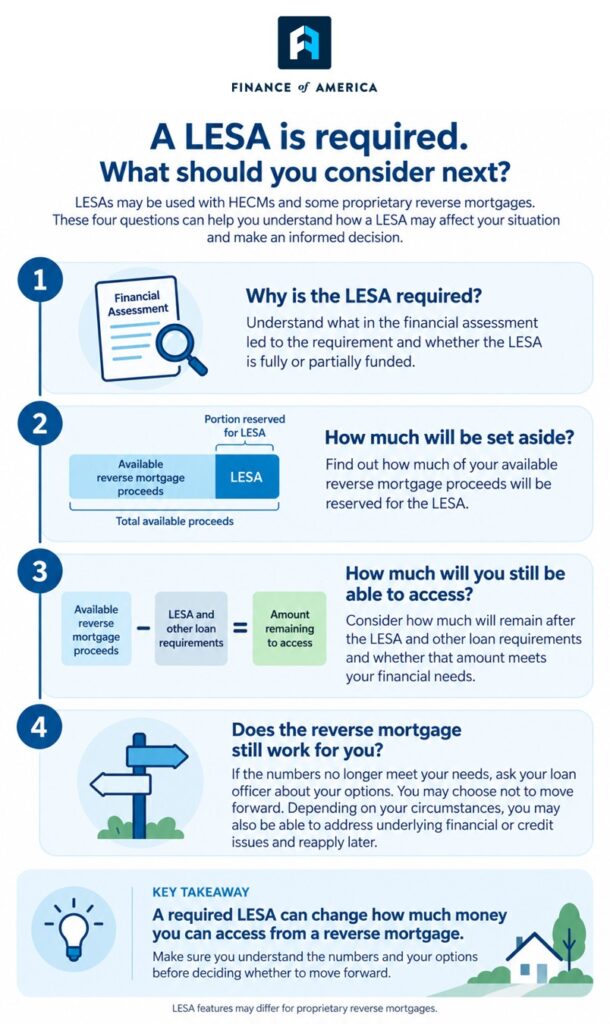
For example, suppose you have $150,000 in available HECM proceeds and a $75,000 existing mortgage that must be paid off. If a $60,000 LESA is also required:
$150,000 available HECM proceeds
– $75,000 existing mortgage
– $60,000 required LESA
= $15,000 remaining to access
In some cases, the LESA and other required obligations may exceed the available HECM proceeds altogether. The loan would then be considered short to close. That doesn’t automatically make you ineligible for the HECM, and you may have the option to bring additional funds to cover the shortage.
Before moving forward, consider whether the money you’ll be able to access after the LESA still meets the financial need that led you to consider a reverse mortgage in the first place. Your loan officer can explain how much will be set aside, how much will remain available, and what options you have if the numbers no longer work for you.
→ Compare your options: Reverse mortgage vs HELOC vs home equity loan
Finance of America does not currently offer home equity loans.
What happens if a LESA runs low or has money remaining?
Property taxes and insurance costs may increase over time, or a borrower may live longer than expected, so a LESA isn’t guaranteed to last for the life of the loan. The loan servicer, therefore, reviews the LESA each year to make sure enough remains to cover upcoming payments.
If the remaining funds are no longer adequate, the borrower becomes responsible for paying the affected expenses without relying on the LESA. Failing to keep up with required property taxes and insurance can put the HECM in default and may ultimately cause the loan to become due and payable.
What happens to unused LESA funds when the loan ends?
Unused LESA funds aren’t lost. The set-aside isn’t actual money sitting in an account. Instead, it represents borrowing capacity against your home equity that has been reserved. If the HECM ends before the full set-aside is needed, the rest remains equity in the home.
What should you ask if your lender says you need a LESA?
If you’re told you need a LESA, understanding why it’s required and how it will affect your loan may help you make a more informed decision.
Start with these questions for your loan officer:
- Why do I need a LESA?
- How much will be set aside?
- How much of my HECM proceeds will remain available to me?
- Is my LESA fully or partially funded?
- Which expenses will the LESA cover?
- Which expenses will I still need to pay myself?
- Who will be responsible for making the payments?
The answers can help you understand what the LESA means for your finances, including how much you’ll be able to access and what expenses you’ll still need to cover.
If you’re still considering a reverse mortgage, try our reverse mortgage calculator to get a general estimate of how much you may be eligible to access before any required set-asides or other loan obligations.
FAQs
Is a LESA required with every reverse mortgage?
No. Not every HECM borrower needs a LESA. Whether one is required depends on the lender’s review of the borrower’s finances. Proprietary reverse mortgages may have different set-aside requirements, depending on the lender and product.
Can you choose a LESA if one isn’t required?
Yes. A HECM borrower who is not required to have a LESA may choose a voluntary fully funded LESA. Doing so reserves part of the available loan proceeds for future property taxes and insurance, leaving less available for the borrower to access.
Can a LESA be removed after closing?
No. Once a LESA is established, it cannot be reduced, removed, or otherwise modified. Changing the LESA would require a full refinance.
→ Read more: Can you refinance a reverse mortgage?
What happens if I don’t want a LESA?
If a LESA is required based on the financial assessment, it can’t simply be waived at the borrower’s request. If you don’t want a HECM with the required LESA, you can choose not to take out the loan. Depending on your financial situation, you may be able to address the underlying credit or financial issues and reapply later.
Can you be required to get a LESA after your reverse mortgage closes?
No. A LESA cannot be added to an existing HECM after closing. Establishing one later would require a full refinance.
About the author

is a Senior Web Content Writer at Finance of America and a journalist with more than 20 years of experience specializing in business, and technology. Her work has been published in The Wall Street Journal, The Financial Times, and numerous other leading outlets.
Disclaimer
This article is intended for general informational and educational purposes only and should not be construed as financial or tax advice. For tax advice, please consult a tax professional. For more information about whether a reverse mortgage fits into your retirement strategy, you should consult your financial advisor.