Explore by category
How to apply for a reverse mortgage: A step-by-step guide

In this article:
Key points
Applying for a reverse mortgage generally follows the same overall process. However, some requirements vary depending on the type of reverse mortgage you choose.
Most applications include documentation, an appraisal, underwriting, and closing before funds are disbursed.
Preparing your documents before you apply may help streamline the application process.
Over the years, you’ve probably filled out your fair share of applications for everything from jobs and mortgages to Medicare and Social Security benefits. If you’re considering a reverse mortgage, you’ll be navigating another application, but it may be more straightforward than you expect.
Each year, thousands of homeowners apply for reverse mortgages. While every situation is different, the process generally follows the same basic steps. This guide explains what to expect before you apply so you can feel more prepared along the way.
How to apply for a reverse mortgage
Applying for a reverse mortgage involves several steps, from confirming your eligibility and completing required counseling to submitting your application, moving through the appraisal, title review, and underwriting process, and closing on the loan. Throughout the process, you’ll also work with several professionals who help guide you through each stage.
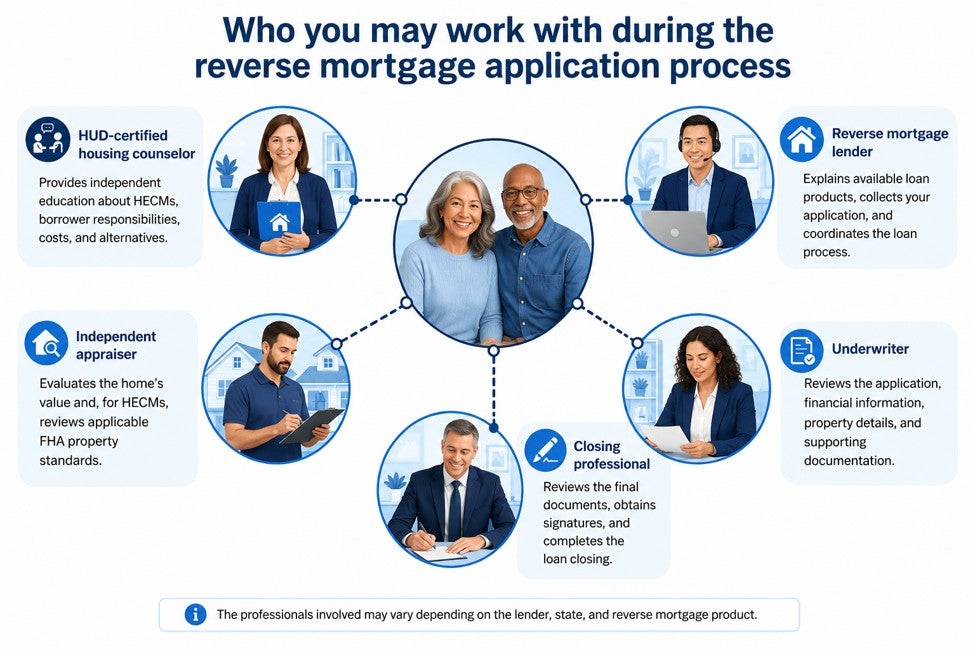
To learn more, please visit the CFPB’s “Reverse Mortgage: A Discussion Guide”
Before you apply
Before beginning the application process, take time to understand how reverse mortgages work and whether they’re a good fit for your financial goals. Compare Home Equity Conversion Mortgages (HECMs) and proprietary reverse mortgages, estimate how much you may be eligible to borrow, and discuss the decision with family members and/or financial advisors. These steps may help you make a more informed decision.
→ Read more: What is a reverse mortgage and how does it work?
Step 1. Determine your eligibility
One of the first steps is confirming that you meet the basic eligibility requirements for a reverse mortgage. At a minimum, this typically includes your age, whether the home is your primary residence, your available home equity, and certain financial considerations. Eligibility requirements vary depending on whether you’re applying for a HECM or a proprietary reverse mortgage.
Understanding the basic requirements before you begin the application process may help you identify the loan options you may be eligible for and avoid delays.
→ Take a closer look: What are reverse mortgage eligibility requirements?
Step 2. Complete reverse mortgage counseling
If you’re applying for a HECM, you’ll need to complete a session with a HUD-certified housing counselor before your lender can begin processing the loan. During counseling, you’ll learn how reverse mortgages work, the costs, financial implications, and responsibilities involved, and possible alternatives before making a final decision.
Afterward, you’ll receive a counseling certificate that’s generally valid for 180 days. Before the application can move forward, you’ll need to provide the signed certificate. This requirement helps ensure you understand your options before the loan process continues.
–> Learn more: What is reverse mortgage counseling?
Step 3. Choose a lender
Choosing the right reverse mortgage lender is an important part of the application process. Some lenders may offer an initial consultation or prequalification to discuss your goals, review your basic eligibility, and explain available loan options before you submit an application. Not every lender provides the same reverse mortgage products, loan terms, fees, or level of service.
Before making your decision, compare offers from multiple lenders and ask about interest rates, closing costs, payment options, expected timelines, and the support you’ll receive throughout the application process. You may also want to discuss how you plan to use your reverse mortgage funds—whether for supplemental cash, home renovations, or other financial goals—to help determine which payment option best fits your needs. If you have an existing mortgage, it must be paid off at closing as a requirement of a HECM.
Step 4. Submit your application
Once you’ve chosen a lender, you’ll complete a reverse mortgage application and provide documentation to verify your identity, finances, and property information. While requirements vary, lenders commonly request:
- Government-issued photo identification
- Social Security number or other taxpayer identification
- Proof of homeownership, such as a deed or property records
- Recent mortgage statements for any existing loans on the property
- Income and asset documentation
- Homeowners insurance information
If you currently have a mortgage, your lender will review your existing loan to determine how much must be paid off at closing.
Your lender will also provide initial disclosures explaining the loan terms, estimated costs, your rights as a borrower, and other required information. For HECMs, these disclosures include the total annual loan cost (TALC) disclosure, which illustrates how the projected annual cost of the loan may vary over time under different scenarios. Submitting complete and accurate documentation may help reduce requests for additional information later.
Step 5. Complete the appraisal, title review, and underwriting process
After your application is submitted, your lender coordinates several reviews before your loan can move toward closing. These typically include:
- Appraisal: For HECMs, a HUD-approved appraiser determines your home’s value and confirms that it meets FHA property standards. The appraisal is typically an out-of-pocket expense, although costs vary by market and lender.
- Title review: This step confirms property ownership and identifies any liens or other issues that may need to be resolved before closing.
- Underwriting and financial assessment: Your lender reviews your finances to evaluate your ability to continue paying property taxes, homeowners insurance, and other required property expenses. If necessary, the lender may establish a Life Expectancy Set-Aside (LESA) to help ensure those obligations continue to be paid.
During this stage, you may also be asked to provide additional documentation or clarification. If the appraisal identifies required home repairs, those issues generally must be resolved before closing. Depending on the loan and the repairs involved, eligible costs may sometimes be funded using reverse mortgage proceeds rather than paid out of pocket.
Step 6. Close on your reverse mortgage
Once underwriting is complete and any remaining conditions have been satisfied, you’ll schedule your loan closing. At this time, you’ll review your final loan disclosures and other closing documents, confirm your payment option, and complete any remaining paperwork.
For HECMs, borrowers generally have a three-business-day right of rescission after closing, allowing them to cancel the loan during that period. Proprietary reverse mortgages offered by private lenders may have different requirements, so ask your lender what applies to your loan. After any applicable rescission period has ended and all closing requirements have been met, your reverse mortgage funds are disbursed according to your selected payment option. Closing requirements vary by lender, state, and reverse mortgage product.
→ Dive deeper: How to get out of a reverse mortgage if your circumstances change
Step 7. Continue meeting your loan obligations
After closing, you’ll need to meet the ongoing requirements of your reverse mortgage. In general, this means:
- Living in the home as your primary residence
- Paying property taxes
- Maintaining homeowners insurance
- Keeping the home in good condition
Most reverse mortgages are non-recourse loans, meaning neither you nor your heirs will owe more than the home’s value when the loan becomes due and payable.1 Continuing to meet these responsibilities may help you remain in good standing throughout the life of the loan.
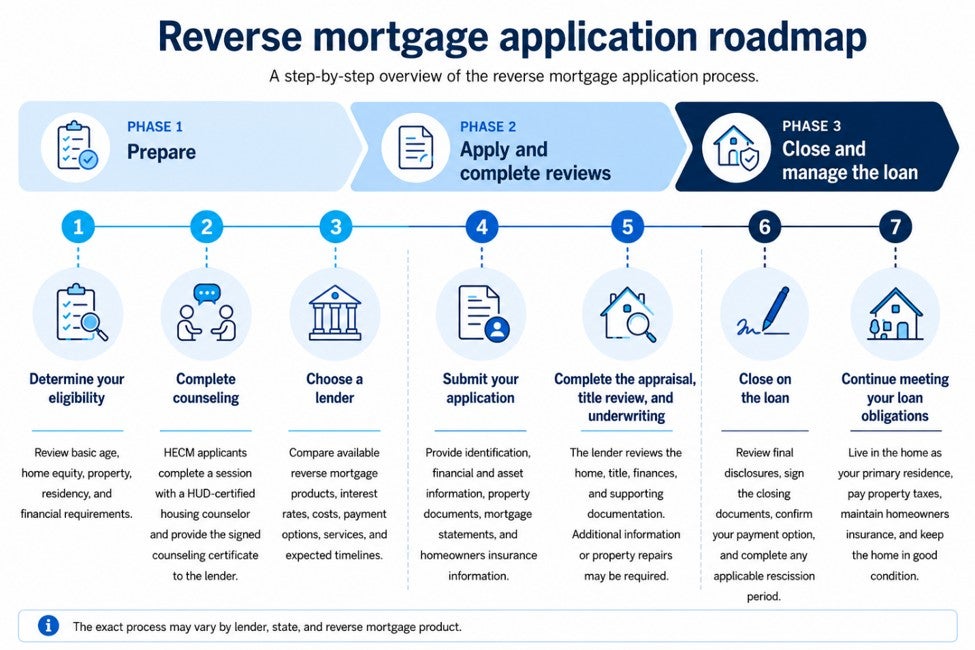
The infographic below summarizes the key steps in the reverse mortgage application process.

What are the requirements for a reverse mortgage?
Reverse mortgage eligibility requirements vary by loan type, but lenders typically evaluate several key factors before approving a loan. These commonly include:
- Age: HECMs are available to eligible homeowners age 62 and older. Some proprietary reverse mortgages may be available to borrowers as young as 55, depending on the product and state.
- Home equity: Lenders review how much equity you have in your home. Some proprietary reverse mortgages may also allow eligible homeowners to borrow above the HECM lending limit.
- Primary residence: The home generally must be your primary residence.
- Financial assessment: Lenders evaluate your ability to continue paying property taxes and homeowners insurance, and to maintain the home in good condition.
- Property and loan requirements: Depending on the loan, additional requirements may include eligible property types and federal debt status. For a HECM, any existing mortgage must be paid off at closing.
For a complete explanation, see our guide to reverse mortgage eligibility requirements.
How long does the reverse mortgage application process take?
At Finance of America, the reverse mortgage application process typically takes 30 to 45 days. However, the exact timeline depends on factors such as scheduling counseling, completing the appraisal, providing required documentation, underwriting, and any required property repairs.
→ Learn more: How long does it take to get a reverse mortgage?

What can delay the reverse mortgage application process?
Several factors may delay the reverse mortgage application process, even after you’ve submitted your application. Common examples include:
- Missing or incomplete documents: Delays often occur when lenders need additional financial or property information before underwriting can continue.
- Scheduling reverse mortgage counseling: For reverse mortgages that require counseling, delays in completing the session may affect the overall application timeline.
- Appraisal scheduling: Availability of a qualified appraiser may vary depending on your location and market conditions.
- Title issues: Existing liens, ownership questions, or other title concerns may need to be resolved before closing.
- Required repairs: For HECMs, certain repairs identified during the appraisal may need to be completed before the loan closes.
- Requests for additional information during underwriting: Your lender may ask for clarification or updated documentation before making a final decision.
Preparing your documents early, scheduling counseling promptly, and responding quickly to lender requests may help reduce delays and keep your application moving forward.
Alternatives to reverse mortgages
A reverse mortgage isn’t the right solution for every homeowner. Depending on your financial goals, age, available home equity, and existing mortgage, you may also consider:
- A home equity loan
- A home equity line of credit (HELOC)
- Refinancing your current mortgage, including a cash-out refinance
- Downsizing to a less expensive home
Finance of America does not currently offer home equity loans.
Each option has different eligibility requirements, costs, repayment obligations, and risks. A financial advisor or HUD-certified counselor may help you compare your choices and determine which option best fits your financial goals and retirement needs.
The table below provides a high-level comparison to help you identify which option may best align with your goals.
| If your goal is to… | You might consider… |
| Access home equity without selling your home | Reverse mortgage |
| Borrow a lump sum or fixed amount | Home equity loan |
| Access funds over time as needed | HELOC |
| Replace your existing mortgage | Cash-out refinance |
| Reduce housing costs | Downsizing |

Ready to apply for a reverse mortgage?
Understanding the reverse mortgage application process before you begin may help you prepare for each stage. If you’re considering a reverse mortgage, Finance of America’s reverse mortgage calculator may help you estimate how much you may be eligible to borrow before deciding whether to apply.
FAQs
Can I start the application before my counseling session, or does counseling have to come first?
You may contact a lender, discuss your options, and receive initial disclosures before your counseling session. However, for a HECM, you’ll need to provide your signed counseling certificate before your lender can order the appraisal or continue processing your application. The counseling certificate is generally valid for 180 days.
Do I have to pay for anything out of pocket during the application process, or does it all come out of the loan?
Some costs, including the counseling fee and appraisal, may need to be paid before closing. Other eligible closing costs may be financed as part of the loan. Counseling and appraisal fees are generally not refundable if the loan does not move forward. Learn more about reverse mortgage costs and fees.
What could cause my application to be turned down during underwriting?
Title or lien problems, a lower-than-expected appraisal, required property repairs, or the results of the financial assessment may affect your application. However, some borrowers are approved with conditions, such as establishing a LESA, rather than being denied outright.
If the appraisal identifies required repairs, can I still close?
It depends on the repairs. For some minor health and safety repairs, the lender may establish a repair set-aside, reserving part of the reverse mortgage proceeds to pay for work completed after closing within a required timeframe. More significant repairs generally must be completed before the loan can close.
Can I change how I receive my money after closing?
For a HECM, you may be able to request a different payment plan after closing, such as changing from monthly payments to a line of credit, subject to your available principal limit. A fee may apply. Proprietary reverse mortgages may not offer the same options, so ask your lender which options apply to your loan.
Can someone help me with the paperwork if I have trouble managing it on my own?
Yes. A trusted person, power of attorney, or HUD-certified counselor may help you understand the documents, and your lender may accommodate accessibility needs. You must still meet the loan’s eligibility requirements and sign the necessary documents. If you use a power of attorney, it must meet your lender’s requirements and, for HECMs, applicable FHA requirements.
Is the money I receive from a reverse mortgage taxable, or will it affect my Social Security?
Reverse mortgage proceeds generally are not considered taxable income and do not affect Social Security or Medicare benefits. However, funds retained beyond the month in which they are received could affect eligibility for needs-based programs such as Medicaid or Supplemental Security Income (SSI). Consider speaking with a tax professional and benefits counselor about your situation.
1Non-recourse means that you, or your estate, can’t owe more than the value of your home when the loan becomes due and the home is sold. Non-recourse means that if you default on the loan, or if the loan cannot otherwise be repaid, the lender cannot look to your other assets (or your estate’s assets) to meet the outstanding balance on your loan.
About the author

is a Senior Web Content Writer at Finance of America and a journalist with more than 20 years of experience specializing in business, and technology. Her work has been published in The Wall Street Journal, The Financial Times, and numerous other leading outlets.
Disclaimer
This article is intended for general informational and educational purposes only and should not be construed as financial or tax advice. For tax advice, please consult a tax professional. For more information about whether a reverse mortgage fits into your retirement strategy, you should consult your financial advisor.