Explore by category
Reverse mortgage age requirements: What homeowners should know

In this article:
- What is the minimum reverse mortgage age?
- Can you get a reverse mortgage at age 55?
- Why do reverse mortgages have age requirements?
- How does reverse mortgage age affect loan amounts?
- What is the best age to get a reverse mortgage?
- Age requirements for couples
- Is there a maximum age for a reverse mortgage?
- What if you don't meet the minimum age requirement?
- Next steps: See how much home equity you could access
- Frequently asked questions
Quick answer: Federally insured Home Equity Conversion Mortgages (HECMs) require borrowers to be at least 62 years old. Some proprietary reverse mortgages may be available to eligible homeowners beginning at age 55, although minimum age requirements vary by loan product and state.
Key Points
Age is one of the factors used to determine how much home equity you may be eligible to access. In general, older borrowers may be able to access a larger percentage of their home’s value.
For couples, the age of the youngest borrower—or an eligible non-borrowing spouse—may affect the amount available through a reverse mortgage.
There isn’t one best age to get a reverse mortgage. The right timing depends on your retirement goals, financial needs, and the type of reverse mortgage you’re considering.
Throughout life, certain birthdays mark important milestones. At 16, you may get a driver’s license. At 18, you become a legal adult. At 21, you can legally purchase alcohol. Later in life, new milestones emerge—from becoming eligible for Social Security retirement benefits at 62 to Medicare at 65.
Reverse mortgages have important age milestones, too. But age does more than determine when you may become eligible—it also affects how much home equity you may be eligible to access and when a reverse mortgage may make the most sense for your financial goals.
This guide explains the minimum age requirements for different types of reverse mortgages, why age affects borrowing power, what couples should know, and how to decide when the timing is right for you.
What is the minimum reverse mortgage age?
Not all reverse mortgages follow the same age requirements. The most common type of reverse mortgage is the federally insured Home Equity Conversion Mortgage (HECM), which generally requires borrowers to be at least 62 years old. Some private loans offered by individual lenders, also known as proprietary reverse mortgages, may be available beginning at age 55, depending on the product and state.
The next section explains how eligibility differs at ages 55, 60, and 62, including important state-specific exceptions for certain proprietary products.
To learn more, please visit the CFPB’s “Reverse Mortgage: A Discussion Guide.”

Can you get a reverse mortgage at age 55?
Yes—but it depends on the type of reverse mortgage and, in some cases, where you live.
Finance of America’s HomeSafe reverse mortgage may be available beginning at age 55 in most states, although minimum age requirements vary by state. Federally insured HECMs generally require borrowers to be at least 62 years old.
The following table provides a quick comparison of the reverse mortgage options that may be available at different ages.
| Age | What may be available |
| 55 | HomeSafe proprietary reverse mortgage in some states (for eligible homeowners) |
| 60 | HomeSafe proprietary reverse mortgage in Massachusetts, New York, and Washington |
| 62 | HomeSafe in North Carolina and Texas; federally insured HECMs and proprietary reverse mortgages |
Actual eligibility depends on the loan product and whether you meet all applicable underwriting requirements.
Why do reverse mortgages have age requirements?
Congress established the HECM program in 1987 to help eligible homeowners age 62 and older access a portion of their home equity while continuing to live in their homes. The program was designed to address a financial challenge that remains relevant today: many homeowners nearing retirement are house-rich but cash-poor, with much of their wealth tied up in their homes. For those homeowners, a reverse mortgage may provide access to a portion of that equity to supplement retirement income, support aging in place, or meet other financial needs later in life.
But age is only one part of the process. Homeowners must also meet other eligibility requirements, including those related to home equity, property eligibility, financial assessment, and reverse mortgage counseling.
→ Find out more: What are reverse mortgage eligibility requirements?
The right to remain in the home is contingent on paying property taxes and homeowner’s insurance, maintaining the home, and complying with the loan terms.

How does reverse mortgage age affect loan amounts?
Age plays an important role in determining how much home equity you may access through a reverse mortgage. The maximum amount you may be eligible to borrow is called the principal limit. It is calculated using several factors, including:
- The age of the youngest borrower (or eligible non-borrowing spouse)
- Your home’s appraised value
- Current interest rates
- The type of reverse mortgage
- Applicable lending limits
Why older borrowers are generally eligible for larger loan amounts
In general, principal limits increase with age because the loan is expected to remain outstanding for a shorter period. As a result, older borrowers may be eligible to access a larger percentage of their home’s value.
Keep in mind the principal limit is not necessarily the amount you will receive. Existing mortgage balances, closing costs, and other obligations may reduce the amount of loan proceeds available.
The table below illustrates how principal limits generally increase with age.
| Youngest borrower age | Illustrative principal limit (percentage of home’s value)* |
| 62 | ~35% |
| 65 | ~37% |
| 70 | ~41% |
| 75 | ~46% |
| 80 | ~52% |
| 85 | ~58% |
*Illustrative only. Principal limits vary based on the youngest borrower’s age, current interest rates, the home’s value, loan type, and other program requirements.
Should you wait to get a reverse mortgage?
The right timing depends on your financial goals, retirement plans, and current needs—not just your age.
As you get older, you may become eligible for larger principal limits, allowing you to access more of your available home equity. Depending on market conditions, rising home values may also increase the amount of equity available over time.
Waiting also involves tradeoffs. Interest rates and home values change over time, making it difficult to predict how much you may ultimately be eligible to borrow. Delaying could also mean postponing access to funds that may help meet your current financial needs.
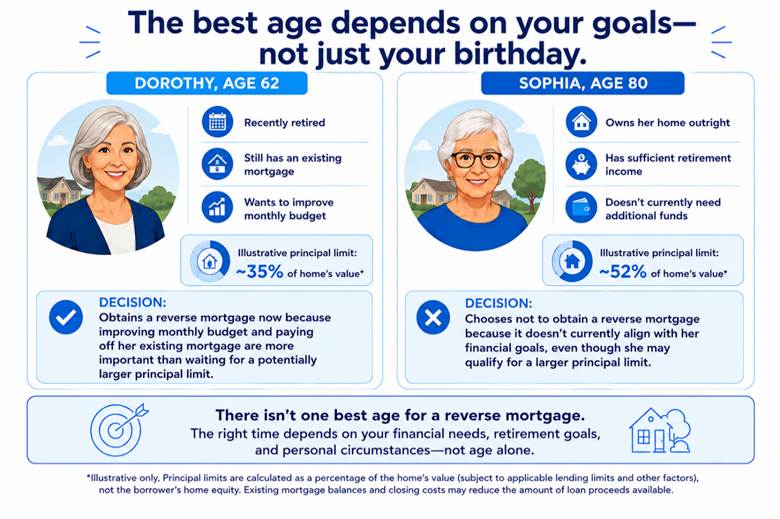
For example, Dorothy is 62 and has just retired. Based on the chart above, she may be eligible for a principal limit of about 35% of her home’s value. If she waited a few more years, she might be eligible to access a larger percentage of her home’s value. However, Dorothy wants to pay off her existing mortgage now, which would end her required monthly mortgage payment and improve her monthly cash budget. For her, accessing less home equity today may better support her immediate financial needs than waiting for a potentially larger loan later.
Sophia is 80 and owns her home outright. Based on the same illustrative example, she may be eligible for a principal limit of about 52% of her home’s value, assuming all other factors remain the same. She has sufficient retirement income today and doesn’t anticipate needing additional funds in the near future. Even though she may be eligible to access more home equity than Dorothy, she decides not to obtain a reverse mortgage because it doesn’t currently fit her financial goals.
What is the best age to get a reverse mortgage?
There isn’t one best age to get a reverse mortgage. The right timing depends on your financial goals, retirement plans, current income needs, and the type of reverse mortgage you may be eligible for.
If you’re under 62
If you’re not yet 62, a federally insured HECM is generally not available. However, some proprietary reverse mortgages may be available beginning at age 55, depending on the product and state.
If accessing home equity before age 62 aligns with your financial goals, a proprietary reverse mortgage may be worth exploring. Otherwise, waiting until you become eligible for a HECM may provide additional options.
When you become eligible for a HECM
At 62, many homeowners become eligible to apply for a federally insured HECM, although meeting the age requirement doesn’t mean you should obtain one immediately.
Some homeowners use a reverse mortgage to supplement retirement income, pay off an existing mortgage, or fund home modifications. Others may decide to wait if they don’t currently need additional funds.
If you’re well into retirement
Many homeowners choose to obtain a reverse mortgage later in retirement. Because principal limits generally increase with age, older borrowers may be eligible to access a larger percentage of their home’s value. They may use those funds to help cover healthcare expenses, accessibility modifications, or support aging in place.
→ Dive deeper: How to age in place: A planning guide for homeowners
The right to remain in the home is contingent on paying property taxes and homeowners insurance, maintaining the home, and complying with the loan terms.
Questions to help you decide
Rather than focusing on a specific age, consider questions such as:
- Do you need to supplement your retirement income, or are you planning ahead?
- How long do you expect to remain in your home?
- Would waiting increase your available loan amount enough to outweigh the advantages of accessing your home equity sooner?
- Are you hoping to preserve home equity for your heirs, or use it to support your retirement goals?
- Have you explored other funding options that may better fit your circumstances?
- Have you discussed the decision with your family or financial advisor?

Age requirements for couples
If two borrowers apply for a reverse mortgage together, the loan amount is generally calculated using the age of the youngest borrower. If one spouse is younger than 62 and doesn’t meet the minimum age requirement for a HECM, they may be designated as an eligible non-borrowing spouse. That spouse’s age may also affect how much may be available through the reverse mortgage.
Why the youngest borrower’s age matters
When there are two borrowers—or an eligible non-borrowing spouse—the calculation is based on the age of the youngest person. A reverse mortgage remains in place until the last eligible borrower or eligible non-borrowing spouse no longer occupies the home. Because a younger person is expected to remain in the home longer, the loan may remain outstanding for a longer period. As a result, a younger borrower or eligible non-borrowing spouse typically means a lower principal limit than an older borrower, assuming all other factors remain the same.
What if only one spouse is eligible?
If one spouse meets the minimum age requirement but the other does not, the younger spouse may be designated as an eligible non-borrowing spouse for a HECM. In 2014, the U.S. Department of Housing and Urban Development (HUD) established safeguards that, in many cases, allow eligible non-borrowing surviving spouses to remain in the home after the borrowing spouse dies or permanently leaves the property, provided they continue meeting the loan’s obligations. To be eligible for these protections, the spouse generally must have been identified as an eligible non-borrowing spouse in the original loan documents and meet all applicable program requirements.
For proprietary reverse mortgages, minimum age requirements and borrower eligibility vary by lender and product.
→ Read more: A non-borrowing spouse’s guide to reverse mortgage
Is there a maximum age for a reverse mortgage?
No. There is generally no maximum age for obtaining a reverse mortgage. As long as you meet the applicable eligibility requirements—which also include home equity, property, and financial criteria—you may remain eligible regardless of your age.
In fact, many homeowners obtain reverse mortgages well into retirement. Although age affects borrowing power, it isn’t the only factor lenders consider. Your home’s value, current interest rates, existing mortgage balance, financial assessment, and the type of reverse mortgage also affect the amount available.
What if you don’t meet the minimum age requirement?
If you don’t meet the minimum age requirement today, you may decide to wait until you become eligible or explore another financing option that better fits your current needs. Depending on your circumstances, that could include a proprietary reverse mortgage (where available), a home equity line of credit (HELOC), a home equity loan, or a cash-out refinance.
→ Learn more: Reverse mortgage vs HELOC vs home equity loan: Comparing your home equity options
Finance of America does not currently offer home equity loans.
Next steps: See how much home equity you could access
Ready to see what your options might look like? Finance of America’s reverse mortgage calculator may help you estimate how much home equity could be available based on your age, home value, and other factors.
Frequently asked questions
Does waiting increase my loan amount?
It may. In general, older borrowers may be eligible for larger principal limits because reverse mortgages are expected to remain outstanding for a shorter period. However, interest rates, home values, and other factors also affect loan amounts, so waiting does not guarantee access to more home equity.
Do both spouses have to be on a reverse mortgage?
No. Depending on the circumstances, one spouse may be the borrower while the other is designated as an eligible non-borrowing spouse for a HECM. Whether both spouses should be listed on the loan depends on factors such as age, ownership, and the type of reverse mortgage being considered.
Do I need to be 62 when I apply, or when the loan closes?
For a HECM, the youngest borrower generally must reach the minimum age by closing, not by the application date. If you turn 62 during the application process, talk with your loan specialist about timing because eligibility is generally determined at closing.
If I obtain a reverse mortgage at 62, will more home equity become available as I get older?
Not automatically. Your principal limit is determined at closing based on factors such as your age and current interest rates, and it doesn’t increase simply because you get older. However, if you have an adjustable-rate HECM line of credit, the unused portion of your available funds may grow over time, increasing your borrowing power.
Does my age affect my reverse mortgage interest rate?
No. Your age affects your principal limit, not your interest rate. Interest rates depend on the reverse mortgage product you choose, whether the rate is fixed or adjustable, and market conditions at closing.
Is there a minimum age for an eligible non-borrowing spouse?
No. For a HECM, an eligible non-borrowing spouse doesn’t need to meet the minimum age requirement. However, their age is still used to calculate the principal limit, so a younger eligible non-borrowing spouse generally results in a smaller amount available.
Can I add a younger spouse to my reverse mortgage after closing?
Generally, no. To be eligible for HUD’s surviving-spouse protections, a non-borrowing spouse generally must be identified in the original loan documents. If a spouse isn’t identified at closing, they typically can’t be added later for purposes of those protections. If you’re married, tell your loan specialist before closing—even if your spouse won’t be a borrower.
Do I need to be 62 to buy a home with a reverse mortgage?
For a HECM for purchase, the same minimum age requirement applies. Because your principal limit helps determine how much of the purchase price the loan may cover, older buyers may be eligible to finance a larger share of the home’s purchase price and bring less of their own funds to closing.
About the author

is a Senior Web Content Writer at Finance of America and a journalist with more than 20 years of experience specializing in business, and technology. Her work has been published in The Wall Street Journal, The Financial Times, and numerous other leading outlets.
Disclaimer
This article is intended for general informational and educational purposes only and should not be construed as financial or tax advice. For tax advice, please consult a tax professional. For more information about whether a reverse mortgage fits into your retirement strategy, you should consult your financial advisor.