Explore by category
How much equity is needed for a reverse mortgage?

In this article:
- What percentage of equity is needed to be eligible?
- What percentage of equity is needed for a HECM?
- What impacts how much equity you need for a reverse mortgage loan?
- What to do if you don’t have enough equity to be eligible for a reverse mortgage
- The bottom line: How much equity is needed for a reverse mortgage
Key points
Most reverse mortgage borrowers need about 50% equity—but that’s not a hard and fast rule.
Eligibility and borrowing power also depend on age, interest rates, and your home’s appraised value.
If you’re short on equity, you may still have options, including paying down your mortgage, waiting for appreciation, making improvements, refinancing, downsizing, or exploring alternative loan products.
If you’ve owned your home for years, you’ve likely built-up significant home equity—and that equity is key to how much you may be eligible to borrow in a reverse mortgage. The exact equity needed for a reverse mortgage depends on your age, home value, and current interest rates.
Unlike a traditional home equity loan, a reverse mortgage generally does not require monthly mortgage payments. Instead, repayment is typically deferred until you sell the home, move out permanently, or pass away. During that time, you’ll need to continue meeting the loan terms, including paying property taxes, maintaining homeowners insurance, and keeping the home in good condition. Because repayment is deferred and the loan balance grows over time, lenders require borrowers to have substantial home equity.
Below, we’ll explain how much equity is typically needed for a reverse mortgage and the factors that affect how much you may be able to borrow.
→ Learn more in our guide: What is a reverse mortgage and how does it work?

What percentage of equity is needed to be eligible?
Most homeowners need at least 50% equity to be eligible for a reverse mortgage. While there is no set minimum, lenders generally expect borrowers to have built substantial home equity prior to approval.
Here’s what that means in plain English:
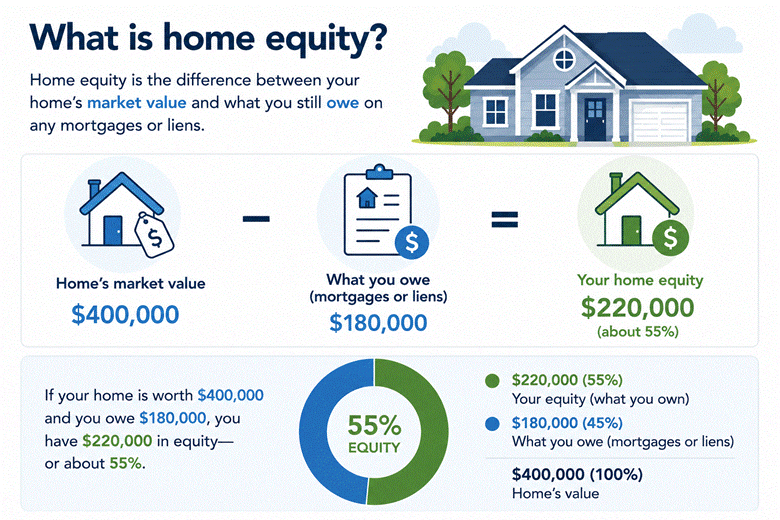
Home equity is the difference between your home’s market value and what you still owe on any mortgages or liens. For example, if your home is worth $400,000 and you owe $180,000, you have $220,000 in home equity—or about 55%.
It’s important to note that a reverse mortgage does not allow you to borrow the full amount of your home equity. Instead, you can only access a portion of it. There are two primary reasons for this:
- Financial reasons: The loan balance is expected to increase over time, so lenders can’t advance all of the home’s equity upfront or the balance would exceed the home’s value.
- Regulatory reasons: Home Equity Conversion Mortgages (HECMs) are insured by the Federal Housing Administration (FHA), and the U.S. Department of Housing and Urban Development (HUD)’s lending formulas intentionally limit how much can be borrowed.
Loan amounts are also based on the age of the youngest borrower or eligible non-borrowing spouse, current interest rates, your home’s appraised value, and applicable lending limits. In general, more home equity may allow you to borrow more.
→ Try our reverse mortgage calculator to estimate how much you may be eligible to borrow.
What percentage of equity is needed for a HECM?
A HECM is the most common type of reverse mortgage. While there is no minimum home equity requirement, most borrowers need at least 50% equity to qualify for a reverse mortgage. HUD, which oversees FHA-insured HECMs, determines eligibility based on several factors, including the amount of home equity you have.
To be eligible for a HECM, at a minimum, you must also:
- Be at least 62 years old.
- Live in the home as your primary residence.
- Own the home outright or have a low enough mortgage balance that it can be paid off with reverse mortgage proceeds.
- Demonstrate the ability to continue paying property taxes, maintaining homeowners insurance, and keeping the home in good condition.
- Complete a session with a HUD-certified counselor.
One important limitation is the FHA lending cap. In 2026, HECM proceeds are calculated using a maximum home value of $1,249,125. If a home is worth more, the loan is still capped, which may limit how much home equity you can access.
Proprietary reverse mortgages, including jumbo reverse mortgages, are private loans not insured by the FHA. While they also require significant home equity, they are not subject to the FHA lending limit, which may make them a better fit for older homeowners with higher-value properties.
However, underwriting standards, loan structures, and consumer protections may differ with these loans because they are set by individual reverse mortgage lenders rather than federal guidelines.
| Feature | HECM | Proprietary |
| FHA insured? | Yes | No |
| Lending cap | $1,249,125 (in 2026) | Varies |
| Minimum age | 62 | May be 55+, depending on product and location* |
| Consumer protections | Standardized | Varies |
* 62 is the minimum age for a HECM. Certain proprietary products have minimum ages as low as 55. 55 in most states, 60 in Massachusetts, New York, and Washington, 62 in North Carolina and Texas.
→ Learn more: What is a HECM?

What impacts how much equity you need for a reverse mortgage loan?
One of the main factors in determining eligibility for a reverse mortgage is having significant home equity, which is generally at least half of the home’s appraised value. However, additional factors influence borrowing power.
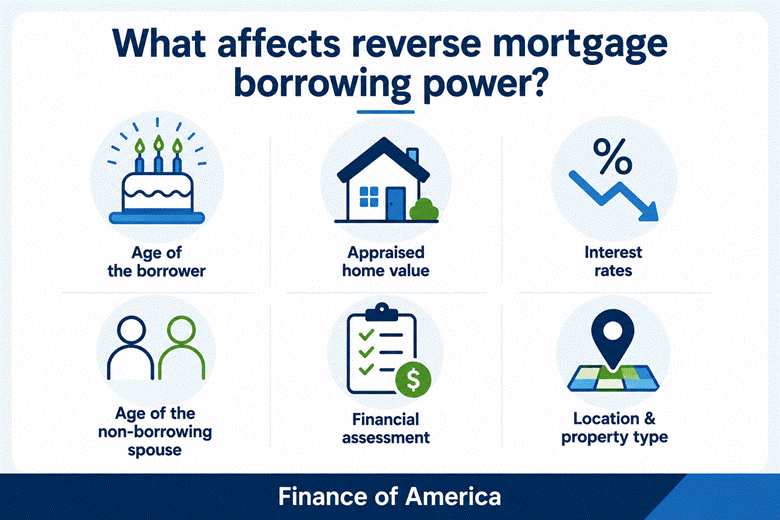
Key considerations include:
- Age of the borrower: Older borrowers are typically eligible for higher loan amounts because the loan is expected to remain outstanding for a shorter period.
- Age of the non-borrowing spouse: A younger non-borrowing spouse could impact how much of your home equity you can access, as they may have rights to stay in the home after the death of the borrower.
- Interest rates: Lower interest rates generally increase the amount you may borrow, while higher rates reduce available proceeds.
- Appraised home value: A higher home value can increase available funds, while a lower appraisal may limit borrowing power.
- Location and property type: The home must meet FHA or lender eligibility standards, which vary by property type and condition.
- Financial assessment: Lenders review income, credit history, and the ability to continue paying property taxes, maintaining homeowners insurance, and keeping the home in good condition.
While home equity is the foundation of eligibility, these factors ultimately determine how much you may be able to access.
What to do if you don’t have enough equity to be eligible for a reverse mortgage
If you recently purchased your home or still carry a large remaining mortgage balance, you may not have the 50% equity lenders require. Or, you may be close to eligibility, but still fall a bit short.
If this is the case, there are several steps you can consider to strengthen your home equity position. Let’s take a closer look at each, one by one.
Wait until your home equity increases
Equity can grow over time. As you continue making monthly mortgage payments and as property values potentially rise, your ownership stake in the home may increase. While real estate markets fluctuate, waiting for appreciation could help some senior homeowners meet home equity requirements without taking additional action.
Pay down debt faster
Reducing your existing mortgage balance is one of the most direct ways to build home equity. Making extra principal payments—or applying a lump sum if available—can help you reach eligibility sooner. Even modest additional payments can make a difference over time.
Make strategic home upgrades
Certain improvements may increase your home’s appraised value, which can strengthen your home equity position. Home repairs that improve structural integrity, functionality, or overall condition may have the greatest impact. However, not all renovations increase value, so it’s important to weigh the cost against the potential return.
Downsize or refinance
Selling your current home and purchasing a less expensive property may free up home equity and reduce ongoing housing costs. Refinancing into a new traditional mortgage could also lower monthly mortgage payments or improve cash flow, helping you pay down your loan balance more efficiently. In some cases, eligible borrowers may also consider using a HECM for purchase to buy a new primary residence and finance part of the transaction with a reverse mortgage.
Consider a HELOC or home equity loan
If you’re not yet eligible for a reverse mortgage, but need access to funds, a home equity loan or home equity line of credit (HELOC) may be an option. These products allow you to borrow against your existing equity. However, they require monthly payments and are based on income and credit qualifications.
→ Learn more about reverse mortgage alternatives: HomeSafe Second vs a home equity line of credit (HELOC).
Finance of America does not currently offer home equity loans.
Explore other reverse mortgage options
In some cases, a proprietary reverse mortgage—a private loan not insured by the FHA—may have different lending limits or underwriting standards. These loan differences can be significant for homeowners with higher-value properties. However, loan structures and protections vary by lender.
Building enough home equity takes time, and the right approach depends on your financial goals and housing plans. If you’re close to eligibility, even incremental changes—such as paying down debt or waiting for appreciation—may make a meaningful difference.
| Strategy | Increases home equity? | Access cash quickly? | Requires additional payments? |
| Wait for appreciation | Yes | No | No (no new loan payments) |
| Pay down mortgage | Yes | No | Yes (additional principal payments) |
| Home improvements | Possibly | No | No (unless financed) |
| HELOC | No | Yes | Yes (monthly payments required after draw period ends) |
| Proprietary reverse mortgage | No (uses existing home equity) | Yes | No (no required monthly mortgage payments; property-related obligations continue)* |
*The borrower must meet all loan obligations, including living in the property as the principal residence and paying property charges, including property taxes, fees, and hazard insurance. The borrower must maintain the home. If the homeowner does not meet these loan obligations, then the loan will need to be repaid.

The bottom line: How much equity is needed for a reverse mortgage
Reverse mortgage lenders typically require substantial home equity—often around 50%. But equity is only part of the equation. Your age, interest rates, home value, property eligibility, and financial assessment also influence how much you may be able to borrow.
If you meet the home equity threshold, a reverse mortgage may provide access to home value without required monthly mortgage payments. If you don’t, options such as paying down your loan, waiting for appreciation, making improvements, refinancing, downsizing, or exploring other alternatives, such as a HELOC, which may help you strengthen your position.
Because every situation is different, it’s important to understand both your current home equity and your borrowing potential. See how much home equity you may be able to access with our reverse mortgage calculator. Or talk with a specialist who can help you explore your options at your own pace.
The borrower must meet all loan obligations, including living in the property as the principal residence and paying property charges, including property taxes, fees, and hazard insurance. The borrower must maintain the home. If the homeowner does not meet these loan obligations, then the loan will need to be repaid.
Frequently Asked Questions
My mortgage balance is bigger than what the reverse mortgage would pay out. Can I bring my own money to closing to cover the difference?
Yes, a borrower may bring funds to closing from savings, the sale of another asset, or a gift to pay off the remaining balance, which is a common path for homeowners who fall just short. Note that the funds cannot come from another loan against the same property and must be documented and sourced for the lender.
I already have a HELOC on my house. Does that count against my equity?
Yes, home equity is measured against every lien on the property, not just the first mortgage, so a HELOC balance reduces it. For a HECM, the HELOC must be paid off before closing. Note that an undrawn line of credit (meaning a HELOC that is open, but with no balance) still counts as an open lien that must be resolved.
What if the appraisal comes back lower than what I think my house is worth?
If the appraisal is lower than you expect, you can request a second appraisal or ask for reconsideration by providing documentation of comparable home sales in your area. In some cases, HUD may require a second appraisal.
I have solar panels on a lease. Does that affect my equity or my eligibility?
In some cases, yes. A leased solar system or a Property Assessed Clean Energy (PACE)-type loan can attach to the property as a lien or a Uniform Commercial Code (UCC) filing that must sit behind the reverse mortgage or be cleared before closing. Provide the loan or assessment paperwork to the lender early in the process, as resolution may take time and could slow down the application process.
My spouse is younger than I am. Does that mean I need more equity?
A younger spouse doesn’t change the home equity threshold, but it may impact how much you’re able to borrow. For a HECM, the proceeds calculation uses the age of the youngest borrower or youngest non-borrowing spouse, so a younger spouse can reduce how much you’re able to borrow.
What happens if my home value decreases after I get a reverse mortgage?
If you have an FHA-insured HECM, the loan is non-recourse, which means you and your heirs will not owe more than the home’s value when it is sold, provided the loan terms are met.
Non-recourse means that you, or your estate, can’t owe more than the value of your home when the loan becomes due and the home is sold. Non-recourse means that if you default on the loan, or if the loan cannot otherwise be repaid, the lender cannot look to your other assets (or your estate’s assets) to meet the outstanding balance on your loan.
To learn more, please visit the CFPB’s “Reverse Mortgage: A Discussion Guide.”
About the author

is a Senior Web Content Writer at Finance of America and a journalist with more than 20 years of experience specializing in business, and technology. Her work has been published in The Wall Street Journal, The Financial Times, and numerous other leading outlets.
Disclaimer
This article is intended for general informational and educational purposes only and should not be construed as financial or tax advice. For tax advice, please consult a tax professional. For more information about whether a reverse mortgage fits into your retirement strategy, you should consult your financial advisor.