Explore by category
How does a reverse mortgage work when you die?

In this article:
- What happens to a reverse mortgage when you die?
- Do all reverse mortgages follow the same rules after death?
- What should your family do after a borrower dies?
- How can heirs resolve a reverse mortgage?
- What happens if someone is still living in the home?
- How long do heirs have to settle a reverse mortgage?
- Who pays the taxes and insurance while the estate settles the loan?
- How can borrowers make things easier for their families?
- What to remember
- FAQs
Key points
A reverse mortgage generally becomes due and payable when the last borrower dies, although certain loans provide protections for eligible non-borrowing spouses.
The lender does not automatically take ownership of the home.
Heirs generally have several options for settling the loan.
Timelines vary by loan type, so staying in contact with the loan servicer may help families understand their options and meet applicable deadlines.
Losing a loved one is difficult enough without having to navigate the financial responsibilities that follow. As heirs begin settling a family member’s affairs, it’s common to have questions about what will happen to their home. If that family member had a reverse mortgage, you may be concerned that the process will be even more complicated—or that the home will have to be turned over to the lender immediately.
Fortunately, that isn’t how reverse mortgages work. While every situation is different, there is an established process for resolving a reverse mortgage loan after a borrower’s death. The loan servicer may be an important resource for answering questions and explaining next steps. This guide is another resource that may help you understand what to expect and the options that may be available.
What happens to a reverse mortgage when you die?
When the last surviving borrower on a reverse mortgage dies, the loan generally becomes due and payable. Certain Home Equity Conversion Mortgages (HECMs), however, provide protections for eligible non-borrowing spouses who meet the applicable requirements.
In general, ownership remains with the borrower’s estate unless it has already been transferred through another legal arrangement. A reverse mortgage servicer will typically contact the estate or the borrower’s heirs to explain the next steps, answer questions, and discuss available options for resolving the loan, which include:
- Selling the home and using the proceeds to repay the reverse mortgage.
- Keeping the home by repaying or refinancing the loan.
- Declining to keep the property.
Another important safeguard is that reverse mortgages are generally non-recourse loans.1 This means neither the borrower’s estate nor the heirs are personally responsible for paying more than the value of the home at the time the loan is repaid, provided the borrower met the ongoing loan obligations, including paying property taxes, maintaining homeowners insurance, and keeping the home in good condition.
If the home sells for more than the amount owed, the remaining equity belongs to the estate—not the lender. After the reverse mortgage and any applicable selling costs are paid, any money left over becomes part of the estate.
→ Take a closer look: How do you repay a reverse mortgage?

Do all reverse mortgages follow the same rules after death?
No. While the overall process is often similar, specific timelines, safeguards, and repayment requirements depend on the type of reverse mortgage. Here’s how they differ.
Home Equity Conversion Mortgages (HECMs)
Most reverse mortgages are HECMs, which are insured by the Federal Housing Administration (FHA) and regulated by the U.S. Department of Housing and Urban Development (HUD). As part of a federal program, HECMs follow certain rules for what happens after the last surviving borrower dies, including the non-recourse protections1 mentioned above, along with HUD-established timelines.
Proprietary reverse mortgages
Proprietary reverse mortgages are private loans offered by individual lenders, such as Finance of America’s HomeSafe. Unlike HECMs, they are not subject to HUD program requirements. Instead, the specific timelines and requirements depend on the lender and the loan agreement.
The chart below summarizes some of the key differences between HECMs and proprietary reverse mortgages after a borrower’s death.
| HECM | Proprietary reverse mortgage | |
| Who offers this loan? | Approved lenders participating in the FHA-insured HECM program | Private lenders, such as Finance of America’s HomeSafe |
| What happens after the borrower dies? | Next steps follow HUD requirements | Next steps follow the lender’s loan terms |
| Non-recourse protections?1 | Yes | Many proprietary reverse mortgages include similar provisions |
| How are timelines determined? | HUD establishes the timeline and may allow extensions in certain circumstances | Timelines depend on the lender and the loan agreement |
| Where should families look for guidance? | The loan servicer and HUD requirements | The loan servicer and the loan agreement |
To learn more, please visit the CFPB’s “Reverse Mortgages: A Discussion Guide.”
What should your family do after a borrower dies?
While every situation is different, knowing what to expect may help families navigate the process more smoothly. After the borrower dies, the reverse mortgage loan is typically resolved in the following stages:
The sections below explain each step in more detail.
Gather important documents
Before contacting the reverse mortgage servicer, collect key documents related to the reverse mortgage, the property, and the estate. These may include:
- The reverse mortgage agreement and related loan documents.
- A copy of the borrower’s death certificate.
- Estate-planning documents, such as a will, trust, or other documents related to administering the estate.
- Property records, homeowners insurance information, and recent property tax records.
- Current mortgage statements or lien information, if applicable.
Notify the loan servicer
Inform the reverse mortgage loan servicer of the borrower’s death. The loan servicer will explain the next steps, discuss available options, and identify any additional documentation needed to resolve the loan.
If you’re not sure who services the reverse mortgage, look for a recent mortgage statement, monthly account statement, or other loan correspondence. These documents typically include the loan servicer’s name and contact information.
For Finance of America reverse mortgages, contact our Support team at 800-816-8179 or visit our Contact Us page.
Review the due-and-payable notice
After learning of the borrower’s death, the loan servicer generally sends a due-and-payable notice within 30 days. For HECMs, the estate or heirs should respond to this notice within the next 30 days. The notice outlines the available options, next steps, and applicable timelines for resolving the loan.
The deadlines for proprietary reverse mortgages, including HomeSafe, may differ. Review the loan documents or contact the loan servicer to confirm the deadlines and requirements that apply to the specific loan.
Decide how to resolve the loan
Before making a decision, heirs may wish to consider factors such as the home’s value, the remaining loan balance, their financial situation, and whether they want to keep the property. The available options—including selling the home, repaying or refinancing the loan, or choosing not to retain the property—are discussed in more detail in the next section. Once the estate or heirs complete the chosen option, the reverse mortgage is settled.

How can heirs resolve a reverse mortgage?
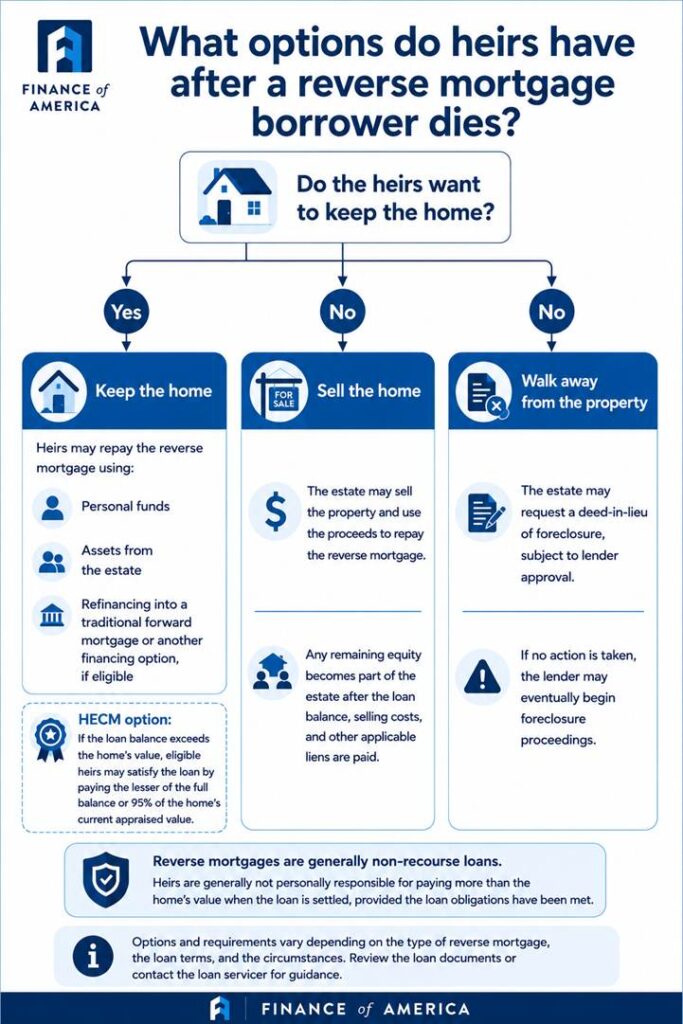
Heirs generally have several options, including:
Sell the home
Many families choose to sell the property and use the sale proceeds to repay the reverse mortgage.
Keep in mind that if the home sells for more than the outstanding loan balance, any remaining equity belongs to the estate after the reverse mortgage, selling expenses, and any other liens on the property have been paid.
Keep the home
Heirs who want to retain the property have the option to pay off the reverse mortgage loan to maintain ownership. Depending on their circumstances, they may choose to do so by:
- Using personal funds.
- Using assets from the estate.
- Refinancing the reverse mortgage into a traditional (forward) mortgage or another financing option, if they are eligible.
For HECMs, eligible heirs who want to keep the home may satisfy the reverse mortgage debt by paying the lesser of:
- The full loan balance.
- 95% of the home’s current appraised value.
This safeguard is part of the HECM program and reflects the loan’s non-recourse protections.1
Decline to keep the property
If they decide not to retain the home, the estate may request to transfer the property to the lender through a deed-in-lieu of foreclosure, subject to the lender’s approval. If no action is taken to satisfy the loan, the lender may eventually begin the foreclosure process.
→ Read more: Are heirs responsible for reverse mortgage debt?
What happens if someone is still living in the home?
A borrower’s death does not always mean the home becomes vacant. Whether the reverse mortgage becomes due and payable depends on who is still living in the home and the type of reverse mortgage.
If the person is:
- A surviving borrower: The loan generally does not become due and payable, provided the surviving borrower continues to meet the ongoing loan obligations, including paying property taxes, maintaining homeowners insurance, and keeping the home in good condition.
- An eligible non-borrowing spouse: Certain HECMs allow an eligible non-borrowing spouse to remain in the home without the loan becoming immediately due and payable, provided the applicable HUD requirements are met. The available safeguards may vary depending on when the loan originated. However, once the borrower dies, no additional funds are available through the reverse mortgage. For example, any remaining line of credit is no longer available, and any monthly loan advances stop.
- An heir or other occupant: If the remaining occupant is not a borrower or an eligible non-borrowing spouse, the reverse mortgage generally becomes due and payable. If the heirs want to keep the home, they may repay or refinance the loan.
→ Learn more: A non-borrowing spouse guide to reverse mortgage

How long do heirs have to settle a reverse mortgage?
HUD has established timelines for HECMs that generally apply after the loan becomes due and payable.
The loan servicer typically provides a due-and-payable notice within 30 days after learning of the borrower’s death. After receiving the notice, the estate or heirs generally should respond within 30 days to let the loan servicer know how they intend to resolve the loan.
Heirs usually have several months to complete the sale of the home or obtain financing before foreclosure proceedings may begin, subject to applicable HUD timelines and any approved extensions.
If additional time is needed, HUD may allow up to two 90-day extensions. These are not automatic and generally require a written request with documentation showing the heirs are actively working to resolve the loan, such as:
- A listing agreement showing the home is being marketed for sale.
- A loan application or other documentation showing refinancing is underway.
Timelines may differ for proprietary reverse mortgages. Review the loan documents or contact the reverse mortgage servicer to confirm the deadlines and requirements that apply to the specific loan.
Stay in regular contact with the loan servicer throughout the process. This may help avoid misunderstandings and ensure requests for additional time are submitted before applicable deadlines.
Important: Interest and applicable fees generally continue to accrue until the reverse mortgage is repaid. Resolving the loan promptly may help reduce the total amount owed.
Having originated many HECMs myself over the years, one message I always emphasized was the importance of preparing borrowers and their families for what happens when the loan becomes due and payable. Stay in close contact with your loan servicer, let them know your intentions, understand your options, and pay close attention to required timelines. Clear and consistent communication with your servicer can make all the difference in navigating the process.
— Susan Pomfret, Director of Consumer Education, Finance of America
Who pays the taxes and insurance while the estate settles the loan?
During the settlement period, it’s important to continue paying property taxes, maintaining homeowners insurance, and meeting any other ongoing loan obligations. Contact the loan servicer to confirm who is responsible for these requirements while the loan is being resolved.
Important: If property taxes become delinquent or homeowners insurance lapses, the loan servicer may begin foreclosure proceedings because the loan terms have not been met, regardless of where the estate is in the settlement process.
For that reason, the executor, personal representative, or heirs should contact the loan servicer as soon as possible after the borrower’s death to determine who will handle these responsibilities while the loan is being resolved.
How can borrowers make things easier for their families?
Helping your family understand your reverse mortgage now may make things easier later. Here are a few simple ways to get started.
Tell your family about your reverse mortgage
Let your family know you have a reverse mortgage before they need to make decisions about it. You may also wish to discuss your hopes for the home, including whether you prefer they keep it, sell it, or consider their options when the time comes.
Keep important documents together
Organize your reverse mortgage documents, estate-planning papers, homeowners insurance information, and other important property records so your executor or family members may easily find them.
Along with these documents, it may also be helpful to keep your loan servicer’s contact information and a record of who is listed on the loan as a borrower or eligible non-borrowing spouse.
Review your estate plan
Consider reviewing your will, trust, or other estate-planning documents to help ensure they continue to reflect your wishes and account for your reverse mortgage.
What to remember
When the last borrower dies, a reverse mortgage becomes due and payable, but that does not mean the lender automatically takes the home. Heirs generally have options for resolving the loan, and understanding what to expect may help them navigate the process.
If you’re considering a reverse mortgage or want to better understand how it may fit into your retirement plans, try out our reverse mortgage calculator or visit our reverse mortgage education center for additional resources.
FAQs
What happens if the reverse mortgage balance is more than the home’s value?
For HECMs, neither the borrower’s estate nor the heirs are generally required to repay more than the home’s value when the loan is settled. This safeguard is part of the HECM program’s non-recourse protections.¹
For proprietary reverse mortgages, including HomeSafe, any applicable non-recourse provisions are outlined in the loan agreement. Review the loan documents or contact the loan servicer to understand how they apply to your loan.
Do heirs keep the money left over if the home sells for more than the loan balance?
If the home sells for more than the amount owed on the reverse mortgage, any remaining proceeds belong to the estate after the loan balance and any applicable selling costs are paid. They are then distributed according to the estate plan or applicable law.
What happens if the estate is still in probate?
Probate does not stop the reverse mortgage from becoming due and payable. If the estate is in probate, the executor or personal representative should notify the loan servicer as soon as possible and stay in contact throughout the process. Depending on the type of reverse mortgage and the circumstances, additional time may be available to settle the loan.
What happens if the borrower dies without a will?
If a borrower dies without a will, state law determines who inherits the estate, including the home. Regardless of who ultimately inherits the property, the reverse mortgage still becomes due and payable, and the estate or heirs will need to work with the loan servicer to resolve the loan.
Does a reverse mortgage decide who inherits the home?
No. A reverse mortgage does not determine who inherits the home. Ownership is determined by the borrower’s estate plan or by applicable state law. After the borrower’s death, the estate or heirs are responsible for resolving the reverse mortgage according to the loan terms.
Can a reverse mortgage be paid off before the borrower dies?
Yes. A reverse mortgage may be repaid at any time without requiring the borrower to sell the property. Learn more in our guide to repaying a reverse mortgage.
1Non-recourse means that you, or your estate, can’t owe more than the value of your home when the loan becomes due and the home is sold. Non-recourse means that if you default on the loan, or if the loan cannot otherwise be repaid, the lender cannot look to your other assets (or your estate’s assets) to meet the outstanding balance on your loan.
About the author

is a Senior Web Content Writer at Finance of America and a journalist with more than 20 years of experience specializing in business, and technology. Her work has been published in The Wall Street Journal, The Financial Times, and numerous other leading outlets.
Disclaimer
This article is intended for general informational and educational purposes only and should not be construed as financial or tax advice. For tax advice, please consult a tax professional. For more information about whether a reverse mortgage fits into your retirement strategy, you should consult your financial advisor.