Explore by category
What is home equity, and how does it work?

In this article:
Quick answer: Home equity is the difference between your home’s current market value and the amount you owe on the property. Your equity may increase or decrease over time as you pay down your mortgage, your home’s value changes, or you borrow against your equity.
Key points
Home equity isn’t cash you have available to spend, and the amount you have doesn’t necessarily determine how much you may be eligible to borrow.
Homeowners may access their home equity by selling their home or borrowing against it through several financing options.
Borrowing against home equity comes with costs and repayment obligations, and the home generally serves as collateral for the loan.
Suppose you purchased your home for $300,000, and its current market value is $400,000. Meanwhile, you’ve been making mortgage payments and gradually reducing what you owe. Both changes could mean you have more home equity than you did when you first bought the property.
But what is home equity, exactly, and what does it mean for you? Whether you’re thinking about selling, refinancing, or borrowing against your home, understanding how much equity you’ve built may give you a clearer picture of your options.
What is home equity?
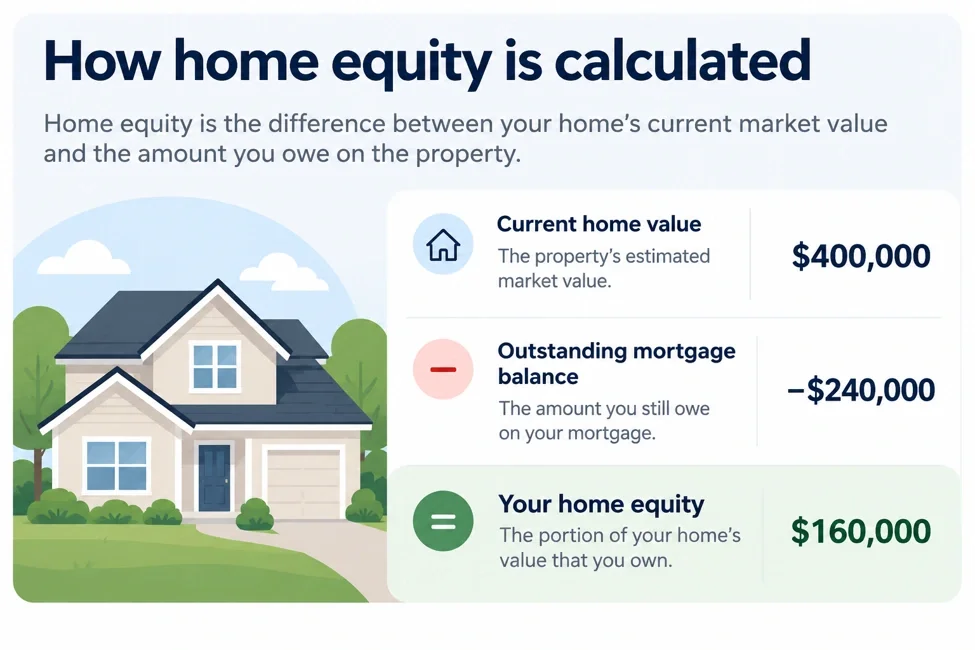
Home equity represents your financial stake in your home. To calculate home equity, subtract the total amount of debt secured by the property from its current market value. That includes your primary mortgage and any other loans secured by the property, such as a home equity loan.
Current market value − Total debt secured by the home = Home equity
For example, suppose your home is currently worth $400,000, and your remaining mortgage balance is $240,000.
In this example, you have $160,000 in home equity. That’s based on what your home is worth today, not necessarily what you originally paid for it.
Important: Having $160,000 in equity doesn’t necessarily mean you could borrow the full amount. How much you may be eligible to access depends on the type of loan and its requirements.

How does home equity work?
Home equity isn’t a fixed amount. It changes as your home’s market value and the amount of debt secured by the property change. Paying down your mortgage may increase your equity, while declining property values or additional borrowing may reduce it.
You can express your equity as a percentage of your home’s value with the following equation:
(Home equity ÷ Home value) × 100 = Home equity percentage
Using our earlier example:
($160,000 ÷ $400,000) × 100 = 40%
That means the homeowner has 40% equity in the property.
Lenders may also look at your loan-to-value (LTV) ratio, which compares your mortgage balance to your home’s value.
(Mortgage balance ÷ Home value) × 100 = LTV ratio
Using our earlier example:
($240,000 ÷ $400,000) × 100 = 60%
That means the homeowner has a 60% LTV ratio.
How do you build equity in your home?
Building home equity may happen gradually over time or through decisions you make as a homeowner. Some factors are within your control, while others are influenced by market conditions and other circumstances.
Here are some ways to establish and grow equity in your home.
Make a down payment
When you buy a home, your down payment generally establishes your initial equity. For example, if you purchase a $300,000 home with a $60,000 down payment, you’d start with approximately $60,000 in equity, assuming the home’s market value matches the purchase price and no other loans are secured by the property.
Pay down your mortgage
With a typical mortgage, a portion of each monthly payment goes toward principal—the amount you still owe on the loan—rather than interest. As you pay down the principal, your equity generally increases, assuming your home’s value stays the same.
Making extra mortgage payments toward your principal may help you pay down your loan balance and build equity faster, depending on your loan terms.
Building equity may also affect your mortgage insurance requirements. For many conventional loans, homeowners may request to cancel private mortgage insurance (PMI) once they have 20% equity based on the home’s original value, provided they meet the applicable requirements.
Make improvements that increase your home’s value
Certain home improvements, such as updating a kitchen or finishing a basement, may increase your property’s market value and, in turn, your equity.
However, spending money on improvements doesn’t necessarily mean your home’s value will increase by the same amount. For example, if you spend $50,000 on a renovation that increases your home’s market value by $30,000, your equity would increase by $30,000, assuming your mortgage balance and other debt secured by the property stay the same.
Routine maintenance, such as repairing a roof or servicing major systems, may help preserve your home’s value without necessarily increasing it.
Build equity as home values rise
Your home may appreciate in value over time due to changes in the local housing market, neighborhood conditions, and broader real estate trends. When that happens, your equity increases without you having to pay down additional mortgage principal.

Can home equity decrease?
Yes. Just as rising property values may increase your home equity, declining values may reduce it, even if you’re making regular mortgage payments.
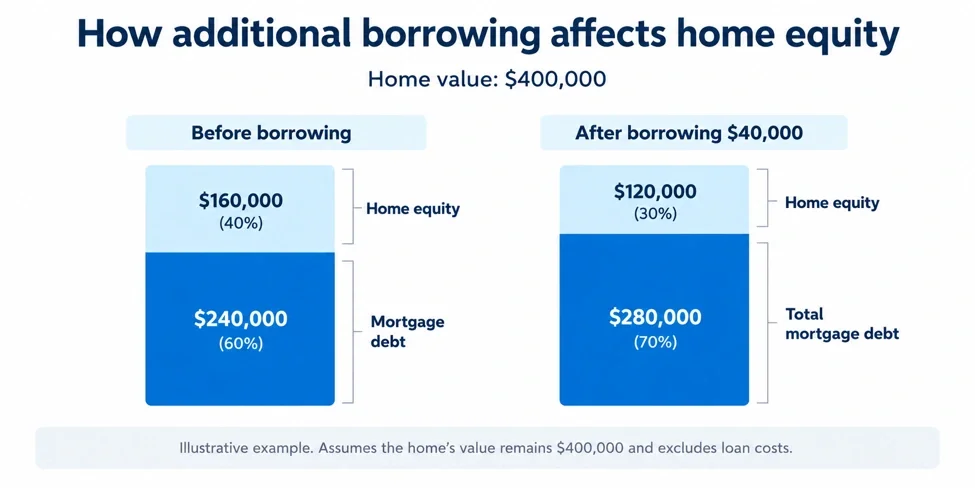
Your equity may also decrease if you take on additional debt secured by your home. For example, let’s say your home is worth $400,000, and you owe $240,000 on your mortgage. That means you have $160,000 in home equity. If you borrow another $40,000 through a home equity loan, your total mortgage debt increases to $280,000, reducing your equity to $120,000, assuming your home’s value stays the same.
Finance of America does not currently offer home equity loans or HELOCs.
How can you access home equity?
Homeowners might consider accessing their equity to fund renovations, cover unexpected expenses, or supplement retirement income. Others may choose to leave their equity untouched, particularly if they don’t have an immediate need for the funds.
For those who do want to access their equity, options include selling their home or borrowing against it. How much you may be eligible to borrow depends on factors such as your home’s value, existing mortgage debt, financial circumstances, and the financing option you choose—not simply how much equity you have.
The following table provides a general overview of common ways to access home equity.
| Option | How it works | Payment requirements and interest rates |
| Sell your home | Receive any remaining funds from the sale after paying off mortgages, other liens, and applicable selling costs. | No new loan or interest payments. |
| Home equity loan* | Borrow a lump sum through a separate loan secured by your home, often called a second mortgage when you have an existing mortgage. | Generally requires monthly principal and interest payments, typically with a fixed interest rate. |
| Home equity line of credit (HELOC)* | Access funds as needed during a set draw period, typically without replacing your existing mortgage. | Generally requires monthly payments, typically with a variable interest rate. |
| Cash-out refinance | Replace your existing mortgage with a larger loan and receive the difference in cash, after applicable costs. | Requires monthly mortgage payments. Fixed and variable rates may be available. |
| Reverse mortgage | Eligible homeowners borrow against their equity without selling their home. Funds may be available as a lump sum, line of credit, or periodic payments, depending on the loan. | No required monthly principal and interest payments, but borrowers must meet ongoing loan obligations, including living in the home as their principal residence, paying required property charges, and maintaining the home.** Fixed or variable rates may be available, depending on the loan and payment option. |
Remember, borrowing against your home generally increases the debt secured by the property, reducing your remaining equity if its value stays the same. Interest and fees may also affect your loan balance or borrowing costs, depending on the financing option. This could influence how much money you receive if you eventually sell your home or how much equity remains for your heirs.
→ Compare your options: HELOC vs. reverse mortgage
*Finance of America does not currently offer home equity loans or HELOCs.
**The borrower must meet all loan obligations, including living in the property as the principal residence and paying property charges, including property taxes, fees, and hazard insurance. The borrower must maintain the home. If the homeowner does not meet these loan obligations, then the loan will need to be repaid.

What should you consider before accessing home equity?
Just because you have home equity doesn’t necessarily mean accessing it is the right move. Whether you decide to use it—and how you choose to do so—should depend in part on the costs, payment requirements, and how much equity you want to preserve.
Here are some questions to ask yourself:
- Do I need to access my home equity? Think about what you would use the funds for and whether you have a reason to access your equity now or would prefer to leave it untouched.
- How much money do I need, and when? Consider whether you need a lump sum for a specific expense or access to funds over time.
- What are the costs? Look at upfront fees, ongoing charges, interest rates, and whether those rates are fixed or variable.
- What payments will I need to make? Compare any required monthly payments, repayment terms, and how those obligations may affect your budget.
- How might accessing equity affect my future plans? Consider how much equity you may have left, how long you expect to remain in your home, and what would happen if you decided to sell.
- Could my decision affect my heirs? Depending on the financing option, borrowing against your home may reduce the equity available to your estate.
Understand what your home equity could mean for you
Knowing how much equity you have in your home—and what causes it to change—may be useful even if you have no plans to borrow against it. That knowledge gives you a clearer picture of where you stand as a homeowner, whether you’re planning to stay put, considering a move, or simply keeping track of your home’s value.
For older homeowners who want to access equity while continuing to live in their homes, a reverse mortgage may be worth exploring. How much you may be eligible to borrow depends on several factors beyond your available equity, including your age, home value, existing mortgage balance, interest rates, and loan requirements.
If you’re considering a reverse mortgage, Finance of America’s reverse mortgage calculator may help you estimate how much home equity you could access.
To learn more, please visit the CFPB’s “Reverse Mortgages: A Discussion Guide.”
The right to remain in the home is contingent on paying property taxes and homeowner’s insurance, maintaining the home, and complying with the loan terms.

FAQs about home equity
Do I have home equity if I still have a mortgage?
You may. You don’t have to pay off your mortgage to have home equity, but the amount you owe must be less than your home’s current market value. For example, if your home is worth $300,000 and you still owe $250,000 on your mortgage, you have $50,000 in equity, assuming there are no other loans secured by the property.
Is home equity the same as the amount I’ve paid toward my mortgage?
No. With a typical mortgage, part of each monthly payment goes toward principal and part toward interest. Only the principal portion reduces what you owe. Your equity also depends on your home’s current market value and any other debt secured by the property.
How long does it take to build equity in a home?
There’s no set timeline for building home equity. How quickly it grows depends on your down payment, how much mortgage principal you pay off, and changes in your home’s market value.
Do you need an appraisal to know how much home equity you have?
Not necessarily. You can estimate your home equity using recent comparable home sales, online home-value estimates, or information from a real estate professional. However, a lender may require a formal appraisal when you apply for financing, and the appraised value may differ from your estimate.
What is negative equity?
Negative equity occurs when the amount you owe on loans secured by your home exceeds its current market value. This is sometimes called being underwater on your mortgage. For example, if your home is worth $250,000 but you owe $275,000, you have $25,000 in negative equity.
This situation may make it more difficult to refinance your mortgage, borrow against your property, or sell your home without bringing money to closing.
What happens to my home equity when I sell my home?
When you sell your home, the sale proceeds generally go toward paying off your mortgage, other liens, and applicable selling costs. Any remaining funds generally go to you as the seller. For example, if you sell your home for $400,000 and owe $240,000 on your mortgage, you’d have $160,000 remaining before selling costs and other applicable deductions.
How much home equity can you borrow?
The amount you may be able to borrow depends on the type of financing, your home’s value, existing mortgage debt, and other eligibility requirements. Lenders may also consider factors such as your credit history, income, and ability to repay, depending on the loan. Having equity doesn’t guarantee you can borrow against it.
How does home equity affect refinancing?
Your home equity may affect your ability to refinance your mortgage, whether you’re looking to change your interest rate or loan terms or access equity through a cash-out refinance. Lenders typically consider your LTV ratio, along with factors such as your credit history, income, and the type of refinance you’re seeking.
Can you lose your home if you borrow against your equity?
Yes. Borrowing against your home may put the property at risk of foreclosure if you don’t meet the loan requirements. Depending on the type of loan, these may include making required monthly payments, paying property taxes and insurance, and maintaining the home. The circumstances that may lead to foreclosure vary by loan type.
Does home equity count toward your net worth?
Yes. Home equity is generally included in your net worth, which is the difference between what you own and what you owe. However, because your home is also where you live, its equity isn’t necessarily money you have available to spend. If you’re planning for retirement, it may be helpful to distinguish between your total net worth and the assets you could use to cover expenses.
Do you pay taxes on home equity?
Simply having home equity generally doesn’t create a tax obligation. Borrowing against your home typically isn’t considered taxable income because the funds must be repaid. However, selling your home may have tax implications, depending on your circumstances. Consult a tax professional for guidance.
Generally, reverse mortgage proceeds, like other loan advances, are not income and therefore are not taxable. Not tax advice. Consult a tax professional.
About the author

is a Senior Web Content Writer at Finance of America and a journalist with more than 20 years of experience specializing in business, and technology. Her work has been published in The Wall Street Journal, The Financial Times, and numerous other leading outlets.
Disclaimer
This article is intended for general informational and educational purposes only and should not be construed as financial or tax advice. For tax advice, please consult a tax professional. For more information about whether a reverse mortgage fits into your retirement strategy, you should consult your financial advisor.