Explore by category
Reverse mortgage examples: How they work in different situations

In this article:
- Reverse mortgage example #1: Choosing a HECM to help manage an existing mortgage
- Reverse mortgage example #2: Accessing equity while keeping an existing mortgage
- Reverse mortgage example #3: Choosing a jumbo reverse mortgage for a higher-value home
- Reverse mortgage example #4: Choosing a line of credit for future needs
- Real-life reverse mortgage examples from Finance of America customers
- Finding the reverse mortgage option that fits your situation
- FAQs about reverse mortgage examples
Key points
Homeowners use reverse mortgages in different ways depending on what they want to accomplish.
HECMs and proprietary reverse mortgages have different eligibility requirements, features, limits, and safeguards.
Jumbo reverse mortgages are a subset of proprietary reverse mortgages.
The examples in this article are illustrative, not estimates of what individual reverse mortgage borrowers may be able to access. Actual proceeds depend on factors such as age, home value, interest rates, mortgage balance, loan type, and product requirements.
Understanding how a reverse mortgage works is one thing. Picturing how one might fit into your retirement plans is another.
A reverse mortgage loan allows eligible homeowners to access a portion of their home equity without selling their home or making required monthly mortgage payments. But homeowners may consider reverse mortgages for very different reasons. One might want to pay off a mortgage and reduce monthly expenses, while another may want funds available for future needs, such as home repairs, healthcare expenses, or travel.
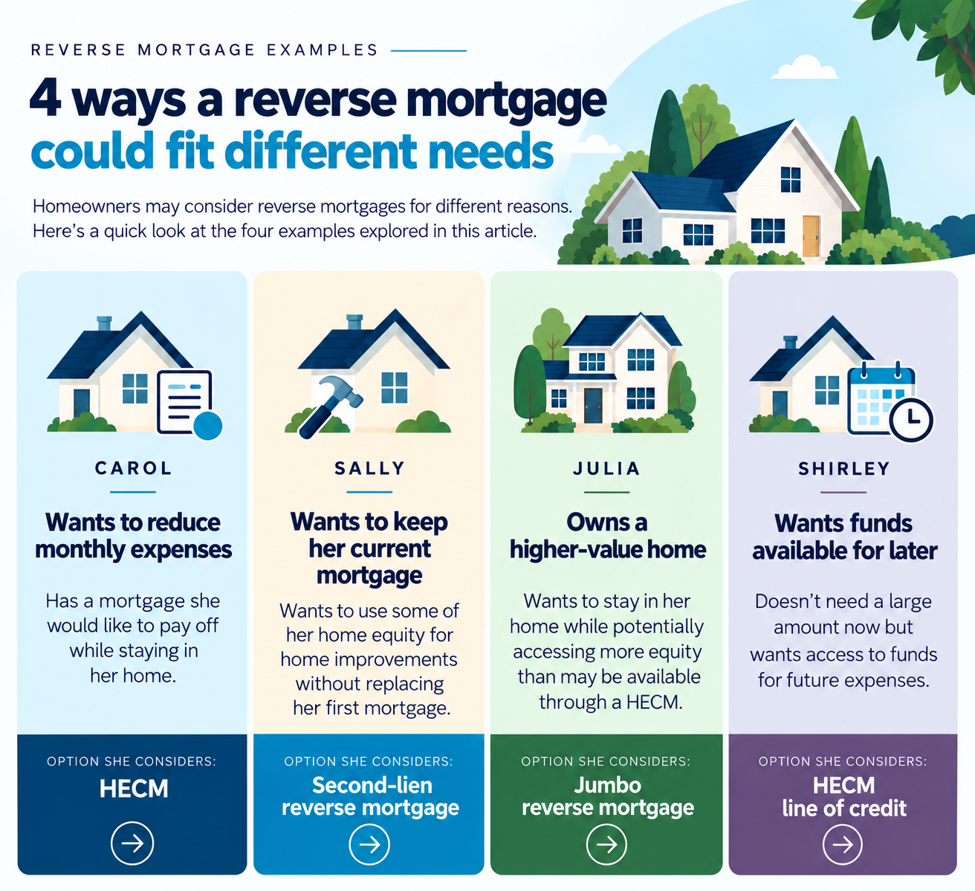
The hypothetical examples below show what some of those possibilities could look like. We’ll also look at the experiences of real Finance of America customers.
To learn more, please visit the CFPB’s “Reverse Mortgages: A Discussion Guide.”
Reverse mortgage example #1: Choosing a HECM to help manage an existing mortgage
Imagine Carol, a retired homeowner who still has a traditional mortgage. She wants to remain in her home, but her monthly mortgage payment takes up more of her retirement budget than she would like.
Carol has thought about keeping her mortgage as is or selling her home and downsizing, but neither option is ideal. She would rather find a way to reduce her monthly expenses without giving up her home. That leads her to look into a Home Equity Conversion Mortgage (HECM).
A HECM reverse mortgage is insured by the Federal Housing Administration (FHA) and available to homeowners age 62 and older. If the borrower has a current mortgage, it will generally need to be paid off at closing. HECM proceeds can be used to pay off the mortgage, either on their own or together with other funds.
Here’s what that could look like for Carol. Say she is 76 and has the following:
- Home value: $850,000
- Existing mortgage balance: $100,000
- Potential HECM principal limit: $349,350*
*Based on a HECM calculation prepared by a Finance of America loan officer using rates as of September 2026.
The HECM proceeds would pay off Carol’s $100,000 mortgage at closing, so she would no longer have that required monthly principal and interest payment.
If Carol took out the HECM, her loan balance would increase as she accessed the proceeds. Interest and applicable charges would also accrue over time, further increasing her outstanding loan balance and reducing her remaining home equity. She would need to continue meeting the loan requirements, including living in the home as her principal residence, paying property taxes and homeowners insurance, and maintaining the property.
Why a HECM fits here: It could allow Carol to stay in her home while paying off her mortgage and reducing her monthly expenses.
→ Learn more: What is a HECM loan, and how does it work?
The borrower must meet all loan obligations, including living in the property as the principal residence and paying property charges, including property taxes, fees, and hazard insurance. The borrower must maintain the home. If the homeowner does not meet these loan obligations, then the loan will need to be repaid.

Reverse mortgage example #2: Accessing equity while keeping an existing mortgage
Sally has substantial home equity and is happy with her interest rate and monthly mortgage payment. She would like to use some of her equity for home improvements that could help her remain in her home longer.
Sally has considered refinancing or taking out a home equity loan or a home equity line of credit (HELOC). But because keeping her existing mortgage is important, she also looks into a proprietary second-lien reverse mortgage.
Proprietary reverse mortgages come from private lenders and may offer features that aren’t available with HECMs. For example, a proprietary second-lien reverse mortgage like HomeSafe Second may allow a homeowner to keep their first mortgage in place rather than paying it off at closing.
Now, imagine Sally is 77 and has the following:
- Home value: Approximately $2 million
- Potential HomeSafe Second loan amount: Up to $500,000*
- Loan costs and other required expenses: $8,782.65
- Approximate remaining proceeds: $491,217
*Based on a HomeSafe Second calculation prepared by a Finance of America loan officer using rates as of September 2026.
Sally could receive the remaining proceeds while keeping her first mortgage and its terms.
If Sally took out a HomeSafe Second loan, she wouldn’t be required to make monthly principal and interest payments on the reverse mortgage. However, she would still have to make the required payments on her first mortgage. She would also need to meet the requirements of the reverse mortgage, including paying property taxes and homeowners insurance and maintaining the home. As interest accrues, the reverse mortgage balance would grow, and her remaining home equity would decrease over time.
Why a second-lien reverse mortgage fits this example: It could allow Sally to use some of her home equity for the improvements she wants to make while keeping her existing mortgage and its terms.
→ Read more: What is a HomeSafe Second mortgage?
The HomeSafe Second reverse mortgage is a proprietary product of Finance of America and is not related to the Home Equity Conversion Mortgage (HECM) program. HomeSafe Second is only available in certain states. Please contact us for a complete list of availability. Terms and conditions on the first lien loan apply. Must meet combined loan value requirements based on a satisfactory appraisal.
The borrower must meet all loan obligations, including living in the property as the principal residence and paying property charges, including property taxes, fees, and hazard insurance. The borrower must maintain the home. If the homeowner does not meet these loan obligations, then the loan will need to be repaid.
Finance of America does not currently offer home equity loans or HELOCs.
Reverse mortgage example #3: Choosing a jumbo reverse mortgage for a higher-value home
Julia has owned her home for many years, and its value has increased substantially. She loves her home and doesn’t want to move, but she would like to use some of her equity for travel and future expenses.
Julia is considering selling, downsizing, or taking out a HECM. Selling would mean leaving the home she loves. However, HECMs are subject to the FHA’s maximum claim amount, which is $1,249,125 in 2026. Even if a home is worth more than the FHA limit, the additional value won’t increase how much the homeowner can borrow with a HECM.
Because Julia owns a higher-value home, she also considers a jumbo reverse mortgage. These proprietary reverse mortgages aren’t subject to the HECM maximum claim amount, so eligible homeowners may be able to access more of their equity, depending on the product and their circumstances.
For example, at age 76, Julia has the following:
- Home value: $4 million
- Potential HomeSafe principal limit: $1.93 million*
- Approximate proceeds after loan costs and other required expenses: $1,887,027
*Based on a HomeSafe calculation prepared by a Finance of America loan officer using rates as of September 2026.
Her loan balance would increase over time as interest and applicable charges accrued, reducing her remaining home equity. She would also need to continue meeting the reverse mortgage requirements.
Why Julia considers a jumbo reverse mortgage: It could allow her to stay in her home while potentially accessing more of her equity for travel and future expenses than she could with a HECM.
→ Take a closer look: What is a jumbo reverse mortgage, and who are they for?

Reverse mortgage example #4: Choosing a line of credit for future needs
Not every homeowner considering a reverse mortgage has a large expense they need to cover.
Shirley is comfortable managing her everyday expenses and doesn’t need a large amount of money right now. But she knows that could change. A major home repair or another unexpected cost could arise, and she likes the idea of having additional funds available if she needs them.
Shirley doesn’t want to borrow money before she needs it, so a reverse mortgage line of credit appeals to her. She could access the money as needed rather than taking it all at once as a lump sum.
Let’s say Shirley is 75 and has the following:
- Home value: $800,000
- Existing mortgage balance: $0
- Approximate proceeds available after costs and other obligations: $302,011*
- Amount received at closing: $10,000
- Amount set aside in a line of credit: Approximately $100,001
- Monthly payment: Approximately $1,364
*Based on a HECM calculation prepared by a Finance of America loan officer using rates as of August 2026.
With a HECM line of credit, interest generally accrues only on the money Shirley borrows, not the unused credit. Her unused borrowing capacity may also grow over time, increasing the amount she could borrow rather than earning interest.
Any amount Shirley draws from the line of credit would increase her loan balance and reduce her remaining home equity. She would also need to continue meeting the requirements of the reverse mortgage.
Why a line of credit appeals to Shirley: It could allow her to keep funds available for future expenses without borrowing the full amount upfront.
→ Dive deeper: What is a reverse mortgage line of credit and how does it work?
Keep in mind: These scenarios aren’t intended as an apples-to-apples comparison. The homeowners differ in age, home value, existing mortgage balance, loan type, payout structure, and other factors that affect available proceeds. Interest rates and product requirements can also change over time.
Real-life reverse mortgage examples from Finance of America customers
The examples above are hypothetical, but homeowners consider reverse mortgages for many of the same reasons in real life.
The following Finance of America customers had their own circumstances, priorities, and plans for their home equity. These stories reflect their individual experiences and illustrate some of the reasons actual borrowers have chosen reverse mortgages.
Finance of America borrowers have been compensated for their participation. Their statements are their own.
Managing financial obligations while staying in a longtime home: Cynthia’s story
Cynthia wanted to remain in the Santa Monica Canyon home where she grew up. Following a divorce, she had taken out a mortgage to buy out her former husband and was also managing a line of credit and credit card debt.
Cynthia ultimately chose a HomeSafe reverse mortgage. Her story describes reducing financial pressure, handling living and home maintenance expenses, and remaining in the home she loves.
→ Meet Cynthia: Living in her corner of paradise
Making home improvements: Ann’s story
Ann was considering selling because her home needed significant work. After researching reverse mortgages, she chose one that allowed her to make improvements to the home instead, including remodeling the kitchen and updating the bathroom and bedroom. She also used some of the proceeds for things she wanted to do, like travel.
→ Meet Ann: How Ann is thriving in retirement
Accessing home equity for retirement goals: Mark’s story
Mark wanted to stay in his home but also wanted to put some of the equity he had built to use in retirement. He chose a HomeSafe reverse mortgage and used the proceeds for another property, flying lessons, a vehicle, and travel.
→ Meet Mark: Putting the house to work
Adding flexibility to retirement: Dennie and Hassan’s story
Dennie and Hassan retired earlier than many people their age and planned to stay in their home long term. After researching their options, they chose a HomeSafe reverse mortgage. Four years later, they were still receiving additional money each month, which gave them more flexibility to spend on the things they enjoyed.
→ Meet Dennie and Hassan: A retirement that lives up to the adventure

Finding the reverse mortgage option that fits your situation
The examples above show some of the ways homeowners might use a reverse mortgage—from paying off a mortgage or accessing equity without refinancing to keeping funds available for the future.
If you’re considering a reverse mortgage, your age, home value, mortgage balance, interest rates, and the loan you choose all affect how much you may be able to borrow.
Curious what the numbers might look like for you? Use our reverse mortgage calculator to get an estimate, or call 800-841-5166 to talk to a Finance of America loan officer.
FAQs about reverse mortgage examples
How much money can you get from a reverse mortgage?
There is no standard loan amount. Available proceeds depend on factors such as your age, home value, interest rates, existing mortgage balance, and the reverse mortgage product itself. Use our reverse mortgage calculator to get an estimate based on your circumstances.
Can you combine reverse mortgage payout options?
In some cases. Certain HECMs may allow borrowers to combine payout options, such as monthly payments and a line of credit. Available payout options vary by product.
→ Learn more: Understanding reverse mortgage payout options
Do you have to use reverse mortgage proceeds for a specific purpose?
Generally, HECMs and proprietary reverse mortgages aren’t restricted to a particular use. Single-purpose reverse mortgages, which may be offered by state or local government agencies or nonprofits, are designed to fund specific expenses, such as home repairs or property taxes.
→ Explore further: What are the three types of reverse mortgage loans?
Can you make payments on a reverse mortgage?
Yes. Although monthly principal and interest payments generally aren’t required, you can make voluntary payments toward the loan balance. You must still meet other loan requirements, such as paying property taxes and homeowners insurance and maintaining the home.
The borrower must meet all loan obligations, including living in the property as the principal residence and paying property charges, including property taxes, fees, and hazard insurance. The borrower must maintain the home. If the homeowner does not meet these loan obligations, then the loan will need to be repaid.
When does a reverse mortgage become due?
A reverse mortgage generally becomes due when the last borrower dies, sells the home, or no longer occupies it as their principal residence. It may also become due if the borrower fails to meet the loan requirements. Additional safeguards may apply to an eligible non-borrowing spouse.
About the author

is a Senior Web Content Writer at Finance of America and a journalist with more than 20 years of experience specializing in business, and technology. Her work has been published in The Wall Street Journal, The Financial Times, and numerous other leading outlets.
Disclaimer
This article is intended for general informational and educational purposes only and should not be construed as financial or tax advice. For tax advice, please consult a tax professional. For more information about whether a reverse mortgage fits into your retirement strategy, you should consult your financial advisor.