Explore by category
9 Alternatives to a reverse mortgage: Which works for you?

In this article:
- When a reverse mortgage might not be the right fit
- Alternatives to a reverse mortgage at a glance
- 1. Cash-out refinance
- 2. Home equity line of credit (HELOC)
- 3. Home equity loan
- 4. Home equity agreement
- 5. Sell and downsize
- 6. Rent out all or part of your home
- 7. Refinance your current mortgage loan
- 8. Look for property tax relief programs
- 9. Borrow from or make an agreement with family
- How to choose between reverse mortgage alternatives
- Next steps with Finance of America
- Frequently asked questions
Key Points
There are several reverse mortgage alternatives, including cash-out refi, HELOC, home equity loan, home equity agreement, selling, renting, a traditional refinance, local tax relief programs, or borrowing from family.
The right option depends on how much money you need, how long you want to stay in your home, whether you can take on a monthly payment, and other factors.
When comparing your options, consider how much the option will cost in the long term and how it fits into your future financial plans.
Like most financial products, reverse mortgages aren’t right in every situation or for every homeowner. The good news is that there is more than one way to use your home equity to support your financial goals. Depending on your finances, your plans for your home, and what you hope to accomplish, another option may be a better fit.
Whether you’re unsure how reverse mortgages work or have researched and decided they’re not the right option for you right now, this article can help. We’ll explore nine other ways you may be able to access your home equity or increase your financial flexibility. We’ll cover how each option works and provide a framework to help you decide which one might best match your needs.
When a reverse mortgage might not be the right fit
A reverse mortgage is a home equity loan that may allow older homeowners to borrow against their home equity. Unlike some other options, there are no monthly mortgage payments required, so long as you continue to live in the home as your primary residence, maintain the home, and keep up with costs like homeowners insurance, hazard insurance, and property taxes. Otherwise, the loan will need to be repaid.
There are also multiple types of reverse mortgages, including Home Equity Conversion Mortgages (HECMs), which are federally insured, and proprietary reverse mortgages offered by private lenders.
→ Learn more: What are the three types of reverse mortgage loans?
For some homeowners, a reverse mortgage may be worth considering. For others, their age, finances, or future plans may make another option a better fit. You may want to consider alternatives to a reverse mortgage if:
- You don’t meet the borrowing requirements: For a HECM, borrowers must be at least 62 and meet financial, property, and home equity requirements. You must also be able to keep up with property taxes, homeowners insurance, and home maintenance. There are also home equity requirements.
- You plan to move soon: A reverse mortgage generally becomes due and payable when you sell the home or it is no longer your primary residence. If you expect to move in the near future, the upfront costs may factor more heavily into your decision.
- You’re still working and can comfortably make monthly payments: If you have sufficient income to make monthly mortgage payments, other ways of accessing your equity—such as a home equity line of credit (HELOC), home equity loan, or cash-out refinance—may be worth comparing with a reverse mortgage.
If you’re still getting familiar with reverse mortgages, read What is a reverse mortgage and how does it work? for more information.

Alternatives to a reverse mortgage at a glance
This article explores nine different alternatives to a reverse mortgage. Below, we’ll dig into the details, but the following chart highlights the core differences potential borrowers should be familiar with.
Note that some options, like a cash-out refi, allow you to access home equity, while others, like selling and downsizing, focus on ways to reduce monthly payments to increase financial flexibility.
| Option | Access to home equity? | Monthly payments? | Keep the current mortgage? | Stay in your home? | Key consideration |
| Reverse mortgage | Yes | No required monthly mortgage payments1 | Generally no2 | Yes3 | Loan balance increases over time |
| Cash-out refinance4 | Yes | Yes | No | Yes | Replaces your current mortgage with a larger one |
| HELOC | Yes | Yes | Yes | Yes | Typically has a variable interest rate |
| Home equity loan4 | Yes | Yes | Yes | Yes | Adds a separate loan and monthly payment |
| Home equity4 agreement | Yes | Generally no monthly loan payment | Potentially; depends on the agreement | Yes | You give up a share of your home’s future value |
| Sell and downsize | Yes, through sale | Depends on new housing | No | No | Requires moving and selling your current home |
| Rent out all or part of your home | No | No new loan payment | Yes | Yes, if renting part | Rental income and expenses can vary |
| Traditional refinance4 | No | Yes | No | Yes | May lower your payment but doesn’t provide cash |
| Property tax relief4 | No | No | Yes | Yes | Eligibility and benefits vary by location |
| Family arrangement | Depends | Depends | Depends | Potentially | Terms should be clearly documented |
1The borrower must meet all loan obligations, including living in the property as the principal residence and paying property charges, including property taxes, fees, and hazard insurance. The borrower must maintain the home. If the homeowner does not meet these loan obligations, then the loan will need to be repaid.
2A reverse mortgage generally pays off any existing mortgage at closing. Some proprietary reverse mortgage products may allow borrowers to retain an existing first mortgage.
3The right to remain in the home is contingent on paying property taxes and homeowner’s insurance, maintaining the home, and complying with the loan terms.
4Finance of America does not offer home equity loans, cash-out refinances, traditional refinances, home equity agreements, or tax relief programs.
Now that we’ve explored the core differences, we’ll take a look at all of the alternatives to a reverse mortgage in more detail, including when it might make sense and important factors to consider.
1. Cash-out refinance
A cash-out refinance lets you access some of your home equity by replacing your current mortgage with a new, larger loan. You receive the difference between the two loan amounts in cash, minus any applicable costs and fees. Unlike a reverse mortgage, you’ll make monthly principal and interest payments on the new mortgage.
Depending on the lender and loan, cash-out refinances may be available with fixed or adjustable interest rates. A fixed-rate loan can provide predictable principal and interest payments, but refinancing also means giving up the interest rate and terms on your current mortgage.
May make sense if: You want a lump sum of cash, can comfortably make monthly mortgage payments, and the terms of a new mortgage make sense for your financial situation.
Keep in mind: Compare the new interest rate, monthly payment, and closing costs with your existing mortgage. If you currently have a low mortgage rate, refinancing at a higher rate could increase both your monthly payment and total borrowing costs.
→ Read more: What is a cash-out refinance? How it works, what it costs, and when it makes sense.

2. Home equity line of credit (HELOC)
A HELOC lets you borrow against your home equity as needed, up to an approved credit limit. Unlike a cash-out refinance, a HELOC typically doesn’t replace your existing mortgage. Instead, it works as a separate line of credit secured by your home.
HELOCs generally have a draw period, during which you can borrow from the available credit, followed by a repayment period. Most HELOCs have variable interest rates, so your rate and monthly payments may change over time. You’ll also need to make required payments, unlike with a reverse mortgage.
May make sense if: You want flexible access to home equity over time rather than one lump sum, and can comfortably make monthly payments.
Keep in mind: A variable interest rate can make future borrowing costs and payments less predictable. Because your home secures the HELOC, falling behind on payments could put your home at risk.
→ Read more: Is a HELOC a good idea?
3. Home equity loan
A home equity loan lets you borrow against your home equity without replacing your existing mortgage. You receive the money as a lump sum and repay it through monthly payments over a set term. Home equity loans typically have fixed interest rates, which means your principal and interest payments remain predictable over the life of the loan.
Unlike a reverse mortgage, a home equity loan requires monthly payments. It also adds a second loan secured by your home if you still have a mortgage.
May make sense if: You need a specific amount of money for a large expense, want predictable monthly payments, and can comfortably manage an additional payment.
Keep in mind: Consider the interest rate, closing costs, and monthly payment when comparing your options. Because your home secures the loan, failing to make the required payments could put it at risk.
Finance of America does not offer home equity loans.

4. Home equity agreement
A home equity agreement (HEA), sometimes called a home equity contract or home equity investment, allows you to receive cash in exchange for a share of your home’s future value. Unlike a home equity loan or HELOC, an HEA isn’t a traditional loan and generally doesn’t require monthly payments or charge interest.
Instead, you agree to repay the provider according to the terms of the agreement, typically when you sell the home or when the agreement ends. The amount you owe may depend on how your home’s value changes over time.
May make sense if: You want to access home equity without taking on a new monthly loan payment and are comfortable sharing a portion of your home’s future value.
Keep in mind: HEAs can be structured differently depending on the provider, so carefully review how your repayment amount is calculated, when repayment is required, and what happens if you sell, refinance, or die before the agreement ends.
Finance of America does not offer home equity agreements.
5. Sell and downsize
Another option is to sell your home and move to a smaller or less expensive property. This might allow you to access your equity without taking out a new loan. After paying off your existing mortgage and selling costs, you can use the rest to buy a new home or supplement your retirement income.
Downsizing can also reduce ongoing housing expenses, such as maintenance, utilities, and property taxes. However, make sure to account for the costs of selling, moving, and purchasing or renting a new home.
May make sense if: You don’t need or want to remain in your current home and could reduce your housing expenses by moving to a less expensive property.
Keep in mind: If the proceeds from your current home aren’t enough to purchase your next home outright, you may need a new mortgage. Compare current interest rates and monthly payments with those on your existing mortgage, particularly if you have a low rate.
6. Rent out all or part of your home
Renting out part of your home, such as a spare bedroom or separate living space, can provide additional income while allowing you to remain in your home. Another option is to move elsewhere and rent out the entire property, potentially creating a source of income without selling.
Unlike borrowing against your equity, renting doesn’t require you to take out a new loan. However, you’ll still be responsible for your existing mortgage, property taxes, homeowners insurance, and any other costs associated with owning the property.
May make sense if: You want to preserve your home equity and generate additional income without borrowing against your home and are comfortable taking on the responsibilities of a landlord.
Keep in mind: Rental income isn’t guaranteed, and you’ll need to account for expenses such as maintenance, repairs, vacancies, and potentially property management. If you’re considering renting your entire home, compare the potential income and expenses with other options, such as selling and downsizing.
7. Refinance your current mortgage loan
A traditional mortgage refinance replaces your current mortgage with a new loan, typically with a different interest rate, term, or both. Unlike a cash-out refinance, you aren’t borrowing additional money from your home equity. Instead, the goal may be to reduce your monthly mortgage payment or change the terms of your loan.
Whether refinancing boosts your financial flexibility depends on the new rate and loan terms available to you. Extending the repayment term, for example, could lower your monthly payment but increase the amount of interest you pay over time.
May make sense if: Your primary goal is to lower your monthly housing expenses rather than access cash from your home equity.
Keep in mind: Refinancing comes with closing costs, and a lower monthly payment doesn’t necessarily mean lower overall borrowing costs. Compare the new interest rate, loan term, closing costs, and total cost of the loan with your existing mortgage before deciding.
8. Look for property tax relief programs
If rising property taxes are putting pressure on your budget, you might be able to reduce that expense without borrowing against your home equity. Many state and local governments offer property tax exemptions, credits, deferrals, or other relief programs.
Programs and eligibility requirements vary by location. Some are specifically available to older homeowners, while others may be based on factors such as income, disability, or veteran status.
May make sense if: Property taxes are a significant strain on your finances, and reducing that expense could make it easier to remain in your home.
Keep in mind: Property tax relief isn’t the same as accessing your home equity, and not everyone will qualify. Check with your state or local tax authority to find programs available in your area and understand the eligibility requirements and potential restrictions.
9. Borrow from or make an agreement with family
Family members may be another potential source of financial support. For example, you could borrow money from a family member with an agreement specifying how and when the loan will be repaid, such as after the home is sold or as part of settling your estate. Another possibility is selling your home to a child or other family member while establishing an agreement that allows you to continue living there.
Families may also choose to structure financial assistance with a future inheritance in mind. These arrangements can offer more flexibility than traditional financing, but they can also become complicated when money, property ownership, and estate plans overlap.
May make sense if: You have family members who are financially able and willing to help and you want more flexibility than a traditional loan may provide.
Keep in mind: Put the terms of any financial or property arrangement in writing, even when everyone involved trusts one another. An attorney or other appropriate professional can help structure the agreement and address issues such as repayment, ownership, taxes, inheritance, and what happens if circumstances change.
How to choose between reverse mortgage alternatives
With so many options for accessing home equity or lowering your expenses, choosing might feel a bit overwhelming. Start by thinking about what you want your home and finances to look like over the next several years. These questions can help you narrow your choices.
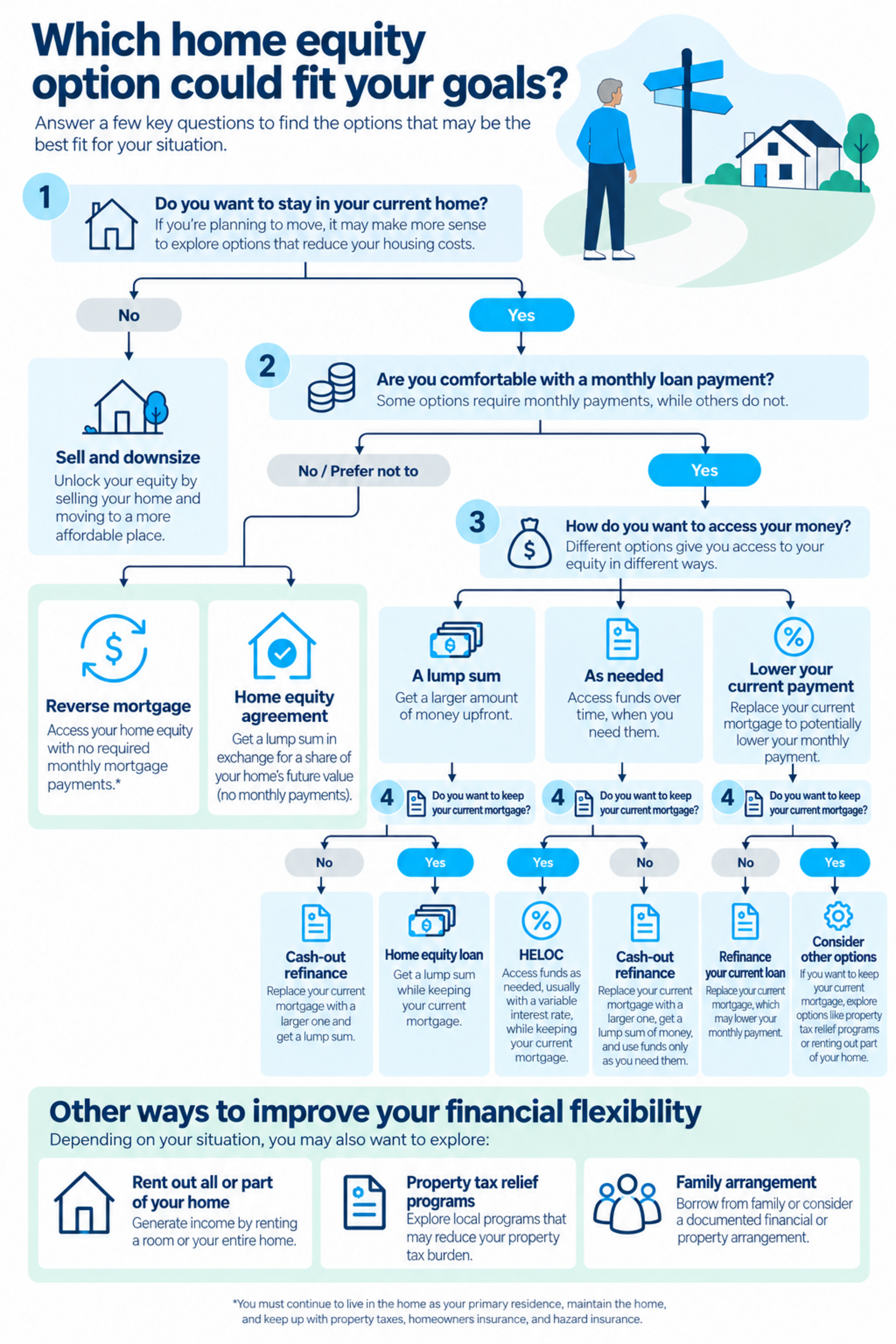
Do you want to stay in your current home?
If staying in your home is a priority, you can rule out selling and downsizing. A reverse mortgage, cash-out refinance, HELOC, home equity loan, or home equity agreement may allow you to access equity while remaining in your home. Renting out part of your home or meeting eligibility requirements for property tax relief could also help you cover expenses without requiring you to move.
Can you comfortably take on a monthly payment?
Your ability and willingness to make monthly payments can significantly narrow your options. Cash-out refinances, HELOCs, and home equity loans require monthly payments. A reverse mortgage doesn’t require monthly mortgage payments as long as you meet the loan terms, while home equity agreements generally don’t require monthly loan payments. If reducing monthly expenses is your primary goal, you might also explore refinancing your existing mortgage or property tax relief before borrowing additional money.
The borrower must meet all loan obligations, including living in the property as the principal residence and paying property charges, including property taxes, fees, and hazard insurance. The borrower must maintain the home. If the homeowner does not meet these loan obligations, then the loan will need to be repaid.
Do you need a lump sum or ongoing access to money?
Think about both how much money you need and when you’ll need it. A home equity loan or cash-out refinance may be useful when you need a lump sum for a large expense. A HELOC allows you to borrow as needed during the draw period, which may be a better option for expenses over time.
Reverse mortgages offer several ways to receive proceeds, depending on the product, including lump-sum payments, monthly payouts, or access to funds through a line of credit.
→ Learn more: Understanding reverse mortgage payout options
Do you want to keep your existing mortgage and interest rate?
If you already have a favorable mortgage rate, consider whether you’re comfortable giving it up. A cash-out refinance or traditional refinance replaces your existing mortgage, so your entire mortgage balance will be subject to the terms of the new loan.
A HELOC, home equity loan, or some home equity agreements may allow you to keep your current first mortgage while accessing equity separately. This distinction can be especially important when current mortgage rates are higher than the rate you already have.
For a reverse mortgage, keep in mind that many options require you to pay off your existing traditional mortgage, which may impact how much equity you could access.
How important is preserving home equity for your heirs or future needs?
Accessing your home equity today generally means less equity may be available later, whether for future expenses, a move, or an inheritance. However, different options affect your remaining equity in different ways.
Consider how much equity you’re comfortable using, how the amount you owe could change over time, and what happens when you sell the home or die. If leaving the home or as much home equity as possible to your heirs is a priority, include that goal when comparing the long-term costs and repayment requirements of each option.
Next steps with Finance of America
At Finance of America, we believe your home equity should work for you in a way that supports your goals. That starts with understanding your choices—including when a reverse mortgage may or may not be the right fit.
If a reverse mortgage is still an option you’re considering, you can get a free reverse mortgage estimate to see how much of your home equity you may be able to access.
If you like the advantages of a reverse mortgage but don’t want to give up your current mortgage rate, HomeSafe Second may be an option to keep your traditional mortgage in place.
The HomeSafe Second reverse mortgage is a proprietary product of Finance of America and is not related to the Home Equity Conversion Mortgage (HECM) program. HomeSafe Second is only available in certain states. Please contact us for a complete list of availability. Terms and conditions on the first lien loan apply. Must meet combined loan value requirements based on a satisfactory appraisal.
Frequently asked questions
What is the best alternative to a reverse mortgage if I want to stay in my home?
There is no one right answer—the best choice depends on your financial situation, how much equity you have, and whether you can make monthly payments. A home equity loan, HELOC, cash-out refinance, or home equity agreement may provide extra cash while allowing you to remain in your home, while downsizing or renting may reduce monthly costs. Refinancing your current mortgage may lower payments, but may mean you pay more interest over the life of the loan.
Is a HELOC better than a HECM reverse mortgage?
It depends on your needs. A HELOC is a revolving line of credit that typically requires monthly payments and may have a variable interest rate. A HECM reverse mortgage does not require monthly mortgage payments, but borrowers must meet the loan terms, including paying property taxes and homeowners insurance and maintaining the home.
How do current interest rates affect reverse mortgages and their alternatives?
Interest rates affect borrowing costs and may influence how much home equity you could access. When comparing options, consider the current interest rate environment, along with fees, monthly payment requirements, and other loan terms. Also consider whether the option offers a fixed or adjustable interest rate, as this can affect both your current and future borrowing costs.
What costs should I compare when considering a reverse mortgage or another home equity option?
Compare interest, closing costs, origination fees, and any applicable mortgage insurance premiums. For a HECM loan insured by the Federal Housing Administration, the total annual loan cost (TALC) disclosure may also help you understand the cost of the loan.
→ Learn more: What is the total annual loan cost (TALC) for a reverse mortgage?
How could choosing a reverse mortgage alternative affect my heirs?
Different home equity options can affect how much equity remains for your heirs. With a reverse mortgage, the loan balance generally grows over time as interest and fees are added, which can reduce the equity left in the home. Other options may preserve more equity or reduce it in different ways, depending on how much you borrow, repayment requirements, and whether you eventually sell the home.
→ Learn more: Are heirs responsible for reverse mortgage debt?
Can you get a reverse mortgage without giving up your current low-rate mortgage?
Yes, through HomeSafe Second, a second-lien reverse mortgage that may allow eligible homeowners to access home equity while keeping an eligible first mortgage in place. You’ll still need to make payments and meet the terms of your existing loan.
The HomeSafe Second reverse mortgage is a proprietary product of Finance of America and is not related to the Home Equity Conversion Mortgage (HECM) program. HomeSafe Second is only available in certain states. Please contact us for a complete list of availability. Terms and conditions on the first lien loan apply. Must meet combined loan value requirements based on a satisfactory appraisal.
What’s the cheapest way to access home equity without a reverse mortgage?
There isn’t one cheapest way to access home equity without a reverse mortgage. Costs depend on the option, lender, and your own circumstances. A HELOC may have lower upfront costs than a home equity loan or cash-out refinance, while selling or downsizing avoids taking out a new loan but comes with its own expenses. Compare interest rates, closing costs, fees, and ongoing payments to decide which is cheapest for you.
About the author

is the Web Content Manager at Finance of America and a journalist with more than 10 years of experience whose work has appeared in MoneyWise, MSN, Yahoo! Finance, and The Motley Fool. She specializes in making complex financial topics accessible and is passionate about advancing financial literacy.
Disclaimer
This article is intended for general informational and educational purposes only and should not be construed as financial or tax advice. For tax advice, please consult a tax professional. For more information about whether a reverse mortgage fits into your retirement strategy, you should consult your financial advisor.