Explore by category
What is a reverse mortgage and how does it work?

In this article:
- What is a reverse mortgage?
- How reverse mortgages work
- Types of reverse mortgages
- Eligibility requirements and qualification factors
- Payment options and distribution methods for reverse mortgages
- Costs and fees associated with reverse mortgage loans
- Advantages and risks for reverse mortgage borrowers
- Reverse mortgage vs other home equity options
- Application process for a reverse mortgage
- What happens at the end of a reverse mortgage?
- Getting a reverse mortgage: Next steps
- Reverse mortgage frequently asked questions
Key Takeaways
A reverse mortgage is a home loan for older homeowners that may convert part of your home’s equity into cash while continuing to live in the home. The loan is typically repaid when the home is sold, the borrower moves out, the last borrower passes away, or loan terms are no longer met.
Most reverse mortgages today are FHA-insured home equity conversion mortgages (HECMs), which include consumer protections, including mandatory counseling to ensure borrowers understand the terms of the loan.
When the loan becomes due, borrowers or heirs have multiple options to resolve it, including selling the home, keeping it by repaying the balance, or transferring the property to the lender.
For many homeowners approaching or living in retirement, home equity may be one of their largest financial resources yet accessing it can feel overwhelming or even a bit risky. A reverse mortgage is one option that could allow older homeowners to tap into that equity, but it comes with unique rules, costs, and long-term considerations that are important to understand.
Today, reverse mortgages are a highly regulated industry, with federal rules, consumer protections, and safeguards designed to help protect borrowers, eligible spouses, and their heirs.
This guide explains how these loans work, who may be eligible, the different loan types and payout options available, potential advantages and risks, and what happens when the loan comes due and payable.
By the end, you’ll have a clearer understanding of whether a reverse mortgage may fit into your retirement and estate planning goals.
What is a reverse mortgage?
A reverse mortgage may allow eligible homeowners to turn part of their home’s equity into cash while remaining in their home. The loan is typically repaid by selling the home, though you may choose to pay out of pocket or get a traditional mortgage to resolve the balance.
The right to remain in the home is contingent on paying property taxes and homeowner’s insurance, maintaining the home, and complying with the loan terms
The age requirements vary by loan type, but are typically available for homeowners over age 55 (for proprietary reverse mortgages) or over age 62 (for FHA-insured home equity conversion mortgages [HECM]).
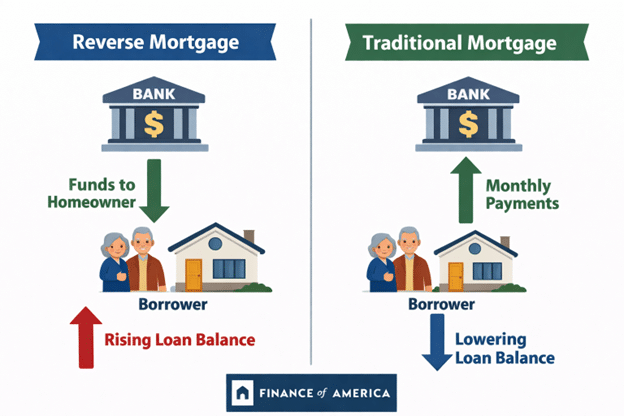
Unlike a traditional mortgage, a reverse mortgage does not require monthly mortgage payments. Instead, funds are disbursed to the homeowner and the loan balance increases over time as interest and fees are added.
These materials were not provided by HUD or FHA and were not approved by FHA or any government agency.
The borrower must meet all loan obligations, including living in the property as the principal residence and paying property charges, including property taxes, fees, hazard insurance. The borrower must maintain the home. If the homeowner does not meet these loan obligations, then the loan will need to be repaid.

How reverse mortgages work
Let’s say Joseph is a 70-year-old widower who owns his home outright. After the death of his wife, he’s looking for a way to access some of his home’s equity to fund a few trips and help his adult daughter purchase a home of her own.
Because Joseph is over 62 and lives in the home as his primary residence, he decides to explore a reverse mortgage. After researching, completing required counseling, and applying with a lender, his house is appraised to determine how much equity may be available based on his age, interest rates, and the home’s value.
Joseph chooses a line of credit rather than a lump-sum disbursement, giving him flexibility to access funds over time. He uses part of the available funds to help his daughter and leaves the rest available for future needs. As he draws from the line of credit, interest and fees are added to the loan balance.
Years later, Joseph decides to sell the home and move closer to family. At that point, the loan becomes due and is repaid from the sale proceeds. Any remaining equity belongs to Joseph.
Because his loan is non-recourse, Joseph is not responsible for any shortfall if the loan balance exceeds the home’s value.
The borrower must meet all loan obligations, including living in the property as the principal residence and paying property charges, including property taxes, fees, hazard insurance. The borrower must maintain the home. If the homeowner does not meet these loan obligations, then the loan will need to be repaid.
A non-recourse reverse mortgage transaction limits the homeowner’s liability to the proceeds of the sale of the home (or any lesser amount specified in the credit obligation). Non-recourse means that you, or your estate, can’t owe more than the value of your home when the loan becomes due and the home is sold. Non-recourse means that if you default on the loan, or if the loan cannot otherwise be repaid, the lender cannot look to your other assets (or your estate’s assets) to meet the outstanding balance on your loan.
How a reverse mortgage differs from a traditional mortgage
The core difference between a reverse and traditional mortgage is how the funds flow. With a traditional mortgage, borrowers make monthly payments that gradually reduce the loan balance over time. In contrast, a reverse mortgage disburses funds to the homeowner, and the loan balance grows as interest accrues.
Another key difference is repayment timing. Traditional mortgages are repaid over a set term, such as 15 or 30 years. A reverse mortgage becomes due only when the borrower sells the home, permanently moves out, the last borrower on the loan passes away, or other terms of the loan are not met.
The borrower must meet all loan obligations, including living in the property as the principal residence and paying property charges, including property taxes, fees, hazard insurance. The borrower must maintain the home. If the homeowner does not meet these loan obligations, then the loan will need to be repaid.
Types of reverse mortgages
The main types of reverse mortgages include HECM loans, which are insured by the Federal Housing Administration (FHA)* and must meet specific HUD requirements, proprietary reverse mortgages, where the lender sets their own terms, and single-purpose reverse mortgages, typically offered by government agencies.
Here’s how they differ:
| Feature | HECM (FHA-Insured)* | Proprietary Reverse Mortgage | Single-Purpose Reverse Mortgage |
| Who offers it | FHA-approved lenders* | Private lenders | State/local agencies or nonprofits |
| Minimum age | 62+ | Varies by lender (sometimes 55+) | Usually 62+ |
| FHA insured | Yes | No | No |
| Non-recourse protection | Yes (required) | Varies by lender | Varies |
| Maximum loan amount | Subject to FHA lending limits* | Often higher than HECM limits | Usually low |
| Payout options | Lump sum, monthly payments, line of credit, or combination | Varies by lender | Single approved purpose only |
| Use of funds | Flexible (living expenses, medical costs, mortgage payoff, etc.) | Generally flexible | Restricted (taxes, insurance, repairs) |
| Required counseling | Yes (HUD-approved) | Often required | Sometimes required |
| Availability | Nationwide | Limited by lender and state | Limited by location |
*These materials were not provided by HUD or FHA and were not approved by FHA or any government agency.
Home equity conversion mortgages (HECMs)
Home equity conversion mortgages, commonly called HECMs, are the most widely used type of reverse mortgage. They are insured by the Federal Housing Administration (FHA) and available through FHA-approved lenders.
HECM loans offer strong consumer protections, including mandatory HUD-approved counseling and non-recourse protection. This means borrowers or their heirs will never owe more than the home’s value when the loan becomes due, even if the loan balance exceeds the home’s market value at the time of sale.
A non-recourse reverse mortgage transaction limits the homeowner’s liability to the proceeds of the sale of the home (or any lesser amount specified in the credit obligation). Non-recourse means that you, or your estate, can’t owe more than the value of your home when the loan becomes due and the home is sold. Non-recourse means that if you default on the loan, or if the loan cannot otherwise be repaid, the lender cannot look to your other assets (or your estate’s assets) to meet the outstanding balance on your loan.
HECMs also provide multiple payout options, including a lump sum, monthly payments, a line of credit, or a combination of these options. Loan amounts are subject to FHA lending limits and are based on factors such as the borrower’s age, interest rates, and the home’s appraised value.
These materials were not provided by HUD or FHA and were not approved by FHA or any government agency.
Proprietary reverse mortgages
Proprietary reverse mortgages are offered by private lenders and are not insured by the FHA. These loans may be an option for homeowners with higher-value homes that exceed FHA lending limits. Jumbo reverse mortgages are a common type of proprietary loan.
Because proprietary reverse mortgages are privately insured, terms, costs, and consumer protections vary by lender. Some proprietary loans offer non-recourse protections similar to HECMs, while others may not. For this reason, reviewing loan terms carefully is especially important.
Proprietary loans may be available to borrowers younger than 62 in certain states, though eligibility requirements and minimum age limits vary.
Single-purpose reverse mortgages
Single-purpose reverse mortgages are typically offered by state or local government agencies or nonprofit organizations. These loans are designed for specific, approved uses, such as paying taxes, homeowners insurance, or funding essential home repairs.
Because the funds are restricted to a specific use, single-purpose reverse mortgages are usually less flexible than HECMs or proprietary loans. Availability can vary by location, and not all homeowners will qualify.

Eligibility requirements and qualification factors
Reverse mortgage eligibility is based on several factors, including age, homeownership status, residency, and financial responsibilities. While specific requirements vary by loan type and lender, most loans have similar qualifications.
General eligibility requirements include:
- Age requirement: At least 62 years old for HECM loans (some proprietary reverse mortgages may allow younger borrowers).
- Homeownership status: You must own your home outright or have a low remaining mortgage balance that can be paid off using reverse mortgage proceeds.
- Primary residence: The home must be your primary residence and where you live most of the year.
- Property type: Eligible homes typically include single-family homes, FHA-approved condominiums, and certain multi-unit properties where the borrower occupies one unit.
- Financial obligations: Borrowers must continue to pay property taxes, homeowners insurance, and maintain the home. There may be other out-of-pocket costs, such as counseling.
- Mandatory counseling: HECM borrowers are required to complete counseling with a HUD-approved housing counselor to review loan terms, costs, and alternatives. Many proprietary lenders also have this requirement.
- Financial assessment: Lenders review income, assets, and credit history to evaluate your ability to meet ongoing loan obligations.
→For more information about eligibility rules and how they apply to different situations, read our full guide on reverse mortgage eligibility requirements.
The borrower must meet all loan obligations, including living in the property as the principal residence and paying property charges, including property taxes, fees, hazard insurance. The borrower must maintain the home. If the homeowner does not meet these loan obligations, then the loan will need to be repaid.
To learn more, please visit the CFPB’s Reverse Mortgage: A Discussion Guide.
Payment options and distribution methods for reverse mortgages
The disbursement options available for a reverse mortgage depend on the type of reverse mortgage and the lender. Common reverse mortgage proceed options include:
- Lump sum: Receive a portion of your available loan proceeds upfront at closing. This option is often used to pay off an existing mortgage or cover large, immediate expenses.
- Monthly payments: Receive fixed monthly payments for a set period or for as long as you live in the home.
- Line of credit: Access funds as needed over time.
- Combination options: Some borrowers choose a mix, such as a line of credit paired with monthly payments.
The type of reverse mortgage you choose may affect which distribution options are available. For example, HECM loans typically offer the most flexibility, while proprietary and single-purpose reverse mortgages may limit how and when funds are disbursed.
How reverse mortgage funds are commonly used
Borrowers may use loan proceeds for a wide range of expenses, including:
- Paying off an existing mortgage (required for HECMs)
- Covering everyday living expenses
- Medical bills and health-related costs
- In-home care or aging-in-place support
- Home repairs, accessibility upgrades, or maintenance
- Building a financial buffer for unexpected expenses
Because how you receive and use the funds can affect loan growth and long-term outcomes, choosing the right payment structure is an important part of the decision-making process.

Costs and fees associated with reverse mortgage loans
Reverse mortgages come with upfront and ongoing costs that borrowers should understand before moving forward. While these costs may be financed as part of the loan, they affect how much equity remains in the home over time.
Common costs and fees include:
- Origination fees: These are fees charged by the lender to process the loan. For HECM loans, these fees are capped by FHA guidelines.
- Closing costs: Similar to a traditional mortgage, these may include appraisal fees, title insurance, recording fees, and other third-party charges.
- Counseling costs: HECM loans and some proprietary reverse mortgages require borrowers to attend a counseling session with a HUD-approved counselor.
- Mortgage insurance premiums (MIP): Required for HECM loans and paid to the FHA.
- Interest charges: Interest accrues on the loan balance over time, increasing the amount owed.
- Servicing fees: Some lenders charge monthly fees for managing the loan, though this varies by lender and loan type.
While borrowers may choose to roll some costs into the loan balance, doing so increases the overall amount owed and reduces remaining home equity. There are additional costs, such as counseling, which must be paid out of pocket. The total cost of a reverse mortgage depends on factors such as the loan type, interest rate, home value, and how long the loan remains outstanding.
→To learn more, read our full guide on reverse mortgage costs and fees.
Advantages and risks for reverse mortgage borrowers
Just like any financial product or loan, reverse mortgages aren’t right for every person or every situation. There are potential advantages for some borrowers but also risks that need to be considered.
Advantages include:
- Access to home equity without monthly mortgage payments: Reverse mortgages allow eligible homeowners to convert home equity into cash while continuing to live in their home. The borrower has to continue to meet all loan obligations, including using the property as their principal residence, paying property taxes, fees, and hazard insurance. You’ll also need to maintain the home. If the homeowner doesn’t meet these obligations, then the loan will need to be repaid.
- Tax-free loan proceeds: Funds received from a reverse mortgage are loan proceeds, not income, and generally are not subject to federal income tax. This is not tax advice–talk to a tax professional for more information.
- Non-recourse protection (HECM loans): For FHA-insured HECM loans, borrowers and heirs will never owe more than the home’s value when the loan becomes due.
- Improved financial flexibility in retirement: Reverse mortgages may help cover living expenses, healthcare costs, or provide a financial buffer for unexpected costs.
- Consumer protections: Mandatory counseling and federal regulations help ensure borrowers understand the loan’s terms, costs, and responsibilities.
The right to remain in the home is contingent on paying property taxes and homeowner’s insurance, maintaining the home, and complying with the loan terms. A non-recourse reverse mortgage transaction limits the homeowner’s liability to the proceeds of the sale of the home (or any lesser amount specified in the credit obligation). Non-recourse means that you, or your estate, can’t owe more than the value of your home when the loan becomes due and the home is sold. Non-recourse means that if you default on the loan, or if the loan cannot otherwise be repaid, the lender cannot look to your other assets (or your estate’s assets) to meet the outstanding balance on your loan.
Risks and drawbacks you’ll want to consider:
- Loan balance increases over time: As interest and fees accrue, the loan balance grows, reducing the amount of equity that may remain for heirs.
- Upfront costs may be higher: Reverse mortgages often carry higher upfront fees than some traditional home equity options.
- Ongoing homeowner responsibilities: Borrowers must continue paying property taxes and homeowners insurance, maintain the home, and live in the property as their primary residence.
- Loan may become due if terms aren’t met: Moving out permanently, entering long-term care, or failing to meet loan obligations may cause the loan to become due.
- Complex loan structure: Reverse mortgages involve long-term financial and estate planning considerations that may not be suitable for every homeowner.
Reverse mortgage vs other home equity options
Your home’s equity can be a powerful financial tool, but reverse mortgages aren’t the only way to access it. Depending on your situation, refinancing, a home equity loan, home equity line of credit (HELOC), or downsizing might be a better fit.
This chart breaks down the core differences:
| Feature | Reverse Mortgage | Refinance | Home Equity Loan | HELOC | Downsize |
| Minimum age | 62+ (HECM) | None | None | None | None |
| Monthly mortgage payments | Not required* | Required | Required | Required | May, but only if you finance a new home |
| Access to cash | Lump sum, monthly payments, line of credit, or combination | Limited (cash-out only) | Lump sum | Line of credit | From sale proceeds |
| Income required to qualify | Limited (a financial assessment is required) | Yes | Yes | Yes | No |
| Interest rate type | Fixed or adjustable | Fixed or adjustable | Fixed | Variable | Varies; depends on if you finance a new home |
| Loan repayment timing | When home is sold, borrower moves out, passes away, or fails to meet loan terms | Over loan term | Over loan term | Over draw + repayment period | No loan |
| Impact on home equity | Decreases over time | Decreases gradually | Decreases with payments | Decreases if balance grows | Equity converted to cash |
| Ability to stay in home | Yes** | Yes | Yes | Yes | No |
| Best for | Retirees seeking cash flow without monthly payments* | Borrowers wanting lower rates | Borrowers who can manage fixed payments | Flexible short-term needs | Homeowners ready to relocate |
*The borrower must meet all loan obligations, including living in the property as the principal residence and paying property charges, including property taxes, fees, hazard insurance. The borrower must maintain the home. If the homeowner does not meet these loan obligations, then the loan will need to be repaid.
**The right to remain in the home is contingent on paying property taxes and homeowner’s insurance, maintaining the home, and complying with the loan terms
Refinancing an existing mortgage
Refinancing replaces your current mortgage with a new loan, often allowing you to secure a lower interest rate or change the loan term. While refinancing may reduce monthly payments, it still requires ongoing payments and sufficient income to qualify.
For retirees on a fixed income, taking on a new monthly obligation may limit cash flow rather than improve it.
Home equity loan
A home equity loan provides a lump sum that is repaid through fixed monthly payments over a set term, typically 5 to 15 years. These loans usually have lower upfront costs than reverse mortgages but require steady income and regular payments.
If preserving equity for heirs is a priority and monthly payments are manageable, a home equity loan may be a good option.
Finance of America does not currently offer home equity loans.
Home equity line of credit (HELOC)
A HELOC offers flexible borrowing through a revolving line of credit, often with variable interest rates. During the draw period—commonly around 5 to 7 years—borrowers may only need to make interest payments.
Eventually, repayment of both principal and interest begins. HELOCs require income and credit qualification and may not be suitable for borrowers who want to avoid monthly payment obligations.
Downsizing to a smaller home
Selling your current home and purchasing a smaller or less expensive property may free up equity and reduce ongoing housing costs. Downsizing may work well for homeowners who are open to relocating and no longer need their current space.
However, this option often include moving expenses, potential tax implications, and leaving a familiar home or community.
Application process for a reverse mortgage
If you think a reverse mortgage might be a good fit, the next step is the application process. This is a structured process designed to make sure you understand the loan and can meet the long-term obligations. While the process can vary by loan type, these are the most common steps:
- Mandatory counseling: Borrowers must meet with a HUD-approved housing counselor (required for HECM loans and some proprietary reverse mortgages). Counseling covers loan terms, costs, responsibilities, and alternatives.
- Apply with a lender: After counseling, you’ll submit an application with a lender, including a financial assessment that reviews income, assets, and credit history.
- Home appraisal: An FHA-approved appraiser determines the home’s value, which helps establish the maximum available loan amount, subject to FHA lending limits.
- Loan processing and underwriting: The lender verifies information, reviews eligibility, and finalizes loan terms.
- Closing and disbursement: Once the loan closes, funds are made available according to the selected payment option.
→For a step-by-step walkthrough of the application process, read How to apply for a reverse mortgage in 5 steps.
What happens at the end of a reverse mortgage?
A reverse mortgage becomes due when a specific event occurs. Understanding these triggers ahead of time may help borrowers and their families prepare and avoid surprises.
The loan typically comes due when:
- The borrower sells the house
- The borrower no longer lives in the home as a primary residence
- The last borrower on the loan passes away
- The borrower fails to maintain the home or pay property taxes
- The borrower otherwise violates the terms of the loan
When any of these events occur, you or your heirs have four main options:
Sell the home
The borrower or heirs can choose to sell the home, then use the proceeds from the sale of the house to pay the loan balance.
→Learn more: Are heirs responsible for reverse mortgage debt?
Keep the home
Borrowers or their heirs may keep the home by paying off the reverse mortgage balance or 95% of the home’s appraised value, whichever is less (for HECM loans). Borrowers may use cash or refinance into a new mortgage.
In some cases, if an heir is age 62 or older, a new reverse mortgage may be an option. Certain proprietary reverse mortgages may be available to heirs as young as 55, depending on the state and lender.
Sign over the title and complete a deed in lieu of foreclosure
The heirs can give the property to the lender by signing a deed in lieu of foreclosure. This act satisfies the debt and will prevent foreclosure of the house. However, this forfeits any remaining equity.
Do nothing
If the borrower or their heir chooses to do nothing with the loan, the lender will foreclose on the home. This is not preferable or advantageous for the heir. Consider working with the lender to resolve the loan in an official way before this happens.
Getting a reverse mortgage: Next steps
A reverse mortgage may help eligible homeowners access home equity while continuing to live in their home, but it isn’t the right solution for everyone. Understanding how the loan works, the costs involved, and the long-term responsibilities is essential.
If you’re exploring reverse mortgages, consider your future plans, discuss options with family members, and speak with a HUD-approved housing counselor.
You can also use our reverse mortgage calculator to estimate how much equity may be available to you.
Reverse mortgage frequently asked questions
Can I lose my home with a reverse mortgage?
Yes, you may lose your home if you fail to meet the loan’s requirements. However, it is not an automatic or fast process. As long as you continue to pay property taxes and homeowners insurance, maintain the home, and live in it as your primary residence, you may remain in your home for as long as you choose.
If a required obligation is missed, the lender must follow a formal process that includes required notices and opportunities to correct the issue before foreclosure may occur.
What happens if I outlive the equity from my reverse mortgage?
You cannot outlive a reverse mortgage or be required to leave your home because the loan balance grows larger than the home’s value. FHA-insured HECM loans are non-recourse, meaning you may continue living in the home as long as you meet the loan’s requirements, even if the balance exceeds the home’s market value.
A non-recourse reverse mortgage transaction limits the homeowner’s liability to the proceeds of the sale of the home (or any lesser amount specified in the credit obligation). Non-recourse means that you, or your estate, can’t owe more than the value of your home when the loan becomes due and the home is sold. Non-recourse means that if you default on the loan, or if the loan cannot otherwise be repaid, the lender cannot look to your other assets (or your estate’s assets) to meet the outstanding balance on your loan.
Can I still leave my home to my kids with a reverse mortgage?
Yes, you may leave your home to your children even with a reverse mortgage. However, when you die, the loan becomes due and your children must choose how to resolve it. They may pay off the reverse mortgage loan balance either with their own funds, by selling the home, or taking out a traditional mortgage.
How does a reverse mortgage impact government benefits like Medicare and Social Security?
A reverse mortgage does not affect Medicare or Social Security benefits. Funds received from a reverse mortgage are loan proceeds, not income, and therefore do not count toward these programs. However, it may affect eligibility for needs-based programs such as Medicaid or Supplemental Security Income (SSI), which have asset limits.
Are reverse mortgages government-insured?
Home equity conversion mortgages (HECMs) are insured by the Federal Housing Administration (FHA). This insurance provides important consumer protections, including non-recourse coverage and safeguards for borrowers and eligible spouses. Other types of reverse mortgages, such as proprietary or single-purpose reverse mortgages, are not FHA-insured and may have different terms, costs, and protections.
About the author

Danielle Antosz
Danielle Antosz is the Web Content Manager at Finance of America and a journalist with more than 10 years of experience whose work has appeared in MoneyWise, MSN, Yahoo! Finance, and The Motley Fool. She specializes in making complex financial topics accessible and is passionate about advancing financial literacy.
Disclaimer
This article is intended for general informational and educational purposes only and should not be construed as financial or tax advice. For tax advice, please consult a tax professional. For more information about whether a reverse mortgage fits into your retirement strategy, you should consult your financial advisor.
