Explore by category
How to care for aging parents: A practical guide for families

In this article:
- How do you know when an aging parent needs more help?
- How do you talk to aging parents about getting help?
- What caregiving responsibilities should families expect?
- What legal and financial documents should be in place?
- Where to find help: professional and community resources
- How can technology help an aging parent stay safe at home?
- How can you create a caregiving plan?
- When is it time to consider different care options?
- How can families pay for an aging parent's care?
- How can caregivers take care of themselves?
- Planning ahead for your parent's changing needs
- FAQs about caring for aging parents
Quick answer: Caring for an aging parent can include helping with everyday activities, addressing health and safety concerns, coordinating medical or financial matters, and finding ways to support their independence.
Key points
A parent’s need for help may develop slowly over time. Shifts in mobility, memory, personal care, household tasks, or finances may signal that it’s time to consider additional help.
Start by observing changes, talking with your parent about their needs and preferences, assessing where help may be needed, and creating a plan together.
A caregiving plan can help families coordinate responsibilities, anticipate future care needs, explore care and funding options, and support a parent’s goal of aging in place.
Caring for aging parents rarely begins with a single moment when everything changes. More often, families notice small signs over time: a missed appointment, an increasingly cluttered home, or a loved one who seems less steady on their feet.
Eventually, helping here and there may become full-blown caregiving—and with it, an unfamiliar role reversal as adult children begin taking care of those who once raised them. For members of what’s called the Sandwich Generation, caregiving may also mean balancing a parent’s needs with those of their own children. According to Pew Research Center, 24% of U.S. adults who have a parent age 65 or older consider themselves caregivers.
As Jennifer McCalley, a palliative care and oncology social worker, told Dartmouth Health, “That role reversal is a really big leap for a lot of people, understandably so. But I think the important thing is to normalize it.”
Whether you’re just beginning to navigate that transition or you’re already providing care, this guide can help you think through what comes next.
How do you know when an aging parent needs more help?
An aging parent may need more help when changes in their health, memory, behavior, home environment, or everyday activities begin to affect their safety or independence.
Start by observing what has changed, talking with your parent about their priorities, assessing where help may be useful, and planning for immediate or longer-term concerns.
Healthcare professionals often consider Activities of Daily Living (ADLs) and Instrumental Activities of Daily Living (IADLs) when evaluating how much assistance an older adult may need. Here’s how the two differ and what to look out for:
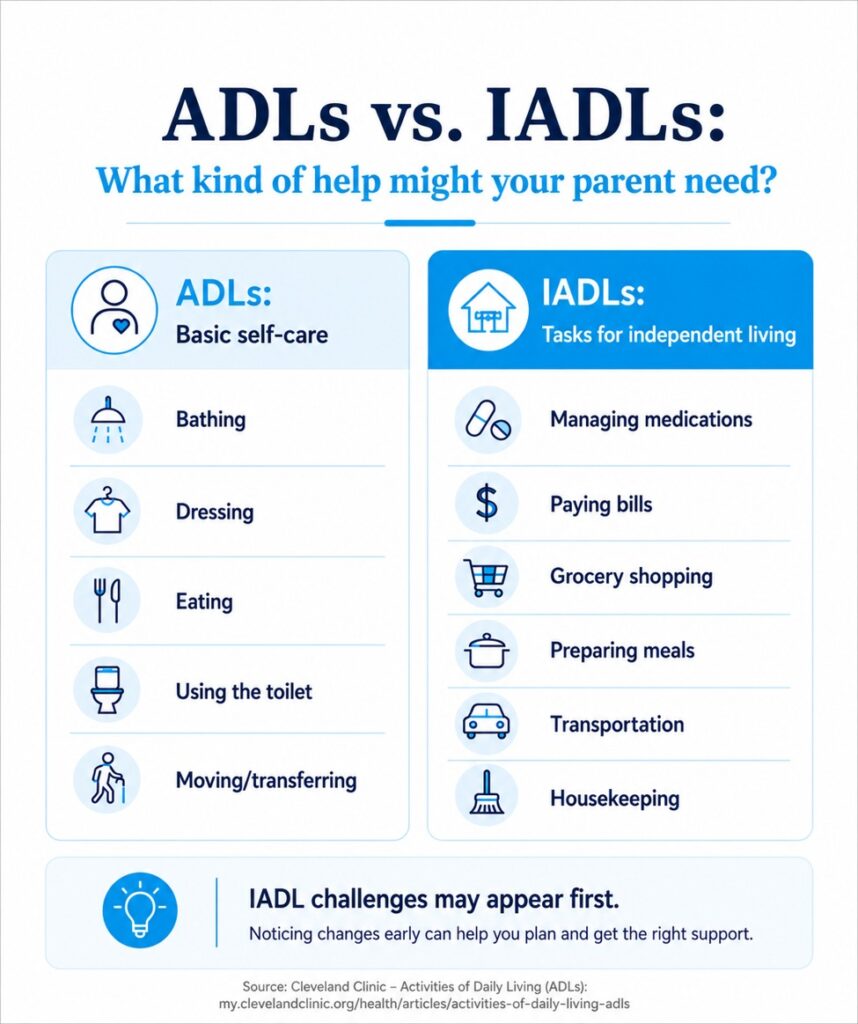
Knowing what else to monitor may also help you recognize when additional support may be needed.
Physical signs
Physical changes that may signal a need for extra help include:
- Frequent falls or problems with balance
- Unexplained weight loss
- Changes in personal hygiene or appearance
- Difficulty walking or getting around
- Missed or incorrectly taken medications
Changes that persist or become more pronounced may be a reason to talk with your parent and their healthcare provider.
Cognitive and behavioral changes
Watch for changes in memory, thinking, judgment, or behavior, including:
- Increasing memory lapses
- Missed appointments
- Confusion
- Changes in mood or judgment
- Social withdrawal or isolation
Some forgetfulness can be a normal part of aging, but the National Institute on Aging recommends talking with a doctor about noticeable changes in memory, particularly when they begin to interfere with everyday activities, such as following recipes, finding the way home, or managing self-care.
Changes around the home
The home environment may offer additional clues, including:
- Increasing clutter or neglected housekeeping
- Unopened mail or unpaid bills
- Spoiled or expired food
- Safety hazards or repairs that have been put off
A professional home safety evaluation may help identify hazards and modifications that support safer aging in place.
→ Learn more: Aging-in-place checklist
Track changes over time
If you’re unsure whether changes are significant, consider keeping an observation log to identify patterns and provide concrete information to discuss with family members or healthcare providers.

How do you talk to aging parents about getting help?
Concerns about a parent’s changing needs can be difficult to raise, particularly when they touch on independence and long-standing routines. As Dr. Hillary Lum, a professor of geriatric medicine at the University of Colorado, explained, “Making your parents feel like they’re part of the decision-making is essential.”
The following approaches may help you put that principle into practice:
- Choose the right time: Start before an urgent situation forces a decision, and consider several smaller conversations rather than trying to resolve everything at once.
- Listen first: Ask what has become more difficult and listen for what they value, want to continue doing independently, and may welcome help with.
- Try the “I wish, I worry, I wonder”-approach suggested by Dartmouth Health: For sensitive topics, framing the conversation around your own hopes and concerns may feel less confrontational:
- “I wish” expresses a shared goal: “I wish we could find a way to make getting to your appointments easier.”
- “I worry” introduces a concern: “I worry about you using the stairs when you’re home alone.”
- “I wonder” invites collaboration: “I wonder if we could look at a few options together.”
- Respect their independence: Involve your parent in decisions about the support they receive and focus on what could help them continue doing the activities that matter to them.
- Involve siblings and other family members: Consider family dynamics as you agree on immediate needs, responsibilities, and how you’ll communicate. Avoid having several people confront your parent at once.
- Bring in outside support if needed: If conversations become difficult or family members disagree, a healthcare provider, social worker, or geriatric care manager may help facilitate the discussion.
- Start small: If your parent is reluctant to accept help, begin with one specific need, such as transportation, yard work, or grocery shopping.
What caregiving responsibilities should families expect?
Pew Research Center found that among Americans caring for an aging parent, 52% regularly help with errands, housework, or home repairs, 42% help manage healthcare, and 39% help manage finances. That support can take many forms, depending on what a parent needs. Common caregiving responsibilities include:
- Personal care: Bathing and dressing, meal preparation, medication reminders, mobility assistance, and personal hygiene. Some tasks may require more hands-on support than a family caregiver is able or comfortable providing, so recognizing your limits is important.
- Household support: Housekeeping, grocery shopping, laundry, home upkeep and repairs, and safety modifications.
- Transportation: Medical appointments, grocery shopping and errands, social activities, and prescription pickups.
- Medical coordination: Scheduling appointments, communicating with healthcare providers, medication management, organizing medical records, and coordinating care among specialists. With your parent’s permission, consider attending appointments to take notes and keep track of instructions or follow-up steps.
- Financial management: Paying bills, monitoring accounts, reviewing insurance and benefits, organizing financial documents, and watching for signs of fraud or financial exploitation. Keep records of money spent on your parent’s behalf, and discuss what they want you to handle and what authority you have to act on their behalf.

What legal and financial documents should be in place?
Putting legal and financial documents in place early may help your parent communicate their wishes and designate people to act on their behalf if needed. Requirements vary by individual circumstances and state law, but common documents include:
- Financial power of attorney: allows your parent to designate someone to handle financial matters, such as paying bills or managing accounts. A durable power of attorney is generally designed to remain in effect if your parent later becomes incapacitated.
- Healthcare power of attorney (HPOA) or proxy: names someone to make healthcare decisions if your parent can no longer make or communicate those decisions. Your parent should discuss their preferences with the person they choose.
- Advance directive or living will: describes preferences for future medical care, including treatments they may or may not want in certain circumstances.
- HIPAA authorization: may allow designated individuals to receive certain protected health information. It does not, by itself, give someone authority to make healthcare decisions.
- Will and estate documents: may include a will, beneficiary designations, and other estate-planning documents. Your parent should also make sure appropriate people know where these documents are stored.
What happens if a parent can no longer sign legal documents?
The ability to sign legal documents generally depends on whether your parent has the legal capacity to understand the document and the consequences of signing it. A dementia diagnosis does not automatically mean they lack that capacity. Because cognitive abilities may change, completing legal planning early may allow your parent to participate in these decisions.
If your parent no longer has the required legal capacity and an appropriate power of attorney isn’t already in place, the family may need to explore guardianship or conservatorship. The meaning and requirements of these arrangements vary by state, so consider consulting an elder law attorney for guidance.
Where to find help: professional and community resources
Professional and community resources may help families caring for aging or elderly parents find local services, coordinate care, and provide support at home. AARP and the National Alliance for Caregiving report that more than 40% of caregivers provide high-intensity care, yet only 22% receive training—suggesting that many caregivers may be taking on significant responsibilities without formal preparation.
Resources to consider when you need outside help include:
- Area Agencies on Aging (AAAs): connect older adults and caregivers with local services that may include transportation, meal delivery, housekeeping assistance, and caregiver support.
- Geriatric care managers: may assess a parent’s needs, develop a care plan, and coordinate services, particularly when care is complex or family members live far away.
- Social workers: may help families navigate healthcare, community services, care transitions, and support programs.
- In-home care agencies: provide services such as personal care, meal preparation, and household assistance.
If you’re unsure where to begin, the federal Eldercare Locator connects older adults and families with local aging services, including Area Agencies on Aging. Search by location at eldercare.acl.gov or call 1-800-677-1116.

How can technology help an aging parent stay safe at home?
Technology may provide additional support at home, including:
- Medical alert systems: wearable buttons, fall detection, or other features that can help an older adult call for assistance in an emergency.
- GPS and location technology: devices that may help locate someone at risk of becoming lost or disoriented.
- Medication reminders and dispensers: tools ranging from phone reminders to automated dispensers that may help with medication routines.
- Cameras and home monitoring: cameras, door sensors, or motion sensors that may help caregivers monitor certain safety concerns.
- Telehealth: virtual appointments that may make it easier to access some healthcare services from home.
Consider your parent’s needs, preferences, and privacy when choosing technology. It should complement—not replace—appropriate caregiving and professional support.
→ Learn more about how technology can help: What is AgeTech?
How can you create a caregiving plan?
Think of a caregiving plan as a working document that can evolve with your parent’s needs. The following elements may help you get started.
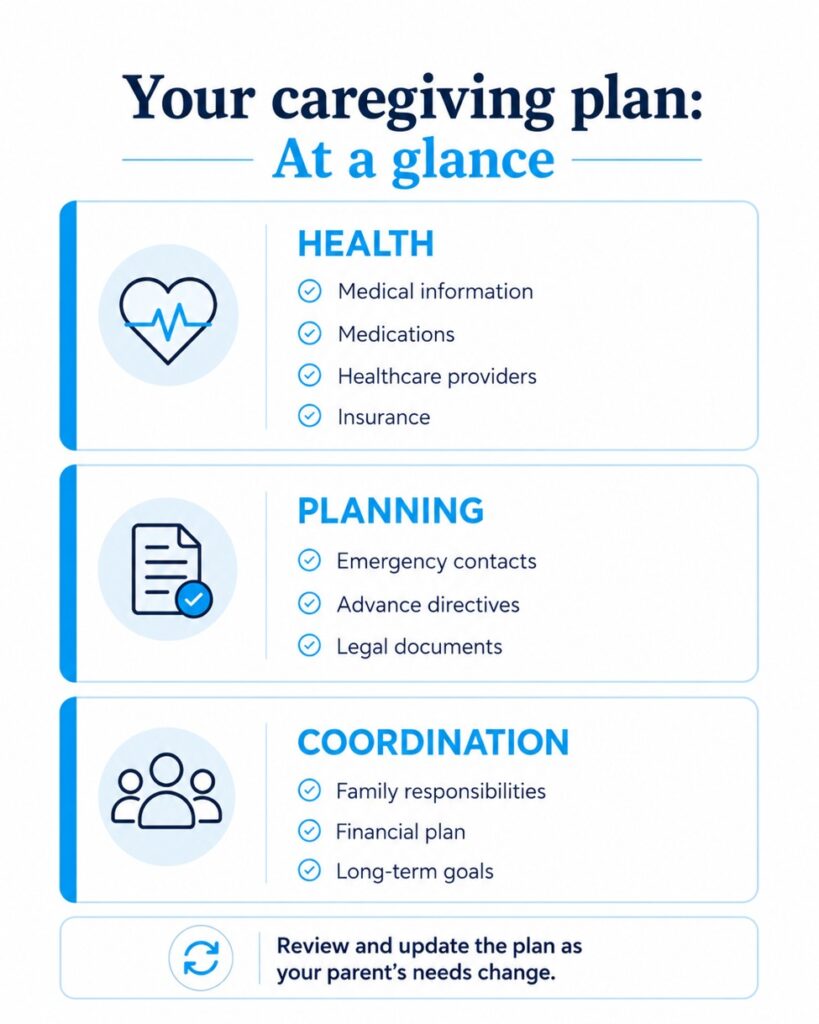
What should a caregiving plan include?
A useful caregiving plan brings together the information your family may need to coordinate care, including:
- Medical information: current health conditions and other relevant information
- Medication list: medications, dosages, and instructions
- Healthcare providers: names and contact information
- Insurance information: health insurance and other relevant coverage
- Emergency contacts: people who should be contacted in an emergency
- Advance directives: documents that communicate your parent’s healthcare wishes
- Legal documents: powers of attorney and other relevant documents, including where they’re stored
- Family responsibilities: who handles each caregiving task
- Financial plan: how current and future care expenses will be managed
- Long-term goals: your parent’s preferences for where and how they want to receive care
Keep the information accessible to appropriate family members or caregivers and review it periodically.
Assign caregiving responsibilities
When several people are involved, clearly assigning responsibilities may help prevent tasks from being missed or falling to one person:
- Transportation
- Financial matters
- Medical appointments
- Meal preparation
- Family communication
Consider each person’s availability and abilities, identify backups for essential tasks, and revisit assignments as your parent’s needs change.
When is it time to consider different care options?
It may be time to think about a different care arrangement when your parent requires more support than family members or current caregivers can provide, safety concerns persist despite added help, or needed services aren’t available in their current setting.
The right fit will depend on your parent’s needs and preferences, available family support, and financial resources. Options may include:
- Aging in place: Helping your parent remain at home may involve home modifications for safety or accessibility, personal or household help, home health services, transportation, meal delivery, or community programs.
- Adult day programs: These programs may provide supervision, meals, social activities, personal care, or health-related services during the day while your parent continues living at home.
- Assisted living: This may be a good fit for parents who need regular help with daily activities but don’t require extensive medical care. Services vary but may include meals, personal care, medication assistance, housekeeping, and social activities.
- Skilled nursing care: This provides a higher level of health and personal care, which may include nursing, 24-hour supervision, assistance with daily activities, and rehabilitation services.
Whenever possible, involve your parent in evaluating the choices and consider what level of support can be provided safely and sustainably over time.
→ Read more: How to age in place
How can families pay for an aging parent’s care?
Care costs vary by location, type of care, and amount of support needed, and covering those expenses may require a combination of resources. AARP and the National Alliance for Caregiving found that half of caregivers report a negative financial impact from caregiving, while one in four report taking on debt.
According to CareScout’s 2025 Cost of Care Survey, national median costs include:
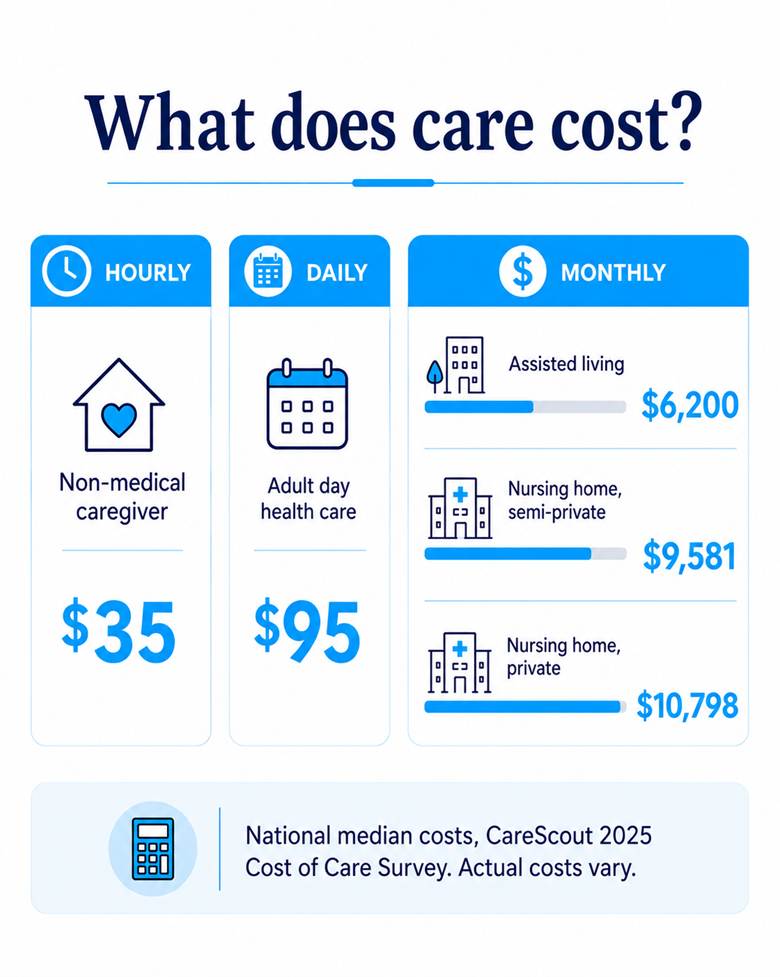
At $35 per hour, 10 to 20 hours of non-medical in-home care would cost roughly $350 to $700 per week. At 44 hours per week, the estimated annual cost is $80,080.
What resources may help pay for care?
Families may cover costs in several ways, including:
- Savings and retirement income: Consider how long care may be needed and what other expenses your parent must continue to cover.
- Long-term care insurance: Review your parent’s policy for covered care, benefit limits, and eligibility requirements.
- Medicare and Medicaid: Medicare generally does not cover long-term custodial care when that is the only care needed, although it may cover certain healthcare services and qualifying short-term skilled nursing care. Medicaid may cover long-term services and supports for eligible individuals, with coverage and eligibility varying by state.
- Veterans benefits: Veterans and surviving spouses may be eligible for programs such as Aid and Attendance, while the Department of Veterans Affairs also offers caregiver support programs.
- Family contributions: Relatives may share care expenses. Discuss what each person can contribute and keep records of shared costs.
- Home equity: Eligible homeowners may be able to access home equity to help pay for care or aging-in-place improvements. Options may include a reverse mortgage, home equity loan, or HELOC, each with different eligibility requirements, costs, repayment terms, and ways of accessing funds. To learn more, please visit the CFPB’s “Reverse Mortgages: A Discussion Guide.”
→ Take a closer look: Reverse mortgage vs. HELOC vs. home equity loan
Can you get paid to be the caregiver?
In some situations, family caregivers may be eligible for compensation through government programs. AARP and the National Alliance for Caregiving report that 11 million family caregivers receive this type of support.
Options may include:
- Medicaid self-directed programs: Depending on eligibility and state rules, some programs may allow certain family members to be paid for providing care.
- VA caregiver programs: Some eligible family caregivers of veterans may receive financial assistance or other support.
- Family caregiver agreements: A parent may pay a family member directly for care under a written agreement outlining the services and compensation.
Rules and eligibility vary by program and location. Before entering into a paid caregiving arrangement, consider consulting the program administrator and a qualified legal or financial professional about potential tax, Medicaid, or other financial implications.
How can caregivers take care of themselves?
Taking on new caregiving responsibilities can affect a caregiver’s health, work, finances, and relationships. Pew found that 39% of people regularly helping an aging parent reported a negative effect on their emotional well-being.
“If you’re a caregiver, you not only need resources, but validation that what you’re doing is extremely difficult,” Kristie Foster, former emergency department manager at Alice Peck Day Memorial Hospital, told Dartmouth Health.
Ways to care for yourself while caregiving include:
- Recognize signs of caregiver burnout: Watch for exhaustion, irritability, isolation, sleep problems, loss of interest in activities, or neglecting your own health. If caregiving is affecting your physical or emotional health, consider talking with your healthcare provider.
- Balance caregiving with work and family: Be realistic about what you’re able to take on, set boundaries around your caregiving responsibilities, and share roles when possible. Explore workplace resources such as flexible scheduling or caregiver leave.
- Ask for specific help: When someone offers to help, suggest a particular task, such as providing transportation, picking up groceries, or preparing a meal.
- Connect with caregiver support groups: In-person or online groups may offer practical ideas, resources, and support from others with similar responsibilities.
- Consider respite care: Temporary help from family, friends, professional caregivers, adult day programs, or residential care may give you time to rest or manage other responsibilities.
Planning ahead for your parent’s changing needs
Caring for aging parents is a process, and the level of support they require may change over time. You don’t need to have every answer at once. Focus on what matters now, plan for what may come next, and involve your parent in decisions whenever possible.
That planning may also include thinking about how future care or aging-in-place expenses will be covered. If home equity is part of your parent’s plan, Finance of America’s reverse mortgage calculator can provide an estimate of how much they may be eligible to access.
FAQs about caring for aging parents
What if my parent refuses help?
Try to understand what’s behind their reluctance, such as concerns about independence, privacy, or control. Focus on one specific need, listen to their preferences, and consider starting with a small change rather than several at once.
When should a parent stop driving?
It may be time to consider stopping driving when changes in vision, physical ability, cognition, reaction time, or behavior behind the wheel make it difficult to drive safely. Warning signs may include getting lost on familiar routes, new dents or scrapes, frequent close calls, difficulty navigating intersections, or increasing anxiety or confusion while driving. AARP’s We Need to Talk program offers resources for discussing driving concerns and exploring next steps.
When should an aging parent stop living alone?
It may be time to reconsider living alone when your parent’s health, safety, or care needs can no longer be adequately supported at home. Before considering a move, explore whether in-home care, home modifications, family assistance, or community services could provide the additional support they need.
How can I prepare before a caregiving crisis?
Talk with your parent about their preferences, organize important medical and financial information, put appropriate legal documents in place, and decide who will handle different caregiving responsibilities. It also helps to have a backup plan if their health or living situation changes unexpectedly.
What’s the difference between power of attorney and guardianship?
A power of attorney generally allows someone to voluntarily authorize another person to act on their behalf. Guardianship generally involves a court appointing someone to make certain decisions for a person who is no longer able to make those elections independently.
Can my parent get a reverse mortgage if they already have a mortgage?
Potentially. An existing mortgage generally must be paid off as part of the reverse mortgage transaction, either with reverse mortgage proceeds or other funds, and the remaining home equity will affect how much may be available to the homeowner.
Can a reverse mortgage still be used if my parent moves to assisted living?
Not if the move is permanent. A reverse mortgage generally requires the borrower to occupy the home as their principal residence. For a Home Equity Conversion Mortgage (HECM), an absence of more than 12 consecutive months in a healthcare facility may cause the loan to become due and payable, although different rules may apply if a co-borrower or eligible non-borrowing spouse remains in the home.
This article is part of our ongoing series on aging in place. If you’re just getting started, check out our other articles below:
- How to age in place — a planning guide for homeowners
- Aging-in-place checklist — preparing for independent living
- Aging-in-place home modifications — making your home safer and more accessible
- What is AgeTech — using technology to support aging in place
- Solo aging: How to play for care, costs, and your future – for those without nearby support
- Fall prevention: A guide for homeowners – tips on how to prevent one of the most common injuries for aging adults
About the author

is a Senior Web Content Writer at Finance of America and a journalist with more than 20 years of experience specializing in business, and technology. Her work has been published in The Wall Street Journal, The Financial Times, and numerous other leading outlets.
Disclaimer
This article is intended for general informational and educational purposes only and should not be construed as financial or tax advice. For tax advice, please consult a tax professional. For more information about whether a reverse mortgage fits into your retirement strategy, you should consult your financial advisor.