Explore by category
House rich, cash strapped: What the Fed’s latest data says about retirement debt

In this article:
For generations, the traditional vision of retirement has been relatively straightforward: pay down debt, build a nest egg, and enter retirement with as few financial obligations as possible.
But a growing number of older Americans have built substantial wealth in their homes while struggling to manage everyday expenses and high-interest debt.
New data from the Federal Reserve Bank of New York underscores the challenge. Today, Americans age 50 and older hold approximately $8.7 trillion in household debt—nearly half of the $18.8 trillion outstanding nationally. And among Americans age 70 and older, total debt has more than doubled since 2013.
Yet the more revealing story is not simply how much debt older Americans carry. It is the contrast between the debt they are keeping current and the debt on which they are falling behind.
Credit cards make up a growing share of debt as Americans age. Credit card balances account for approximately 6.8% of total debt among people ages 50 to 59, rising to 7.8% among those ages 60 to 69, and 9.2% among people 70 and older.
Among people age 70 and older, serious credit card delinquency has more than doubled from its 2022 lows and is now higher than among people in their 60s. Mortgage delinquency among those same age groups, meanwhile, has remained comparatively low.
This contrast points to a striking retirement-finance paradox: older borrowers may be keeping up with their mortgages even as high-interest credit card balances become harder to manage. The data does not show that one is causing the other, or why individual households prioritize one payment over another, but the pattern deserves attention.
Understanding the state of retirement debt, and the debt management choices available to homeowners, needs to be a bigger part of the retirement-planning conversation. That conversation has long centered on accumulating: saving, investing, and paying down what you owe. As Americans live longer and retirement grows more complex, it also has to address how the wealth people have built, including the equity in their homes, is used to fund the retirement they envision.
Home equity is often the largest asset on the balance sheet and the one most often left out of the plan.
The question is not whether a retiree carries debt. It is whether what they own and what they owe, taken together, can provide security, steady cash flow and flexibility through a retirement that may last decades.
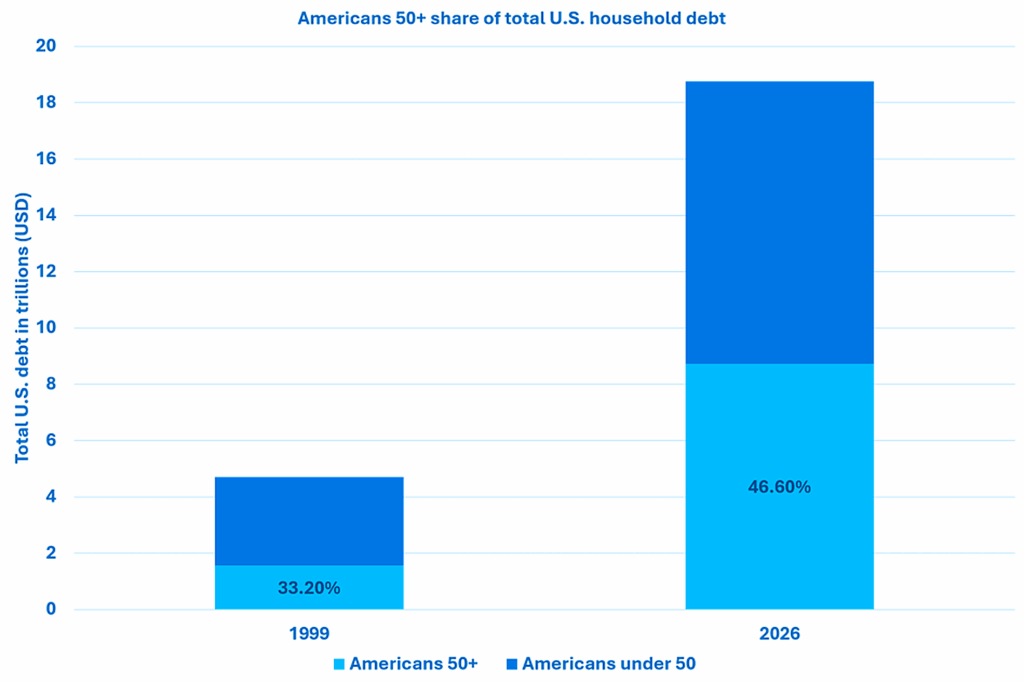
Total household debt by age, showing the growing share held by Americans 50+
Source: New York Fed Consumer Credit Panel/Equifax, Q2 2026.
Why retirement balance sheets are under pressure
Several pressures can converge on retirement budgets.
Longer retirements require savings and income to stretch further. Healthcare, caregiving, insurance, property taxes, home repairs, and inflation can strain relatively fixed incomes. Some retirees also provide financial support to children or grandchildren.
When cash runs short, households may turn to credit cards, personal loans, or home equity to cover expenses.
The home is often the largest asset on a retiree’s balance sheet. Many retirees have spent decades paying toward their mortgage and building equity. Others secured historically low mortgage rates and may be reluctant to give up that financing by selling or refinancing.
Rising home equity line of credit (HELOC) balances may indicate that more homeowners are looking to their houses for the liquidity they need. Nationwide HELOC balances have risen for 17 consecutive quarters, climbing from a low of approximately $317 billion in the first quarter of 2022 to $459 billion in the second quarter of 2026.
The national totals do not say which group is driving HELOC growth. But Americans 60 and older hold roughly 40% of outstanding HELOC balances, which suggests the product is already a common fixture of retirement balance sheets.
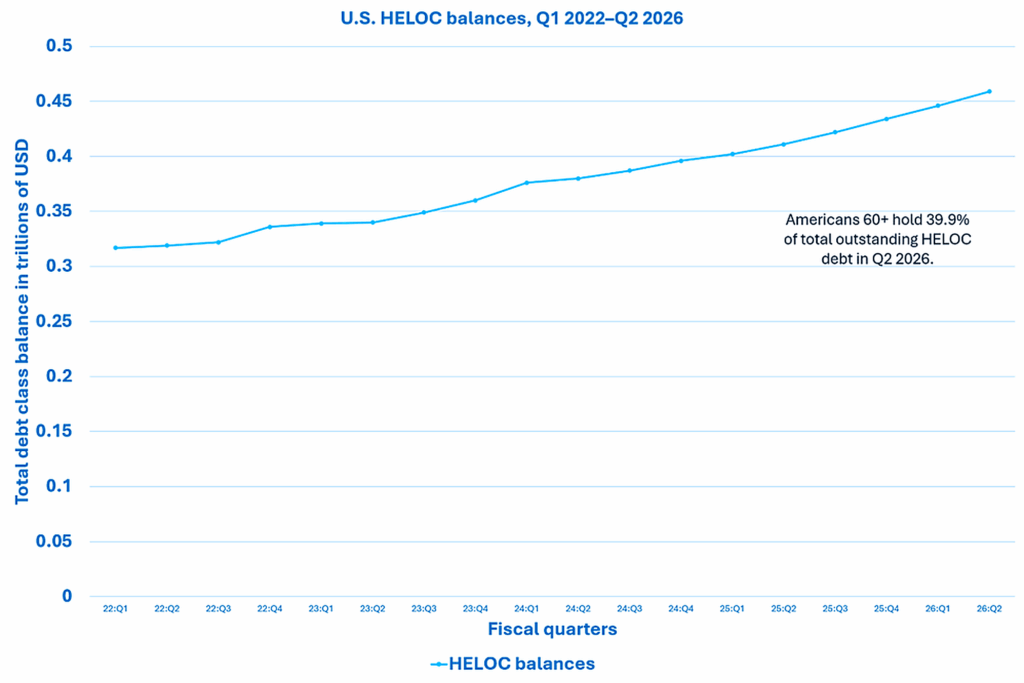
U.S. HELOC balances, Q1 2022–Q2 2026
Key takeaway: Outstanding balances have increased for 17 consecutive quarters.
Source: Federal Reserve Bank of New York, Quarterly Report on Household Debt and Credit.

Debt is changing in retirement
Debt itself is not new to retirement. Mortgages have long followed some homeowners beyond their final paycheck, and borrowing can serve legitimate financial purposes at any age.
The key questions are what the debt costs, how payments affect monthly cash flow, and whether the structure remains manageable over time. Put plainly, a mortgage locked in at 7% and a credit card charging more than 20% are not the same kind of debt, even when the balances look alike.
For example, on a $10,000 balance, a mortgage costs roughly $700 a year in interest, provided a 7% rate. The average credit card interest rate was 22.36% in August 2026, according to Federal Reserve data. On the same $10,000 balance, the card would cost $2,236, and its minimum payment can leave the balance largely intact year after year. That is why the card balance, not the mortgage, is usually the one eating into a retiree’s budget.
For someone living primarily on Social Security, a pension, or withdrawals from retirement savings, a high-interest credit card payment can leave less money available for groceries, healthcare, home maintenance and other necessities.
Then factor in expenses a retirement plan may not have anticipated, such as major home repairs, medical bills, family needs or other unexpected costs.
Even financially comfortable retirees have to plan for emergencies. For those on a fixed income, a credit card is often the only emergency tool within reach.
Revolving debt can also be difficult to reduce when a significant portion of each payment goes toward interest rather than principal. Over time, what began as a temporary fix grows into an unmanageable monthly expense.
This doesn’t mean that credit card debt is always wrong, nor does it mean retirees should eliminate all forms of debt.
Here’s the central retirement debt management question retirees should ask themselves: Could a different debt strategy be better suited to my financial goals in retirement?
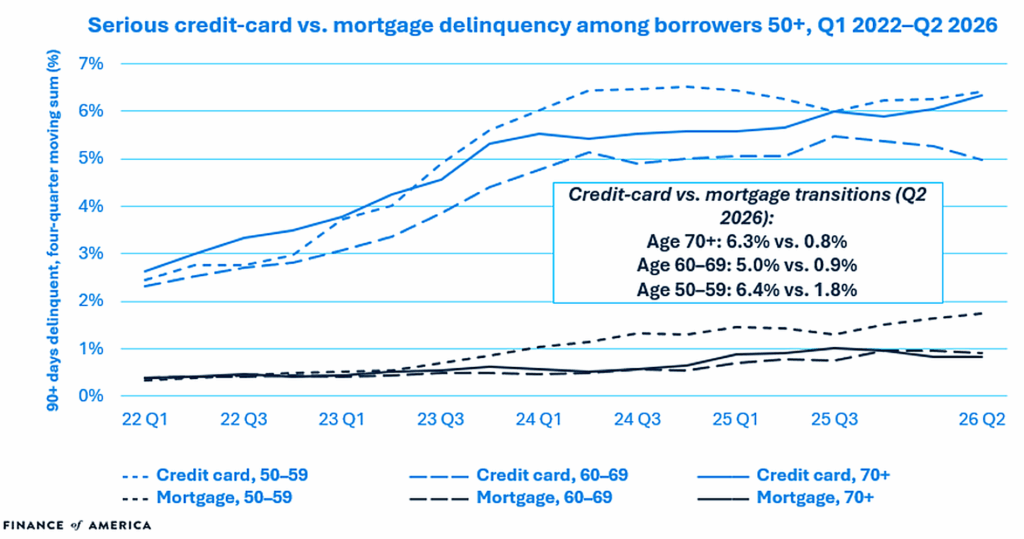
Serious credit-card vs. mortgage delinquency among borrowers 50+, Q1 2022–Q2 2026]
Key takeaway: In every age group over 50, the share of credit-card debt in serious delinquency is several times the share of mortgage debt; among borrowers 70+ it is 6.3% vs. 0.8%.
Source: New York Fed Consumer Credit Panel/Equifax. Four-quarter moving sum.
Understanding the options
There is no universal solution for a retiree dealing with high-interest debt. The appropriate strategy depends on income, assets, expenses, health, housing plans, and long-term financial goals.
It also helps to be clear-eyed about what home equity does and does not do. Paying off credit cards with home equity does not make the debt go away. It moves the balance from an unsecured card to a loan secured by the home, usually at a lower cost, but with its own fees, risks and long-term consequences. The card rate disappears; the obligation does not.
- Using income or savings: For some households, paying down balances with existing income or retirement savings may be the simplest path. It avoids taking on another loan, but retirees with limited cash flow need to consider the effect that larger withdrawals could have on future income needs, taxes and the longevity of their savings.
- Downsizing: Selling a home and moving to a less expensive property can unlock accumulated equity while potentially lowering ongoing housing expenses. But transaction and moving costs can be substantial, leaving a longtime home can carry an emotional cost, and a smaller property in the same community may not always cost significantly less.
- Balance transfers: A lower-rate or introductory 0% balance-transfer offer may provide temporary relief for some credit card borrowers. The benefit depends on fees, the length of the promotional period and the borrower’s ability to repay the balance before the higher rate takes effect.
- Nonprofit credit counseling: A nonprofit credit counselor can help consumers review budgets, evaluate alternatives and, in some circumstances, develop a debt-management plan. These plans generally still require consistent monthly payments, so they may not fully address a significant gap between household income and expenses.
- A traditional HELOC or home equity loan: Homeowners may be able to access accumulated equity without refinancing their existing first mortgage. These products require a monthly payment but may carry lower interest rates than credit cards. HELOC rates are often variable and the required payment typically rises once the draw period ends and principal comes due. Because a home secures the debt, borrowers need to understand the consequences of failing to meet their obligations.
- A traditional reverse mortgage: With a reverse mortgage, eligible older homeowners are lent a portion of the value of their home with no required monthly mortgage payment. Homeowners can elect from different disbursement schedules, including a lump sum, monthly installments, or a line of credit. This can provide another option for retirees who have substantial home equity but may have difficulty qualifying for a HELOC because their retirement income results in a higher debt-to-income ratio (DTI). In a reverse mortgage, interest and fees are added to the balance over time, which reduces remaining home equity. Borrowers remain responsible for property taxes, homeowners’ insurance, maintaining the property and meeting other loan requirements.
- Second-lien reverse mortgage. The clearest way to understand a second-lien reverse mortgage is to set it beside a HELOC, because the two tap the same equity from the same position. Both are second mortgages that leave the existing first mortgage, and its rate, untouched. The difference is what happens every month afterward.
A HELOC adds a required payment, usually at a variable rate, and that payment generally rises once the draw period ends. A second-lien reverse mortgage requires no monthly payment on the new loan. The borrower must meet all loan obligations, including meeting all loan obligations under the first lien mortgage, living in the property as the principal residence and paying property charges, including property taxes, fees, and hazard insurance. The borrower must maintain the home. If the homeowner does not meet these loan obligations, then the loan will need to be repaid. Instead, interest accrues to the balance, typically at a fixed rate, and the loan is repaid when the home is sold, the borrower moves out permanently or the last borrower passes away.
Because no new payment is added, qualifying rests less on the debt-to-income math that disqualifies many retirees applying for a HELOC, and more on the borrower’s age, the equity in the home and the ability to keep paying taxes, insurance and the existing first mortgage.
The trade-off runs the other way. A HELOC borrower keeps the balance in check by paying it down each month; a reverse borrower’s balance grows, so the total interest cost over the life of the loan can be higher and the equity left for later, or for heirs, shrinks. For a homeowner whose real constraint is monthly cash flow, that can be a trade worth making. For one with ample income who intends to repay quickly, a HELOC may be the better fit.
The point is not that any single strategy is right for everyone. It is that retirees should compare the full range of choices for long-term debt planning, rather than defaulting to the most familiar option.
If you or your family are thinking about any of these tools, it’s important to discuss options with a trusted financial advisor with a fiduciary duty (i.e., an advisor who is legally obliged to act in your best interest at all times). This advisor should be unaffiliated with the company behind the debt-planning tool you ultimately select.

Eight questions to ask before accessing home equity
Before accessing home equity to address higher interest debt or other retirement expenses, homeowners should assess their finances, goals, and alternatives.
These questions can help guide a conversation with a trusted financial professional:
1. What am I trying to accomplish?
Is the goal to pay down high-interest debt, reduce monthly expenses, help family members, improve the home, supplement retirement income, or prepare for unexpected costs?
2. Have I explored alternatives?
Could changes to spending, a debt-repayment plan, nonprofit credit counseling or downsizing accomplish the same objective without borrowing against the home?
3. What happens to my monthly cash flow?
Will the option create another required monthly payment, or could it reduce existing monthly obligations?
4. What will it cost over time?
Consider interest rates, closing costs and fees—not just the amount of money available today. Homeowners should also understand how borrowing will affect the equity remaining in the property.
5. Can I continue meeting the responsibilities of homeownership?
Property taxes, homeowners’ insurance, maintenance and any applicable first-mortgage payments need to remain affordable.
6. How long do I expect to stay in my home?
Healthcare needs, lifestyle changes or plans to relocate can affect whether using home equity makes financial sense.
7. What could the decision mean for my family and estate?
Borrowing against a home may reduce the equity ultimately available to heirs. Families may want to discuss those implications together with appropriate financial, tax or estate-planning professionals.
8. Have I spoken with an independent housing counselor?
A HUD-certified housing counselor can help homeowners understand reverse mortgage terms, costs, responsibilities and alternatives. HUD-approved reverse mortgage counseling is required before obtaining a federally insured Home Equity Conversion Mortgage, or HECM.
Retirement planning needs a wider lens
Debt is increasingly part of retirement planning, but the amount owed is only one piece of the picture.
For some homeowners, allowing expensive revolving balances to grow while leaving home equity untouched could increase long-term financial strain.
At the same time, borrowing against the home is a significant decision. Unlocking home equity deserves careful consideration of costs, alternatives and long-term consequences with a fiduciary financial advisor.
Retirees need a realistic view of the whole balance sheet: income, savings, investments, debt and home equity, considered together rather than with the home set aside as a separate or untouchable asset. From there, the question is how those pieces, combined, support the life they want to live in retirement.
For those considering their options, independent resources can be a useful starting point. HUD-approved housing counseling agencies can help homeowners evaluate reverse mortgages and alternatives, and the Consumer Financial Protection Bureau offers educational resources explaining reverse mortgage costs, obligations and consumer protections. Finance of America also provides educational materials covering reverse mortgages, alternatives and ways homeowners may use equity in retirement.
These resources are a starting point, not a substitute for advice from a financial professional tailored to an individual household’s circumstances.
As retirement changes, so must the conversation about financing it. The aim is not to eliminate every debt, but to understand the trade-offs and build flexibility for today’s needs and the years ahead.
–> Learn more about HomeSafe Second, a second-lien reverse mortgage from Finance of America.
About the author

is President of Finance of America Companies Inc., one of the nation’s largest home equity lenders for people in and near retirement. She leads a fully remote team of roughly 850 people on a mission to bring home equity into the mainstream of retirement planning.
Disclaimer
This article is intended for general informational and educational purposes only and should not be construed as financial or tax advice. For tax advice, please consult a tax professional. For more information about whether a reverse mortgage fits into your retirement strategy, you should consult your financial advisor.