Explore by category
What are the disadvantages of a reverse mortgage?

Key points
Reverse mortgage are a financial tool that may give eligible homeowners more flexibility in how they use their home equity, but it also comes with trade-offs borrowers need to understand.
Trade offs can vary by loan type but may include limits on how much you can borrow, upfront costs that increase your loan balance, ongoing obligations, and a reduction in your available home equity.
Which drawbacks impact you the most can vary depending on whether you take out a HECM or proprietary reverse mortgage and your financial situation. Understanding the drawbacks may help you make a more informed decision.
Quick answer: Potential drawbacks to a reverse mortgage may include federal rules limiting how much you can borrow for HECMs, closing costs and fees that can increase your loan balance, a reduction in equity available for your heirs or later expenses, and ongoing loan obligations that you must meet to keep the loan in good standing.
Reverse mortgages are growing in popularity. Between 2023 and 2025, reverse mortgage originations grew nearly 26%, according to Housing Wire. This rise in popularity raises questions for many homeowners, including whether it is a valid financial product and what its drawbacks might be.
At Finance of America, we believe reverse mortgages are a powerful tool that may help eligible homeowners pursue what matters most to them. However, they aren’t right for everyone or every situation. In addition to understanding when a reverse mortgage is a good idea, it’s also important to understand the drawbacks.
→ New to reverse mortgages? Learn more: What is a reverse mortgage and how does it work?
Key downsides of a reverse mortgage
A reverse mortgage may give eligible homeowners more flexibility in how they use their home equity, but it also comes with trade-offs borrowers need to understand. Specific drawbacks may matter more depending on your financial situation, how long you plan to remain in the home, and whether you expect to need access to your home equity in the future.
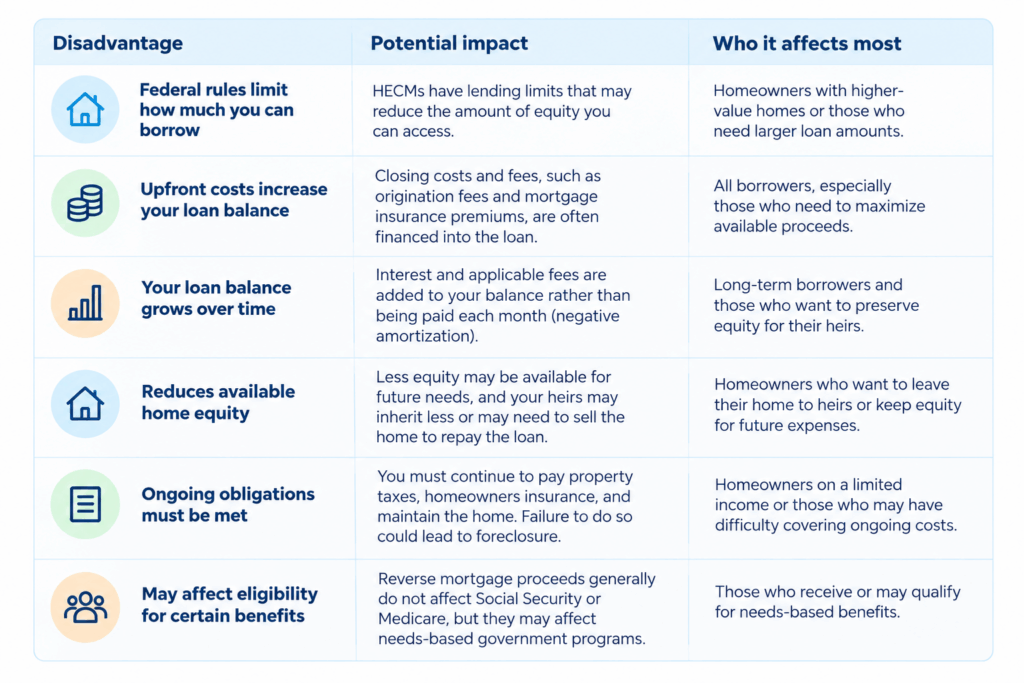
This chart explains the core disadvantages and who is more likely to be impacted by them. We’ll explore all of the potential drawbacks in more detail below.

Federal rules limit how much you can borrow for a Home Equity Conversion Mortgage (HECM)
Home Equity Conversion Mortgages (HECMs), the most common type of reverse mortgage, are insured by the Federal Housing Administration (FHA) and must follow rules set by the U.S. Department of Housing and Urban Development (HUD). One of those rules limits the home value that can be used to calculate how much you may be able to borrow.
For 2026, the HECM maximum claim amount is $1,249,125 nationwide. This means that if your home is worth more than $1,249,125, the value above the limit won’t be used to calculate your HECM proceeds. The amount you can actually access will be lower and depends on factors such as your age and current interest rates.
However, not all reverse mortgages are HECMs. Private lenders offer proprietary reverse mortgages that aren’t subject to the FHA lending limit. Depending on the loan and your circumstances, they may allow eligible homeowners to access more equity, particularly from higher-value homes.
→ Learn more: What are the three types of reverse mortgage loans?
Upfront costs are often wrapped into your loan balance at closing, increasing the loan balance
Like other mortgage products, reverse mortgages come with closing costs and fees. For a HECM, these may include an origination fee, an upfront mortgage insurance premium (MIP), an appraisal fee, counseling costs, and other third-party closing costs. (Proprietary reverse mortgages generally don’t include mortgage insurance premiums, but may have similar closing costs and fees, depending on the lender and loan product.)
Rather than paying all these expenses out of pocket, borrowers can often finance eligible costs through the reverse mortgage. While this means paying less out of pocket at closing, it can reduce the amount of home equity available to you and increase your initial loan balance.
Here’s a hypothetical example for illustration only:
Assume a borrower is eligible for $150,000 in HECM proceeds before financed closing costs. If the applicable financed costs total $15,000, only about $135,000 would remain available after deducting those costs.
Actual proceeds and costs vary based on the borrower, property, interest rate, loan terms, third-party charges, and other applicable factors.
Before closing, review your loan documents carefully to understand which costs are being financed into the loan and how that will affect your available proceeds and loan balance.

No required monthly mortgage payment means your loan balance grows over time
One of the main advantages of a reverse mortgage is that borrowers aren’t required to make monthly mortgage payments as long as they meet the loan terms, which include living in the home as their primary residence, maintaining it, and paying property taxes, insurance, and other fees.
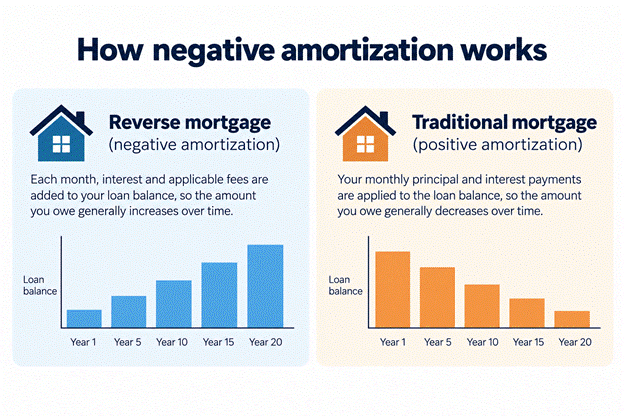
However, failing to make monthly mortgage payments means the loan balance grows over time. This is known as negative amortization. Interest and applicable fees are added to the outstanding loan balance rather than being paid each month. As the balance increases, interest accrues on the higher amount, causing the amount owed to continue growing over time.
This works differently from a traditional mortgage, where monthly principal and interest payments generally reduce the loan balance over time. However, reverse mortgage borrowers can choose to make voluntary payments to reduce the balance or accrued interest.
The borrower must meet all loan obligations, including living in the property as the principal residence and paying property charges, including property taxes, fees, and hazard insurance. The borrower must maintain the home. If the homeowner does not meet these loan obligations, then the loan will need to be repaid.
Reduces available home equity that you might need later
A reverse mortgage converts a portion of your home equity into loan proceeds you can use to fund home repairs, pay off medical bills, or create more financial flexibility. But as you access those funds, the loan balance increases, and the amount of home equity available to you goes down.
That matters because home equity is often used as a financial resource later in life. If you eventually want to sell your home, pay for long-term care, or access equity for another purpose, the balance on a reverse mortgage loan could leave you with less equity.
Using home equity through a reverse mortgage can also reduce the amount of equity left for your heirs. However, many reverse mortgages include safeguards that can limit how much borrowers or their estates must repay.
→ Learn more: Who owns the house with a reverse mortgage?

Ongoing loan obligations may be challenging on a limited budget
Reverse mortgages come with specific loan requirements that must be met. If you are unable to meet your loan obligations, the reverse mortgage may become due and payable. Most of those requirements are ones you’re already responsible for, including keeping up with costs like:
- Property taxes
- HOA fees (if applicable)
- Home maintenance costs
- Homeowners insurance
Although reverse mortgages don’t require monthly mortgage payments, you do need to budget for these ongoing expenses. For some HECM borrowers, a portion of the loan proceeds may be set aside in a life expectancy set-aside (LESA) to help pay property taxes and homeowners insurance. Whether a LESA is required depends on your financial assessment.
The borrower must meet all loan obligations, including living in the property as the principal residence and paying property charges, including property taxes, fees, and hazard insurance. The borrower must maintain the home. If the homeowner does not meet these loan obligations, then the loan will need to be repaid.
May impact needs-based government benefits
Reverse mortgage proceeds are considered loan proceeds, not income. As a result, having a reverse mortgage generally doesn’t affect benefits that aren’t based on financial need, such as Social Security retirement benefits or Medicare.
However, reverse mortgage proceeds may affect eligibility for needs-based programs, such as Supplemental Security Income (SSI) or Medicaid. For example, proceeds that remain in your bank account may be counted as a resource and could put you over a program’s asset limit.
Rules vary by program and your specific circumstances, so consider speaking with a qualified benefits advisor to determine how a reverse mortgage might impact your eligibility for needs-based programs.
Extended absences from your home can cause the loan to become due
Reverse mortgages are designed for your primary residence, which means you need to live in the home for most of the year. For a HECM, at least one borrower generally must continue to use the home as their principal residence.
How long you can be away depends on the reason. If the last borrower is away for more than six consecutive months for a non-medical reason, the home may no longer qualify as their principal residence, and the loan may become due and payable. If the absence is due to physical or mental illness, such as an extended stay in a healthcare facility, the borrower can generally be away for up to 12 consecutive months.
These rules are worth considering when planning for the future, especially if you may eventually spend significant time away from home or need long-term care.
Risk of scams and fraud
Reverse mortgages are legitimate financial products, but scammers sometimes use them—or a homeowner’s interest in accessing their home equity—as an opportunity. Older homeowners can be particularly attractive targets because they often have substantial equity in their homes.
Reverse mortgage scams can take different forms:
- Contractor scams: A contractor pressures you to get a reverse mortgage to pay for unnecessary or overpriced home repairs.
- Investment scams: Someone encourages you to use your reverse mortgage proceeds to invest in a questionable business or investment scheme.
- Foreclosure scams: A scammer falsely promises they can help you avoid foreclosure, often in exchange for money or personal information.
- Deed or title fraud: Someone attempts to transfer ownership of your home or manipulate property records fraudulently.
Be cautious of anyone who pressures you to take out a reverse mortgage, tells you how you must use the proceeds, or asks you to sign documents you don’t understand. For a HECM, required counseling with a HUD-certified housing counselor provides an opportunity to learn how the loan works and discuss alternatives before moving forward.
→ Learn more: Protecting your home from mortgage scams
May create repayment challenges for heirs
When the last borrower or eligible non-borrowing spouse dies, a reverse mortgage generally becomes due. This doesn’t necessarily mean heirs have to give up the home, but they do need to decide how to handle repaying the loan balance.
Depending on the circumstances, heirs may be able to:
- Sell the home: The reverse mortgage is repaid from the sale proceeds, and any remaining equity generally belongs to the estate.
- Keep the home: Heirs may be able to repay the reverse mortgage using their own funds or financing.
- Turn it over to the lender: If heirs don’t want to keep or sell the property themselves, they may allow the lender to take possession.
It’s important to note that HECMs are non-recourse loans1 that provide important protection if the loan balance exceeds the home’s value. Generally, neither the borrower nor their heirs is personally responsible for paying the difference, provided applicable requirements are met.
Because heirs may have limited time to decide what to do with the property, discussing your reverse mortgage with family in advance can make the process easier.
→ Learn more: Are heirs responsible for reverse mortgage debt?
Alternatives to a reverse mortgage: Home equity line of credit, home equity loan, or cash-out refinance
A reverse mortgage isn’t the only way to access your home equity. Depending on your financial situation and goals, other options you may want to consider include:
- Home equity loan: Provides a lump sum that’s typically repaid through fixed monthly payments.
- Home equity line of credit (HELOC): Provides a revolving line of credit you can borrow from as needed, with required payments based on the loan terms.
- Cash-out refinance: Replaces your existing mortgage with a larger loan and provides the difference in cash.
- Selling or downsizing: Allows you to access the equity in your current home without taking out another loan.
→ Explore more options: 9 Alternatives to a reverse mortgage: Which works for you?
Finance of America does not offer home equity loans or HELOCs.
Is a reverse mortgage right for you?
Reverse mortgages do have some disadvantages, but that doesn’t mean they’re a poor fit for everyone. For eligible homeowners, a reverse mortgage can provide access to much-needed home equity.
Before deciding if a reverse mortgage is right for you, consider:
- How long you expect to stay in your home: Upfront costs may make a reverse mortgage less appealing if you expect to move relatively soon.
- How much equity you want to preserve: Your loan balance generally grows over time, which can leave less equity for future needs or your heirs.
- Whether you can afford ongoing home expenses: You’ll still be responsible for property taxes, homeowners insurance, maintenance, and other applicable property charges.
- How other alternatives fit your plans: Compare it with reverse mortgage alternatives such as a HELOC, home equity loan, cash-out refinance, or selling or downsizing.
If you’re wondering what a reverse mortgage could look like for your situation, a good next step is to estimate how much home equity you may be able to access.
→ Use our reverse mortgage calculator to see how much you might be eligible to borrow.
Can a reverse mortgage lead to foreclosure?
Yes, a reverse mortgage can lead to foreclosure if you fail to meet the loan requirements, but foreclosure is generally a last resort. Depending on the circumstances, borrowers may have opportunities to resolve the issue before foreclosure occurs.
Can you pay off a reverse mortgage early?
Yes, you can generally pay off a reverse mortgage at any time without a prepayment penalty. You can also make voluntary payments toward the loan balance at any point, which can reduce the amount of interest that accrues and help preserve more of your home equity.
Do you have to pay back a reverse mortgage if you live past a certain age?
Generally, no. A reverse mortgage doesn’t become due simply because the borrower reaches a certain age or has had the loan for a certain number of years. However, you will need to continue meeting the terms of the loan: living in the home, maintaining it, and paying property taxes and insurance.
→ Learn more: How do you repay a reverse mortgage? Understanding your options
Can you sell your home if you have a reverse mortgage?
Yes, you can sell your home if you have a reverse mortgage. Generally, the loan balance is repaid from the sale proceeds, and the remaining equity is yours to keep. If the home sells for less than the amount owed, non-recourse protections may limit how much you or your estate is required to repay, depending on the type of reverse mortgage.1
What happens if a reverse mortgage balance becomes higher than the home’s value?
While this situation is uncommon, if the loan balance exceeds your home’s value, you generally won’t have to pay the difference out of pocket as long as the loan is non-recourse. For FHA-insured HECMs, borrowers and their heirs generally will not owe more than the home’s value when the loan is repaid, provided applicable requirements are met.
Can you get a reverse mortgage if you still have a mortgage?
Yes, you can generally get a reverse mortgage if you still have a mortgage. At closing, your existing mortgage is typically paid off first using proceeds from the reverse mortgage. Once that mortgage and other closing costs are paid, any remaining proceeds are available to you based on the payout option you choose.
Can you cancel a reverse mortgage after you sign?
Yes, in some cases. For most HECMs, a three-business-day right of rescission begins after the loan closes, giving you time to cancel without penalty. The three-business-day period generally begins the first business day after closing. This right does not apply to HECMs for Purchase and may vary for proprietary reverse mortgages.
→ Learn more: How to get out of a reverse mortgage if your circumstances change
What is a TALC, and why does it matter?
A total annual loan cost (TALC) disclosure is an estimate of the annual cost of a reverse mortgage over different periods of time and under different home appreciation scenarios. TALC matters because it accounts for costs such as interest, mortgage insurance premiums, and other loan fees, making it easier to compare the overall cost of reverse mortgage options.
1Non-recourse means that you, or your estate, can’t owe more than the value of your home when the loan becomes due and the home is sold. Non-recourse means that if you default on the loan, or if the loan cannot otherwise be repaid, the lender cannot look to your other assets (or your estate’s assets) to meet the outstanding balance on your loan.
About the author

is the Web Content Manager at Finance of America and a journalist with more than 10 years of experience whose work has appeared in MoneyWise, MSN, Yahoo! Finance, and The Motley Fool. She specializes in making complex financial topics accessible and is passionate about advancing financial literacy.
Disclaimer
This article is intended for general informational and educational purposes only and should not be construed as financial or tax advice. For tax advice, please consult a tax professional. For more information about whether a reverse mortgage fits into your retirement strategy, you should consult your financial advisor.